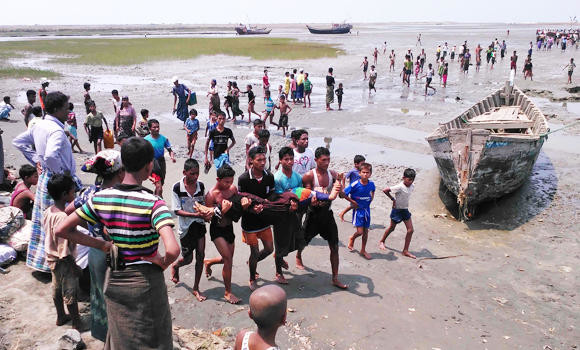
YANGON: Witnesses to a boat capsize off Myanmar that left some 21 people dead, including children, say the victims were from the persecuted Rohingya Muslim minority and blamed the tragedy on travel restrictions that forced them to journey by sea.
At least 21 people, including nine children, died after a packed boat capsized in choppy waters as it approached the Rakhine state capital of Sittwe, according to the United Nations.
Most of the passengers were inhabitants of Sin Tet Maw, in Paukaw township, a camp for Rohingya Muslim minority members forced from their homes by bouts of communal violence.
“It (the boat accident) happened because of unsafe transport... we cannot use direct transport (overland) to Sittwe to buy goods or medicine,” Rohingya activist, Kyaw Hla Aung, told AFP from Sittwe.
The boat’s passengers had received special permission to travel by boat to the market in Sittwe from Paukaw — a journey through the mouth of a wide river that then skirts several kilometers around the coast to the capital.
More than 100,000 Rohingya have been forced to live in apartheid-like conditions since unrest between Buddhists and Muslims left hundreds dead in 2012.
Their movement and access to services, including health care, is severely restricted by authorities in the Buddhist-majority country.
Another Rohingya man, Tin Hla, who also lives in the camp of 1,500 people, said his son was unaccounted for among the boat passengers.
“When we need to go to Sittwe, we have to go there in an unsafe way (by sea),” he said, adding that he fears the worst for his son and had traveled to Sittwe to find his body.
Myanmar does not formally recognize the Rohingya as one of the country’s patchwork of ethnic minorities.
A rising tide of Buddhist nationalism has in recent years deepened hostility toward the group — most of whom are rendered stateless by a web of citizenship laws.
Many Rohingya trace their roots in the country back for generations.
But officials routinely refer to them as “Bengalis” — a pejorative term identifying them as outsiders from neighboring Bangladesh.
“This accident serves as a tragic reminder of the vulnerability that many communities and families face in this area of Rakhine,” said Janet Jackson, the UN’s resident and humanitarian co-ordinator in Myanmar.
“Their only option is to use this mode of travel in order to access livelihoods, and other basic services that are essential for a dignified life.”


![]()

21 Rohingya die as boat capsizes off Myanmar
21 Rohingya die as boat capsizes off Myanmar
Thai runner-up party seeks criminal case against election officials
- A Thai political party that came second in this month’s vote filed a criminal complaint Thursday against the nation’s election commissioner
BANGKOK: A Thai political party that came second in this month’s vote filed a criminal complaint Thursday against the nation’s election commissioners, accusing them of violating election laws, the party’s deputy told AFP.
The reformist People’s Party “submitted a case” to a criminal court against seven election commissioners, the Election Commission’s secretary-general and another election official, deputy party leader Wayo Assawarungruang said.
“Two charges involve wrongful exercise of duties, and the last charge we claimed was about marking ballots with QR codes and barcodes which allow the votes to be traced and not kept secret as it should be,” Wayo said.
The Election Commission confirmed the victory of caretaker Prime Minister Anutin Charnvirakul’s conservative Bhumjaithai party on Wednesday, ratifying most of the vote results.
Bhumjaithai won 170 constituencies, the most of any party, while People’s Party — which had been polling first ahead of the election — came in second, with 88 constituencies, the commission said.
Some citizens and experts raised concerns after election day that QR codes and barcodes found on ballots could be used to identify individual voters.
But the commission said the markings were to ensure electoral security and prevent the use of fake ballots.
The Criminal Court for Corruption and Misconduct Cases said it will decide whether to hear the case by March 24, according to Wayo.
If the court takes up the case, the nine face a maximum prison sentence of 20 years and the loss of their political rights for a decade.
The reformist People’s Party “submitted a case” to a criminal court against seven election commissioners, the Election Commission’s secretary-general and another election official, deputy party leader Wayo Assawarungruang said.
“Two charges involve wrongful exercise of duties, and the last charge we claimed was about marking ballots with QR codes and barcodes which allow the votes to be traced and not kept secret as it should be,” Wayo said.
The Election Commission confirmed the victory of caretaker Prime Minister Anutin Charnvirakul’s conservative Bhumjaithai party on Wednesday, ratifying most of the vote results.
Bhumjaithai won 170 constituencies, the most of any party, while People’s Party — which had been polling first ahead of the election — came in second, with 88 constituencies, the commission said.
Some citizens and experts raised concerns after election day that QR codes and barcodes found on ballots could be used to identify individual voters.
But the commission said the markings were to ensure electoral security and prevent the use of fake ballots.
The Criminal Court for Corruption and Misconduct Cases said it will decide whether to hear the case by March 24, according to Wayo.
If the court takes up the case, the nine face a maximum prison sentence of 20 years and the loss of their political rights for a decade.
Latest updates


© 2026 SAUDI RESEARCH & PUBLISHING COMPANY, All Rights Reserved And subject to Terms of Use Agreement.