BERLIN: US intelligence spied on talks German Chancellor Angela Merkel held with the UN chief and key European leaders, a German newspaper reported Tuesday citing classified documents released by WikiLeaks.
The US National Security Agency (NSA), which drew fire for tapping Merkel’s mobile phone, also gathered information on a 2008 conversation about climate change she held with UN Secretary General Ban Ki-moon, the Sueddeutsche Zeitung daily said.
In the exchange ahead of the Copenhagen climate summit, Merkel said the world expected the EU to take a leading role on the issue, while Ban praised Merkel’s personal engagement on tackling climate change, the report said.
WikiLeaks founder Julian Assange said in an online statement that “today we showed that UN Secretary General Ban Ki-Moon’s private meetings over how to save the planet from climate change were bugged by a country intent on protecting its largest oil companies.”
German-US relations were badly strained after fugitive US intelligence contractor Edward Snowden in 2013 revealed widespread US foreign surveillance, including tapping Merkel’s mobile phone.
Issues surrounding such surveillance are hotly debated in Germany, a country with raw memories of state snooping under fascist and communist dictatorships.
Wikileaks also released new documents on a 2011 meeting Merkel held with then French president Nicolas Sarkozy and then Italian prime minister Silvio Berlusconi.
In the meeting Merkel and Sarkozy pressured Berlusconi to reduce public debt and strengthen Italy’s banking sector, reported the Sueddeutsche.
The meeting was tense and unfriendly, according to a Berlusconi adviser, who the daily said may have been the target through whom the NSA obtained the information.
Another document showed the NSA listened in on talks between Berlusconi and Israeli Prime Minister Benjamin Netanyahu, in which Netanyahu asked Berlusconi to help him improve relations with Washington that were strained by plans for Jewish settlements in East Jerusalem.
WikiLeaks, founded by Australian Assange in 2006, has infuriated the United States by releasing some 500,000 secret military files on the wars in Afghanistan and Iraq and 250,000 diplomatic cables.


US surveillance of Merkel wider than thought: WikiLeaks
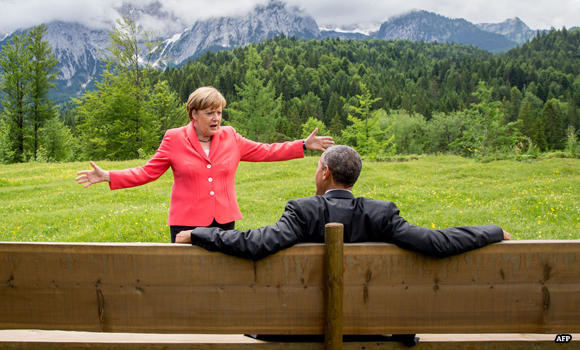
US surveillance of Merkel wider than thought: WikiLeaks

North Korean leader Kim inspects new warship, claims progress toward nuclear-armed navy
- Kim has hailed the development of Choe Hyon as a significant advancement toward his goal of expanding the operational range and preemptive strike capabilities of his nuclear-armed military
SEOUL, South Korea: North Korean leader Kim Jong Un inspected his new destroyer for two straight days ahead of its commissioning and observed a test of cruise missiles fired from the warship, vowing to accelerate the nuclear-armament of his navy, state media said Thursday.
The North’s official Korean Central News Agency said Kim, during his visits to the western shipyard of Nampo on Tuesday and Wednesday, also inspected the construction of a third destroyer of the same class as his 5,000-ton warship, the Choe Hyon, first unveiled in April 2025.
Kim has hailed the development of Choe Hyon as a significant advancement toward his goal of expanding the operational range and preemptive strike capabilities of his nuclear-armed military. State media says the ship is designed to handle various weapons systems, including antiair and anti-naval weapons, as well as nuclear-capable ballistic and cruise missiles. South Korean military officials and experts say Choe Hyon was likely built with Russian assistance amid deepening military ties, but some have raised doubts about whether it’s ready for active service.
North Korea unveiled a second destroyer of the same class in May last year, but it was damaged during a botched launching ceremony at the northeastern port of Chongjin, triggering a furious reaction from Kim, who called the failure “criminal.” North Korea has said the new destroyer, named Kang Kon, was relaunched in June after repair, but outside experts have questioned whether the ship is fully operational.
After observing Choe Hyon’s sea trials on Tuesday, Kim said the ship met operational requirements and called it a symbol of the country’s expanding naval capabilities. He called for building two warships a year over the next five years of the same or higher class as the Choe Hyon.
Kim came back Wednesday to observe a test launch of cruise missiles from the Choe Hyon. State media published photos of him watching from shore as several projectiles rose from the vessel in plumes of white smoke and described the weapons as “strategic,” a term used for nuclear-capable systems.
After years of spurring ballistic missile development, Kim has shifted his focus more toward naval capabilities, including an ongoing construction of a nuclear-powered submarine. KCNA said the third destroyer under construction at the Nampo shipyard is expected to be completed by the ruling Workers’ Party’s founding anniversary in October.
Naval capabilities were also a key focus when Kim outlined his five-year military goals at last month’s Workers’ Party congress, which included calls for intercontinental ballistic missiles capable of being launched from underwater.
Kim on Tuesday claimed that his efforts to arm his navy with nuclear weapons were “making satisfactory” progress. He said those purported advancements would “constitute a radical change in defending our maritime sovereignty, something that we have not achieved for half a century.”
KCNA did not elaborate on what Kim meant. Some analysts say North Korea may be preparing to formally declare a maritime boundary that could encroach on waters controlled by rival South Korea.
As inter-Korean tensions worsen, Kim has repeatedly said he does not recognize the Northern Limit Line, drawn by the US-led UN Command at the end of the 1950-53 Korean War. The poorly drawn western sea boundary has been the site of several deadly naval clashes in past years.
At the party congress, Kim doubled down on plans to expand North Korea’s nuclear arsenal, which already is equipped with various weapons systems threatening the United States and US allies in Asia, and confirmed his hard-line view of rival South Korea.
But he left the door open for dialogue with the Trump administration, reiterating Pyongyang’s demand that Washington drop its insistence on denuclearization as a precondition for resuming long-stalled talks.


