Millions suffer from El Nino impact

Updated 02 December 2015
Follow

Millions suffer from El Nino impact

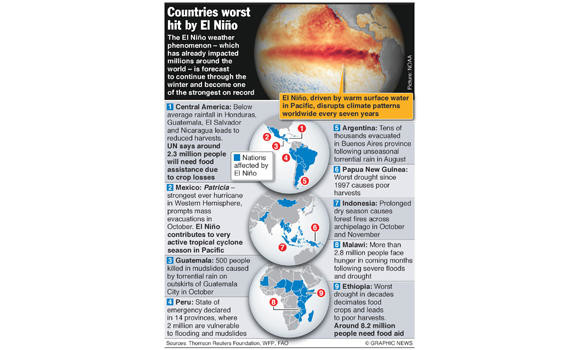
MEXICO CITY: Millions of people around the world are suffering the impacts of a strong El Niño weather pattern. The phenomenon is forecast to continue through the winter and become one of the strongest on record.
Mexico weathered a record eastern Pacific hurricane season with almost no deaths and relatively little damage, given the intensity of this year’s storms.
The US National Oceanic and Atmospheric Administration released its 2015 hurricane season report recently, saying that “this is the first year since reliable record keeping began in 1971 that the eastern Pacific saw nine major hurricanes,” which are defined as Category 3 or higher with winds of at least 111 mph (178 kph).
Turning to the worst of those storms, the report noted that Hurricane Patricia was “the strongest hurricane on record in the Western Hemisphere” just before it struck a sparsely populated stretch of Mexico’s Pacific coast in October. But while Patricia caused tens of millions of dollars in damage, there was no confirmed death attributed to the storm — or from any of the other eight major hurricanes in the eastern pacific this year.
Mexicans have wondered why the country escaped any major disaster, and President Enrique Pena Nieto even attributed the lack of damage to prayer circles and “the faith of the Mexican people.”
But Dr. Gerry Bell, the lead seasonal hurricane forecaster at NOAA’s Climate Prediction Center, said Tuesday the same thing that made Pacific hurricanes stronger — the El Nino weather phenomenon — may have also made them less deadly. El Nino is an ocean-warming phenomenon seen once every few years that can change weather patterns globally.
“El Nino made both the central and eastern Pacific hurricane seasons more intense,” Bell wrote. “El Nino also caused the storms in the eastern Pacific to form farther west from the west coast of Mexico, and to also track more westward. As a result most of those storms remained over the open ocean throughout their life.”
Bell attributed the lack of deaths from Patricia “to excellent responses from emergency managers and citizens before the storm struck.”
The Atlantic hurricane season was below normal, with 11 named storms.
The 2015 hurricane season ended Monday, and there is no telling what next year may be like.
Bell wrote that “sometimes El Nino is a multi-year phenomenon, but we cannot currently tell whether this one will be.” He said computer models for now are pointing to the current El Nino dissipating late next spring.


Rescuers search for missing sailors after US sinks Iranian warship off Sri Lanka 

Healthcare workers carry the bodies of Iranian sailors who died in a US torpedo attack on their frigate IRIS Dena off Sri Lanka.
Updated 9 sec ago
Follow

Rescuers search for missing sailors after US sinks Iranian warship off Sri Lanka 

  • US submarine attack stretched battlefield beyond Middle East, furthest point since war began
  • At least 87 Iranian sailors were killed in the attack, while about 60 remain unaccounted for 

COLOMBO: Sri Lankan rescuers continued searching for dozens of missing sailors after a US submarine sank an Iranian warship in the Indian Ocean, as a second Iranian vessel sailed close to the island nation’s territorial waters on Thursday. 

The Sri Lankan Navy has recovered at least 87 bodies and rescued 32 people after responding to a distress call on Wednesday morning from an Iranian frigate, the IRIS Dena, which was sunk by a torpedo fired by a US submarine. 

A second Iranian vessel — reportedly carrying about 100 people onboard — was heading towards Sri Lanka’s territorial waters on Thursday, said Nalinda Jayatissa, media minister and Cabinet spokesperson. 

“The government is taking necessary interventions to ensure the safety of those on board,” he told parliament. 

“Sri Lanka is committed to international peace, particularly peace in the Indian Ocean. We are acting according to international law and on humanitarian grounds to safeguard regional stability.” 

IRIS Dena, an Iranian vessel with a crew of about 180, was sailing in international waters as it returned from the International Fleet Review 2026, a naval exercise organized by India in the Bay of Bengal, when it was torpedoed. 

The strike was the first use by the US of a torpedo against an enemy ship in combat since the Second World War. Pete Hegseth, the US defense secretary, confirmed the sinking of the Iranian warship by an American submarine in the Indian Ocean, describing it as a “quiet death.” 

The sinking of IRIS Dena came as the US and Israel continued to launch air strikes on Iran after killing Supreme Leader Ali Khamenei and senior Iranian officials on Saturday, as Tehran responded with counterstrikes against US bases in the Gulf region. 

The attack off Sri Lanka’s coast, thousands of kilometers away from Tehran, has stretched the battlefield beyond the Middle East, its furthest point since the war began. At least 17 Iranian naval vessels have been sunk since last weekend, according to US Adm. Brad Cooper, who leads the US military’s Central Command. 

Authorities at the National Hospital in Galle told Arab News that the rescued Iranian sailors were “out of danger.” One of those rescued remained in the intensive care unit, while most of them were treated for fractures and chest pain. 

“They were sleeping at the time of the blast,” said a source at the hospital, who requested anonymity because they were not authorized to speak to the media. 

“There is a language barrier. We find it difficult to communicate with the patients properly and have sought assistance from the Iranian Embassy in Colombo.” 

Iran has requested the repatriation of the deceased Iranian sailors, according to Deputy Health Minister Hansaka Wijemuni, who said that authorities are now making preparations to do so.

Iran’s Foreign Minister Abbas Araghchi said that IRIS Dena was struck in international waters without warning. 

“The U.S. has perpetrated an atrocity at sea, 2,000 miles away from Iran’s shores,” he wrote on X.

“Mark my words: The U.S. will come to bitterly regret (the) precedent it has set.”