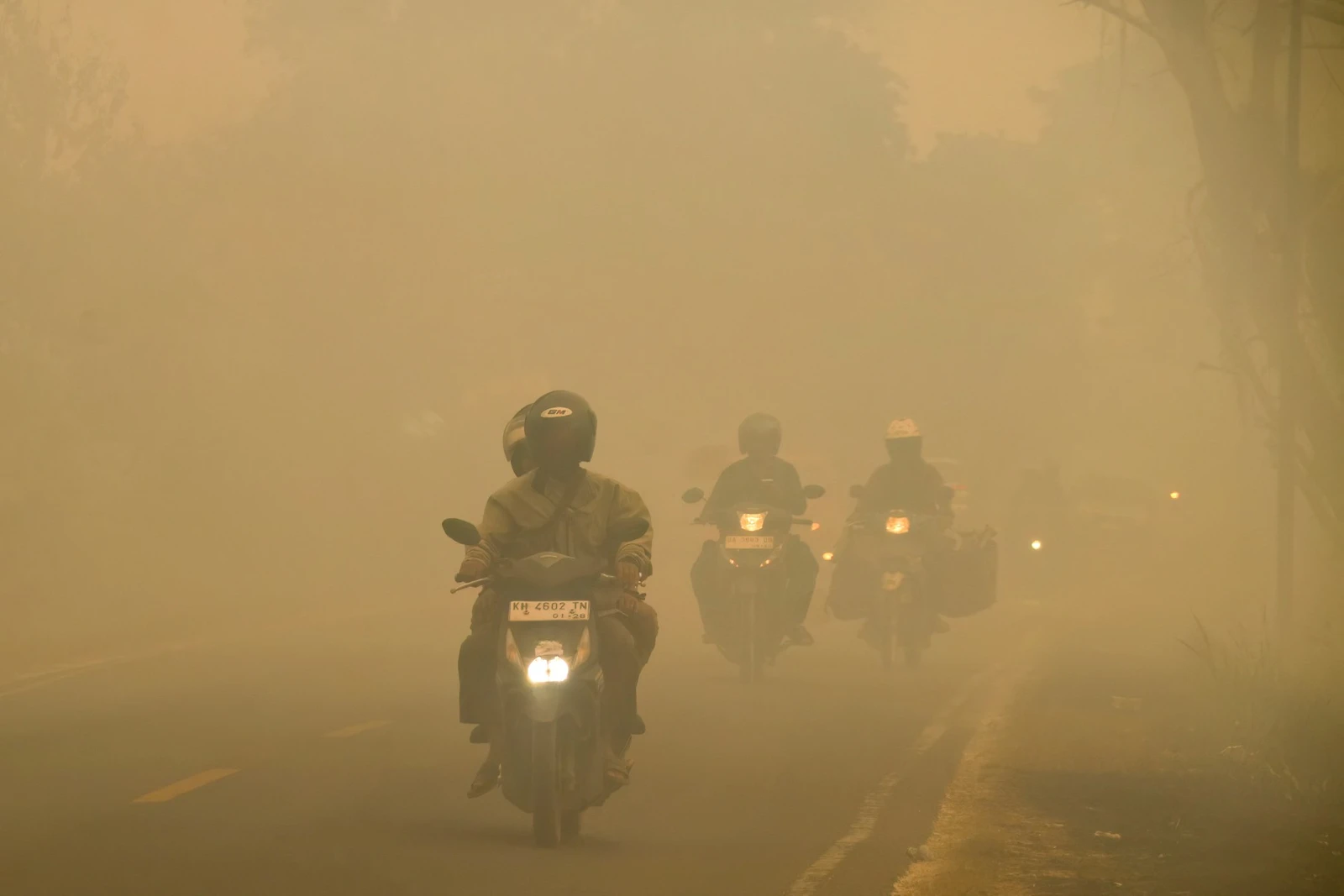
For the last four weeks, Sri Vivi has been waking up to a blanket of yellow-brown haze every morning, as thick smog shrouded her hometown village in Sekadau, West Kalimantan.
Whenever she leaves her house, the 33-year-old has to face toxic smoke caused by widespread forest and peatland burning across the island, which have been raging for weeks on the Indonesian islands of Borneo, also known as Kalimantan, and Sumatra.
“There’s such low visibility on the road because of the smoke,” Vivi told Arab News.
“When I’m on my motorbike to get to work, the smoke is so thick that it stings my eyes and makes it difficult to breathe.”
In West Kalimantan, thick smog reduced visibility to less than 1km in recent days while the Air Quality Index reached an “extremely dangerous” level of 752 on Saturday. On the AQI scale from 0 to 500, good air quality is represented by levels below 50, while levels above 300 are dangerous.
But health is not Vivi’s only concern as fires continue to spread in the province, which has been the most affected. With each passing day, she is increasingly worried that the blaze may one day reach her Sungai Ayak village, home to more than 4,400 people.
“The thing is, we have such limited firefighting capabilities. Should we need assistance from another city or village, the fastest way would require crossing the river and that can be a bit of a problem,” she said.
Indonesians have taken to social media to raise awareness on the situation since August, particularly across Kalimantan, by posting clips of blazing fires, burned forest, and how toxic smog became part of the daily lives of many people.
Six Indonesian provinces are hit the hardest by forest and land fires, causing toxic haze and smoke that has now spread to Singapore, Malaysia, Brunei and the Philippines.
Malaysia declared a state of emergency on Friday in Serian district in the state of Sarawak, which lies along the border with West Kalimantan, as the haze conditions caused air pollution to rise to “hazardous” levels.
Kuala Lumpur, the country’s capital on Peninsular Malaysia, has also been engulfed by smoke from fires burning in Sumatra.
“I think the situation is getting worse. I’ve been getting a sore throat every time I wake up in the morning. Even when there was rain the other day, it didn’t help to wash away the haze, and it’s still very hazy in the morning. It’s very depressing to have weather like this,” Steph Lam, a resident of Kuala Lumpur, told Arab News.
“Give me back my fresh air.”
The blanket of toxic haze has also enveloped neighboring Singapore, where its 24-hour Pollutant Standards Index entered the “unhealthy” range on Friday, the first time since 2023. Authorities cautioned that the city-state “may continue to be affected by the transboundary haze” in the coming days.
In the Philippines, at least two cities in the southern island of Mindanao had “very unhealthy” air quality levels, according to data issued by the country’s Environmental Management Bureau on Saturday, while Brunei also recorded “unhealthy” air quality across all of its four districts.
Indonesia is experiencing one of its worst fire seasons in years, driven in part by the powerful El Nino, a weather phenomenon marked by shifting ocean temperatures. It causes droughts to countries such as Indonesia, while unleashing torrents of rain on others.
In August, government data showed that there were over 9,400 hotspots in the country, compared to only about 500 in the same month last year.
More than 202,000 hectares of land have burned since the beginning of 2026, according to Indonesia’s forest ministry. The fires and choking smoke are not only impacting human health, but also endangering wildlife. In Kalimantan, the ministry said at least one orangutan has died from inhaling the smoke.
Over 50,000 cases of respiratory infections linked to land and forest fires were recorded between July and August, Indonesia’s Health Ministry said. More than 12,000 of those cases are of children under five years old.
Indonesia’s Disaster Management Agency, or BNPB, said on Saturday it is working with regional governments and relevant units to “continue to strengthen efforts through land operations, air patrols, water bombings and weather modification” to contain the fires.
Kiki Taufik, Global Head of Indonesia Forest Campaign, told Arab News that the intensity of these forest fires can also be traced to the government’s lack of preparation for this year’s dry season.
“It can be said that the Indonesian government ignored data, warnings, information and science,” he told Arab News.
Despite warnings for the super El Nino that came as early as March from Indonesia’s meteorological agency BMKG and the National Research and Innovation Agency BRIN, there were no mitigation efforts from relevant authorities.
He also pointed to Indonesia’s decreasing budget for disaster management, which stood at less than 500 billion rupiah ($28.3 million) for 2026, compared to 2 trillion rupiah in 2025 and nearly 5 trillion rupiah in 2024.
“Can you imagine, we are in the midst of a climate crisis; natural crises are becoming increasingly frequent and massive in scale. But the budget that has been set aside for disaster management is very little,” Taufik said.
“It’s very obvious that the current administration— President Prabowo— is negligent in this regard. In fact, one has to question whether or not he stands with the people. This issue demands scrutiny, because he displays a severe lack of empathy.”
‘Give me back my fresh air’: Indonesian wildfire haze spreads across Southeast Asia