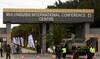
KUWAIT CITY: Saudi Arabia pledged on Wednesday to provide $300 million to help fund humanitarian efforts to deal with the war in Syria. The Kingdom’s Finance Minister Ibrahim Al-Assaf made the announcement at an aid donor conference chaired by UN Secretary-General Ban Ki-moon in Kuwait.
Kuwait and United Arab Emirates (UAE) also announced a pledge of $300 million each, as UN chief Ban Ki-moon warned of a “catastrophic” situation. “Due to the great sufferings of the Syrian people and to help ensure the success of the conference, I announce the Kuwaiti donation of $300 million for the Syrian people,” Kuwait Emir Sheikh Sabah Al-Ahmad Al-Sabah said as he opened the one-day conference in Kuwait City. Announcing the funding, UAE Crown Prince Sheikh Mohammed bin Zayed Al Nahyan said since the start of the Syria crisis the UAE had been committed to providing relief for Syrian refugees in neighboring countries.
Also addressing the International Humanitarian Pledging Conference for Syria, Ban called for urgent financial aid, warning that if funds were not forthcoming “more Syrians will die.”
“The situation in Syria is catastrophic,” the UN chief said as he urged all parties to the conflict to “stop the killings.”
On Tuesday, the European Union and the US promised a total of nearly $300 million. Along with the pledges from gulf states, the amount donated pushes close to the UN’s appeal for at least $1.5 billion in immediate aid.
The head of the US delegation, Assistant Secretary of State Anne Richard, lauded the donations from Gulf nations.
While international aid channels are open to refugee camps in places such as Turkey and Jordan, there is far more limited capacity to organize relief efforts inside Syria because of the fighting and obstacles from Assad’s regime.
Paris-based Medecins Sans Frontieres, or Doctors Without Borders, said the UN and others need to open more routes for aid to reach rebel-held areas, which now receive only a “tiny share” of international humanitarian help.
“The current aid system is unable to address the worsening living conditions facing people who live inside Syria,” MSF president, Marie-Pierre Allie, said in a statement.
The escalating hardships in camps outside Syria also can be used by Assad’s government as potential fodder in its claims that rebels are responsible for the country’s collapse, said Fawaz Gerges, head of the Middle East Center at the London School of Economics.
“The misery of the refugees, their suffering in neighboring countries, provide the ammunition for Assad, who is saying to them, ‘See, you have no one else but your country, so come home,’” Gerges said.
The United Nations says that more than 60,000 people have been killed in Syria’s 22-month conflict, which erupted in March 2011 with peaceful protests but morphed into an armed insurgency after a harsh regime crackdown.