- The Saudi GT's Rookie Racing Series launched with ten amateur racers aiming to transition from karting to international circuits
- Participants ranged from teenagers to those in their 20s, fostering a supportive community while competing against each other
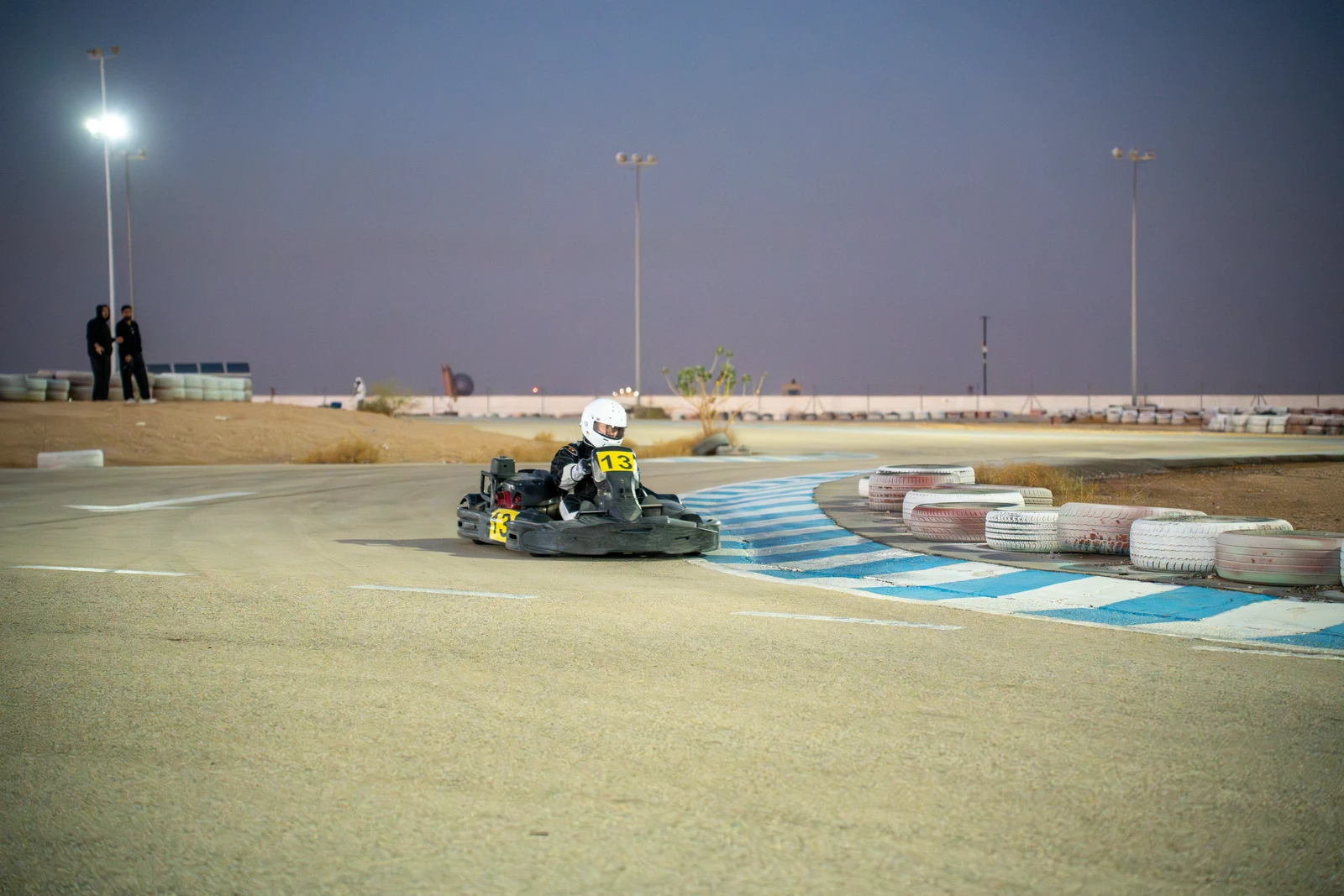
RIYADH: Ten amateur racers took to the track in Dirab on Saturday evening, sharing a long-term ambition: to make the leap from karting to international circuits.
The event marked the inaugural race of Saudi GT’s Rookie Racing Series, an initiative designed to broaden access to motorsport by giving newcomers and hobbyists an opportunity to develop their skills and gain competitive experience. But the race proved to not only polish skills, but the community around it.
For Abdulaziz Abo Al-Naja, the competitive racer behind the initiative, creating that opportunity is personal. Having entered the sport relatively late and navigated much of his own racing journey without financial backing, he hopes to make the path easier for those following in his footsteps.
Abo Al-Naja first discovered motorsport through online simulator racing in 2023. After taking on a summer job and investing his earnings in a racing simulator, he began karting in mid-2024, aged 19. “I always had the urge to drive and drive fast, and when I got my racing simulator, it was like I found what I wanted to spend all my time on,” he said.
Seeing his simulator lap times approach those of professional drivers prompted him to consider what he could achieve on a real circuit. He was also drawn to the prospect of pursuing something challenging and representing Saudi Arabia on an international stage.
Despite starting later than many of his competitors, who often begin racing as young children, Abo Al-Naja quickly made his mark. After entering the Saudi Sodi World Series mid-season in 2024, he secured several podium finishes and fastest laps, earning a place with Team Saudi at the MENA Championship in Qatar.
In 2025, he became a Saudi and Sharjah endurance champion and Saudi sprint vice-champion, although financial constraints prevented him from attending that year’s MENA Championship. He has since competed in more than 100 races and finished first in the 2026 Toyota Riyadh Qualifying Karting Championship.
With ambitions extending towards Rotax racing, Formula 4 and GT competitions, he sees the rookie series as an opportunity to help others take their first steps in a sport that can be difficult to enter.
“If you look at countries outside (Saudi Arabia), they have significant exposure around karting, with events, livestreams, and so much investment in the sport,” he told Arab News.
“Here, we have so many drivers. Saudis are among the best drivers around the world, but we don’t have all of those facilities, luxuries or privileges.
“It’s a big step to take, but I’m actually trying to change the karting and racing scene in Saudi, at least for beginners, to give them a chance to start. When I promoted it, I wanted people to know that if they’re too intimidated to join the professionals, this is their chance.”
The participants in the inaugural event ranged from teenagers to racers in their 20s but shared a desire to build a supportive yet competitive environment in which they could challenge one another and improve.
For 24-year-old Malek Al-Dabbagh, that sense of community is as important to the sport’s development as the competition itself.
“Community matters because it creates that sense of healthy competitiveness. And that’s what, in my opinion, really incentivizes the sport to grow,” he told Arab News after the evening’s first race.
“When you have all these friends you can call, coming together, visiting, participating and cheering everyone else on, it’s good to be a part of.”
His first race also offered a lesson in the importance of restraint on the track. Despite qualifying in third position, Al-Dabbagh lost ground shortly after the start, eventually dropping to eighth place.
“I was one of the quickest drivers today, but I ended up spinning all the way to the back of the field. I tried to fight back, but it wasn’t enough. I ended up finishing eighth,” he said.
Although he has yet to gain professional racing experience, Al-Dabbagh has been driving with friends for almost 11 years and hopes to pursue the sport professionally, potentially in GT racing or other competitions.
Fifteen-year-old Kareem Shaheen, who recently made his debut in a Saudi SWS sprint race, described the competition as an intense introduction to the series.
“It was a very hectic, very chaotic race. There were some ups and there was one down,” he said.
Shaheen moved from seventh to third position during the race, but a penalty for exceeding track limits eventually dropped him to fourth.
“I think giving these opportunities to rookies and less experienced people results in more inclusivity for motorsports. It creates more room for others to perform,” he said.
“It really shows the potential that rookies might have that could have remained hidden due to a lack of space that can accommodate them in karting.”
Shaheen said he was particularly keen to take part in the series’ inaugural event to assess areas for improvement and prepare for upcoming Saudi SWS sprint races.
For race director Talal Sultan Nugali, the value of such initiatives extends beyond the competition itself.
“It’s an amazing community, and I wish more people would look at it and give it a chance. It could make a big difference not just in the racing world, but overall,” he told Arab News.
Karting is often dismissed as a recreational activity for children, Nugali said, overlooking its importance as an entry point into professional motorsports and a discipline that develops skills extending well beyond the track.
“This is the grassroots of motorsport itself,” he said. “It’s a safer alternative, and it’s something that you can build a career off of. At the same time, it’s a grassroots essential that teaches you so much that stays with you for the rest of your life, and the community itself stays with you.”
Nugali has been racing at the Dirab circuit for three years and is now co-owner of Saudi Stormracers, a team that also operates at the track.
He said the early stages of a racing journey can be among the most rewarding, as newcomers learn the fundamentals of competition while building relationships with fellow drivers.
He pointed to the consistency of the local racing community as another factor driving participation. Regular monthly races bring together familiar competitors, many of whom have spent years training and racing alongside one another.
That continuity encourages drivers to keep practicing, remain accountable, and develop their skills over time. His advice to beginners is straightforward: Spend as much time behind the wheel as possible.
“The more you get to sit down and drive, the better and better you’ll get, because you’ll be able to tell the difference between a good lap and a bad lap. Over time, you’ll develop those skills,” he said.
For Abo Al-Naja, the intensity of racing is part of what makes the sport so compelling.
“You (have) a million thoughts in your head the night before, trying to sleep, imagining yourself perfecting every turn. But you forget everything once you drive. When the car is moving, you have no time to think; you can only react to how the car is behaving,” he said.
He said the most rewarding part of launching the rookie series was seeing participants experience that intensity for themselves. Abo Al-Naja hopes the initiative will ultimately spark more racing careers in the Kingdom, drawing on the opportunities he had to create for himself.
“Facing the track is like facing real life. You have to be calm and collected on the inside, but aggressive and brave on the outside, without cracking under pressure when it matters the most,” he said. “I see myself in every rookie I meet, and I myself am still a rookie compared to many higher-level racers and racing series.”