The Kingdom is seeking to exploit solar energy in desalination by establishing research collaborations with universities and research centers.
Abdul Rahman Al-Badri, member of the Research Committee at the King Abdul Aziz City for Science and Technology (KACST), pointed out that the first scientific communication to achieve this was a collaboration between the King Abdulaziz City and the US company IBM in 2009. This project included the development of solar cells to be used in the desalination of water as part of the King Abdullah Initiative for solar-powered desalination.
The project aims to achieve the supply of low-cost energy in order for it to be competitive with petroleum energy. A research team from KACST participated in the development of manufactured solar cells made from silicon and gallium arsenic. These cells used in two different projects — the Al-Khafji project for desalination and the Rabigh project — as an initial step to generalize the experience in different areas in the Kingdom in the east and west coasts to provide potable water.
In addition to the use of solar energy in desalination, the larger aim is to take advantage of the locally developed solar cells as an important energy-generating source to produce electricity in the areas where it is most needed.
Observers say that the research team is producing good results in creating efficient solar cells with globally competitive prices meeting Saudi and international specifications. Hossam Khunkar, member of the Research Committee at KACST, said that the team has provided many high-quality patents and inventions in this field, having already developed three-link solar cells with a higher efficiency than the high concentration solar complexes manufactured commercially around the world. He added that it is in fact possible to locally produce 95 percent of solar collectors in the Kingdom.
Abd Al-Edaibi, professor of solar energy research at the Institute of Energy Research in KACST, said that the Kingdom has achieved milestones in the area of alternative energy and the localization of manufacturing, production and developing solar PV panels.
The Kingdom’s future plan includes investing in this area to secure half of the country’s electricity needs during the next 20 years. The Kingdom is also increasingly moving toward developing sources of energy that do not depend on fossil fuels, such as solar, wind and nuclear energy.


![]()
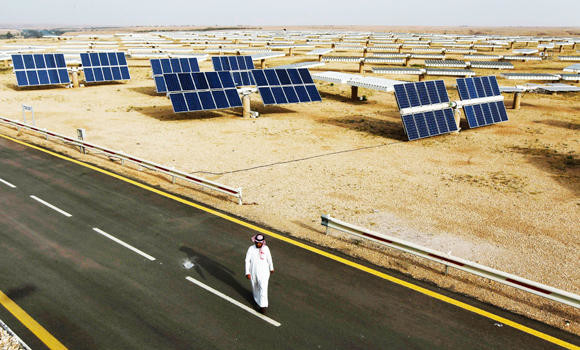
KSA plans to use solar energy for desalination
KSA plans to use solar energy for desalination
Latest updates


Recommended


© 2026 SAUDI RESEARCH & PUBLISHING COMPANY, All Rights Reserved And subject to Terms of Use Agreement.