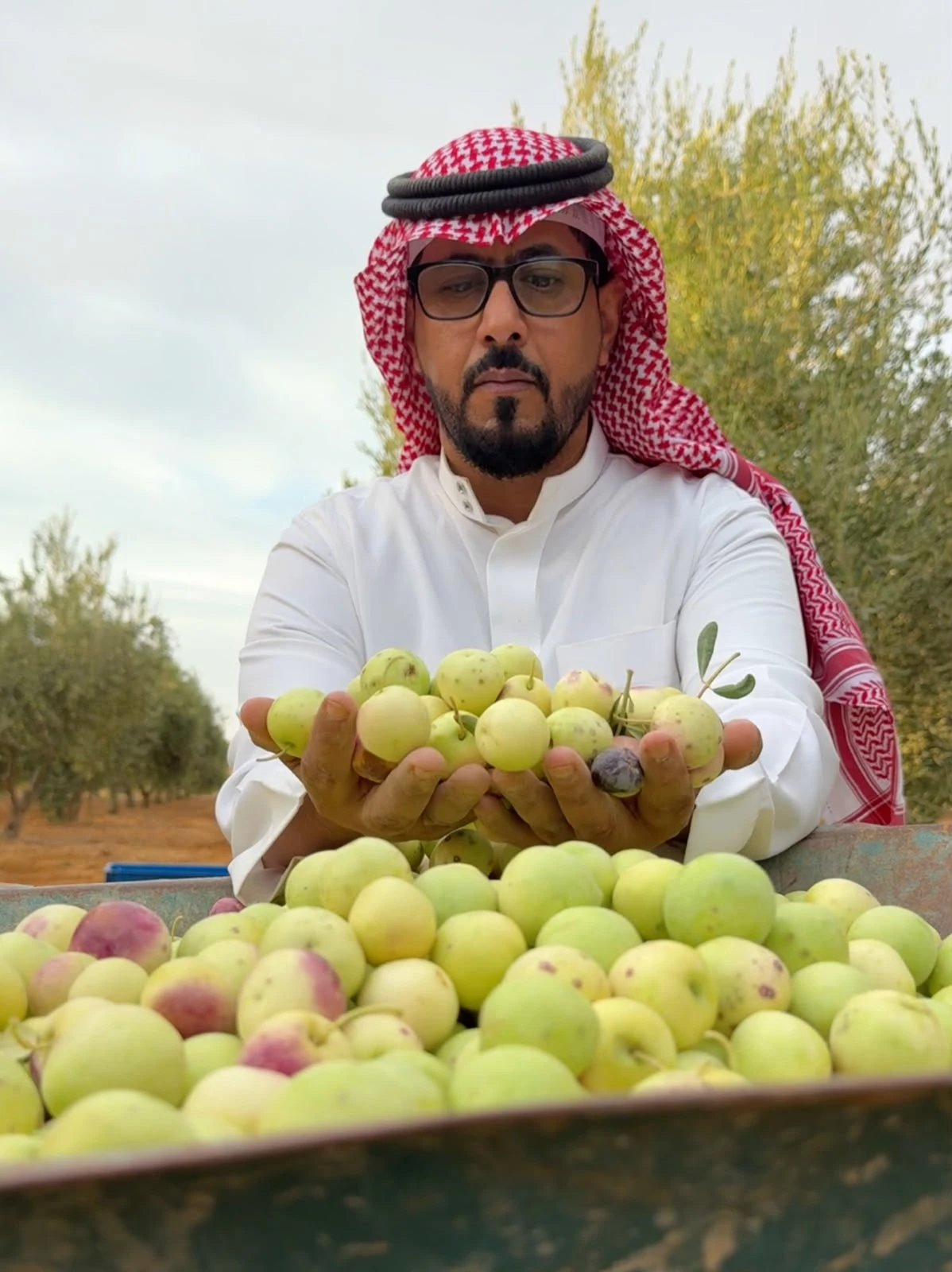
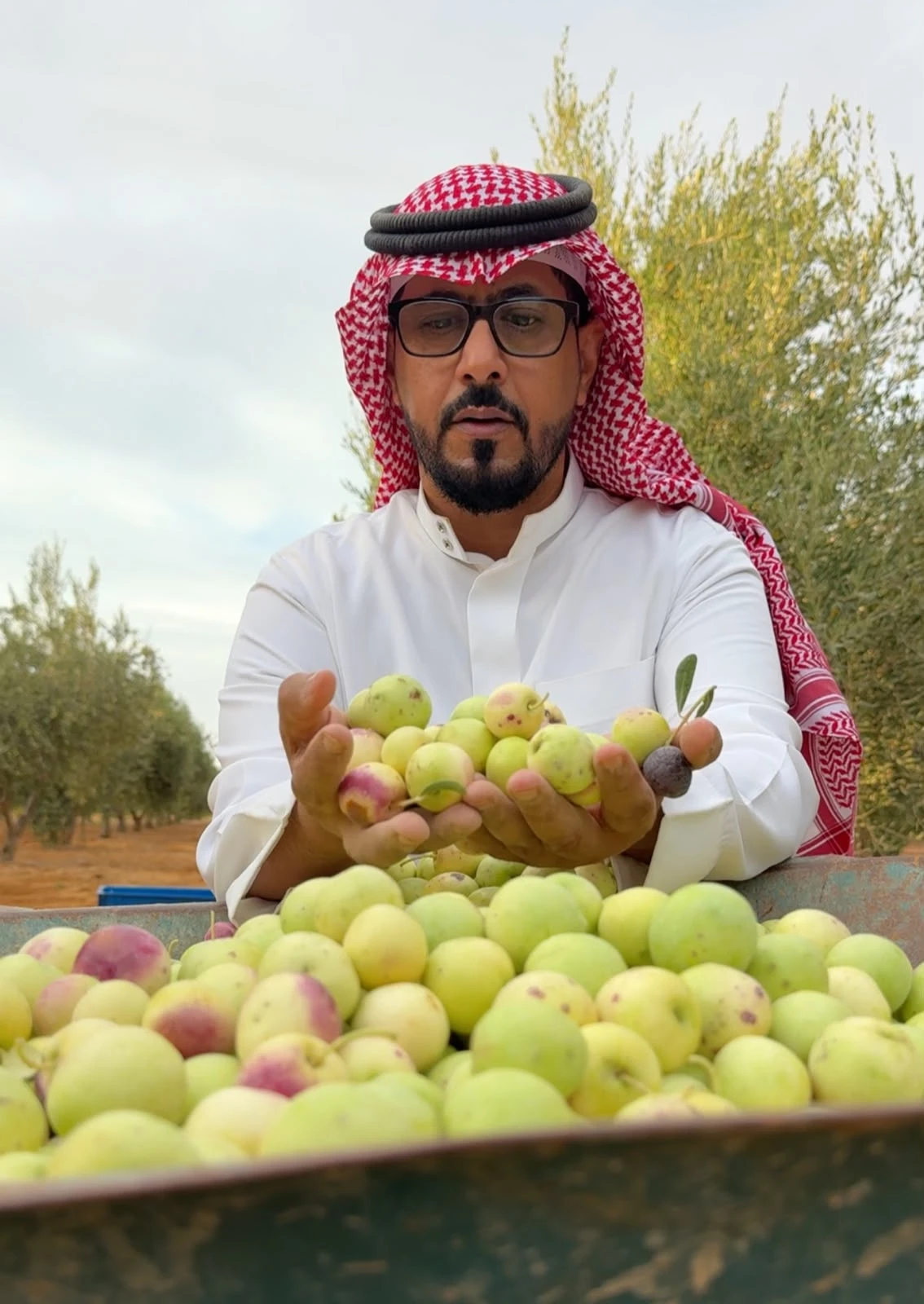
- Unusually large olives grown by Hamoud Al-Sharari have attracted interest from farmers and agricultural specialists in Saudi Arabia and abroad
MAKKAH: A Saudi farmer who began growing olive trees as a hobby more than two decades ago is now cultivating an unusual variety that produces fruit reportedly as large as plums.
The unusually large olives grown by Hamoud Al-Sharari have attracted interest from farmers and agricultural specialists in Saudi Arabia and abroad.
Al-Sharari said his experience with olive growing began around 2002, when he had little knowledge of trees and cultivation and was more focused on fodder and livestock.
“The beginning was simply about reviving the farm. We would bring trees and plant them, and we did not know much about the varieties or the details of olive cultivation,” he said.
But growing interest in olive farming in the region, and the festivals and events that came with it, led him to see the tree differently. He gradually began collecting seedlings from different sources and places, searching for the best and highest-quality types, before the venture developed into a specialized interest in olive cultivation and propagation.
In 2004, Al-Sharari began cultivating the field where the unusually large olives now grow. He noticed that some trees produced significantly larger fruit than others.
When Al-Sharari brought the olive seedlings from several sources, some from outside Saudi Arabia, such as from Jordan and Syria, he did not treat them as a commercial project.
“I was not looking for a return from them. To me it was just a tree on the farm. But after I pressed the oil and production exceeded my needs, I began giving it away to others. Then people started asking for it, and after that I began selling it,” he said.
As his experience grew, Al-Sharari said he became someone the region's farmers turned to for advice on olive growing, with some now consulting him on choosing varieties and how to handle them.
Al-Sharari stressed that the olives are not genetically modified and that he feeds his trees only organic fertilizers, to preserve the nature of the trees and the quality of their yield.
According to the farmer, the size of the olives prompted one of the people he consulted to suggest the name “Barqoun,” a blend of the Arabic words for plum (barqouq) and olive (zaytoun).
He added that olive farmers and specialists from Syria, Jordan, Morocco, Tunisia and Palestine contacted him after seeing the fruit, and several expressed surprise at its size. He said he had searched for similar fruit himself during visits to a number of regions and countries without finding, in his experience, anything that matched it in size.
The farm has a limited number of these distinctive trees, within a field of hundreds of olive trees. Al-Sharari is now working to propagate them through a dedicated nursery and cuttings, but the process is not easy: The rooting rate, he said, is weaker than in some other olive varieties.
By Al-Sharari’s estimates, the large fruit may yield less oil than some smaller varieties, and he noted that a bigger olive does not necessarily mean a higher oil content.
Some varieties can reach an oil content of about 20 percent, he said, while he expects the figure for this large olive to be around 10 percent. He stressed, however, that a lower oil content does not mean lower quality.
Al-Sharari compares the fruit to well-known varieties used mainly for pickling, such as Kalamata, Jallut and Nassouhi, and believes its large size makes it especially suitable for consumption as a table olive.
After years of trial, Al-Sharari is now working to increase the number of trees through propagation, but demand, he said, has outgrown his current ability to supply seedlings to those who want them.
“I multiplied them through cuttings, and people started asking for them. We are trying to expand as much as we can and meet people's requests,” he said.