- Foreign vets plan hydrotherapy, dietary changes to help restore elephant’s muscle strength
- Veterinarian says Madhubala is not close to death but warns her condition remains serious
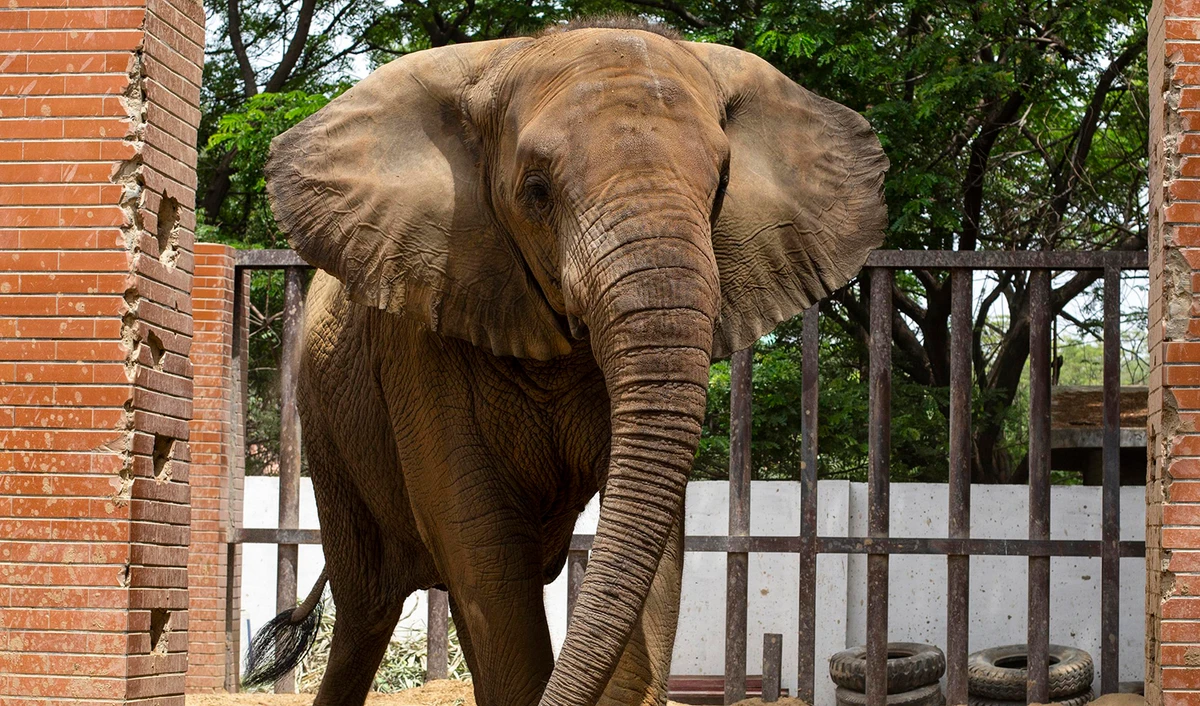
KARACHI: A 22-year-old African elephant at Karachi’s Safari Park has lost over 200 kilograms and significant muscle mass in her hind legs, an international veterinarian said on Friday, as foreign specialists outlined an intensive plan to rehabilitate her.
Madhubala, named after a famous Indian film actress of the 1950s, has suffered serious health problems for more than two months, according to Dr. Amir Khalil, a veterinarian with the international animal welfare organization FOUR PAWS.
Khalil, who is in Karachi with Sri Lankan wildlife veterinarian Dr. Buddhika Bandara, said Madhubala’s condition remained concerning, although recent tests showed that earlier bacterial and parasitic infections had cleared.
“She lost a lot of weight, over 200 kilograms,” Khalil told reporters at Safari Park. “She lost a lot of muscles from her hind leg. She has swelling, some wound on the nail, and she is not able to sleep. If she sleeps, she cannot stand up again because her hind leg is very weak.”
The specialists plan to introduce hydrotherapy, improve the treatment area where Madhubala receives injections and add more protein to her diet to help her regain strength and muscle.
Part of the swimming pool at Safari Park will be deepened by about one meter so the elephant can exercise her legs in water without bearing her full weight, Khalil said. A crane or a special support belt could also be used to help her move.
“Water is the best treatment,” he said.
Madhubala and Malika, who also lives at Safari Park, are Pakistan’s last two captive African elephants. Both previously tested positive for tuberculosis and were treated for about one and a half years.
Madhubala tested negative for tuberculosis at her last examination in May, Khalil said. Blood tests taken several weeks ago had also shown bacterial and parasitic infections, but results received two days ago indicated that both infections had cleared.
Despite the improvement, Madhubala remains vulnerable. Khalil said he did not believe the elephant was close to death but warned: “If we don’t apply so many things, yes, the elephant is threatened.”
He said her health problems likely stemmed from several factors, including previous infections, prolonged tuberculosis treatment and a weakened immune system, rather than poor care by local staff.
Madhubala was moved from Karachi Zoo to Safari Park in November 2024, after around 15 years apart from the other elephants brought to Pakistan with her from Tanzania. Her longtime companion Noor Jehan died at Karachi Zoo in April 2023 after prolonged health problems, while Sonia, another elephant at Safari Park, died in December 2024, weeks after Madhubala’s arrival.
The deaths prompted renewed scrutiny of conditions for captive elephants in Karachi and their access to specialized veterinary care.
Khalil said Madhubala’s recovery was the immediate priority, and any discussion of moving her elsewhere could only take place once her condition improved.
“Our task here together with the team in Pakistan is to give a chance for Madhubala,” he said. “She deserves it. She is a young elephant.”
Asked about her prospects, Khalil said weeks of treatment and coordination with the local team gave reason for hope.
“I see there is a light, and there is a reason we are here to do our best,” he said.