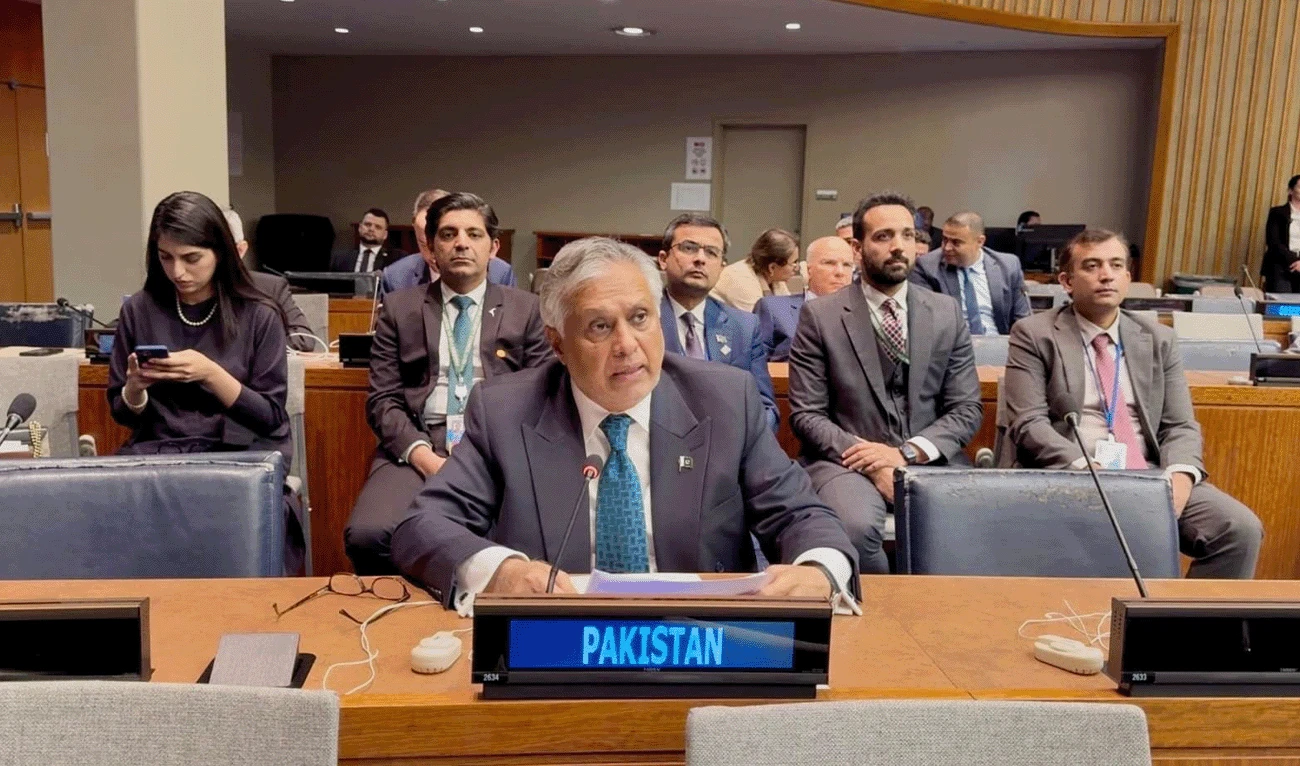
- Ishaq Dar speaks at Jordan-convened Arab-Islamic meeting in New York
- His call follows renewed Israeli visits, Jewish prayers at Al-Aqsa compound
ISLAMABAD: Pakistan on Saturday called for the rejection of Israeli measures aimed at changing the character and status of Jerusalem, as Arab and Muslim nations met following renewed Israeli visits and Jewish prayers at the Al-Aqsa Mosque compound in occupied East Jerusalem in recent weeks.
The meeting in New York came days after Israeli National Security Minister Itamar Ben-Gvir entered the Al-Aqsa compound, known to Jews as the Temple Mount, during the Jewish holiday of Yom Kippur, while hundreds of Jewish visitors entered the site under Israeli police protection.
Jordan, which convened the meeting, condemned the visits and prayers as violations of longstanding arrangements governing one of the world’s most sensitive religious sites.
“Israel has no sovereignty over the Occupied Palestinian Territory, including its Holy Sites,” Pakistan’s Deputy Prime Minister and Foreign Minister Ishaq Dar told a joint meeting of an Arab League ministerial committee and four Islamic countries — Pakistan, Türkiye, Malaysia and Indonesia — on the sidelines of the UN General Assembly.
“We reaffirm our strong support for the Hashemite Custodianship over the Islamic and Christian Holy Sites and for the exclusive jurisdiction of the Jerusalem Endowments and Al-Aqsa Mosque Affairs Department over Al-Aqsa Mosque/Al-Haram Al-Sharif.”
Dar said the countries should “firmly reject any unilateral measures aimed at changing the character, identity or status of Jerusalem” and mobilize international support to preserve the historical and legal status quo governing the city and its holy sites.
The Al-Aqsa compound, Islam’s third-holiest site and Judaism’s holiest, has long been a flashpoint in the Israeli-Palestinian conflict. Under longstanding arrangements, the compound is administered by the Jordanian-backed Islamic Waqf, while Israel controls security and access. Non-Muslims may visit the site but, under the traditional status quo, are not permitted to pray there.
The arrangements have come under growing strain as Ben-Gvir and other Israeli politicians and Jewish groups have made repeated visits to the compound, with Jewish prayer increasingly taking place there. Israeli Prime Minister Benjamin Netanyahu has previously said his government has not changed the status quo, despite Ben-Gvir publicly advocating Jewish prayer at the site.
Netanyahu himself visited tunnels beneath occupied East Jerusalem’s Old City near the Al-Aqsa compound this month and attended prayers at the Western Wall.
Jordan has a particular role in the dispute through the Hashemite custodianship of Muslim and Christian holy sites in Jerusalem. Its special role was recognized in the 1994 Israel-Jordan peace treaty, while a 2013 agreement between Jordan’s King Abdullah II and Palestinian President Mahmoud Abbas reaffirmed the monarch’s custodianship and authority to safeguard the holy sites, particularly Al-Aqsa.
Saturday’s talks were convened by Jordan as a follow-up to an Aug. 5 ministerial meeting in Amman that brought together Arab League states and Pakistan, Türkiye, Malaysia and Indonesia to coordinate a response to developments in Jerusalem.
East Jerusalem was captured by Israel in the 1967 Middle East war and later annexed in a move not recognized internationally. Palestinians want East Jerusalem as the capital of a future state.
Dar said the participating countries should ensure “sustained international attention” to Jerusalem and coordinate a timely response to violations of the established status quo.
He also reiterated Pakistan’s support for an independent Palestinian state based on the pre-June 1967 borders, with East Jerusalem, or Al-Quds Al-Sharif, as its capital.
“Pakistan will continue to work closely with Arab and Islamic countries in support of these objectives,” Dar said. “At this critical juncture, our unity and collective resolve are more important than ever.”