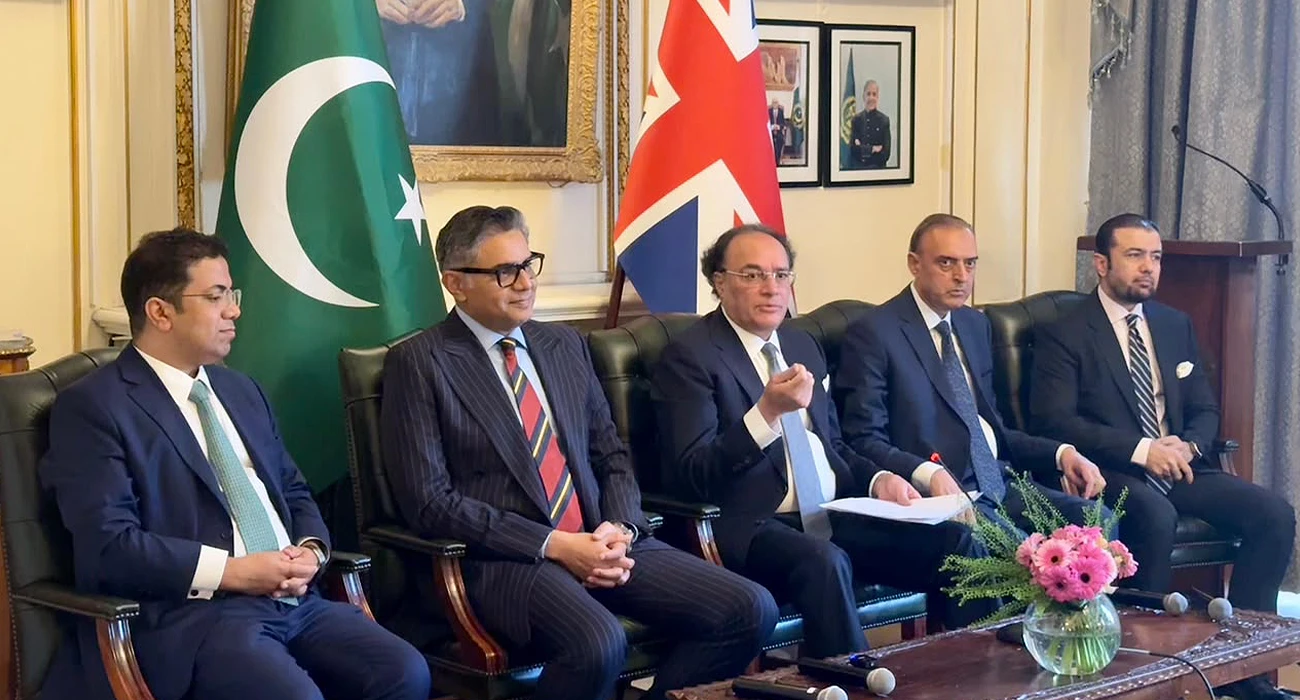
- Pakistan High Commission hosts roundtable conference for investors, financial management firms
- Finance minister admits US-Iran war, floods in 2025 dealt economic setbacks for Pakistan
KARACHI: Finance Minister Muhammad Aurangzeb assured global investors at a roundtable investment conference in London that Pakistan is “open for business” with renewed investors, the Finance Division said on Thursday, citing macroeconomic reforms undertaken by Islamabad in recent years.
The finance minister was speaking to leading investors and global financial management firms at a “Pakistan Investment Roundtable” conference hosted by the Pakistan High Commission in London.
Pakistan has eyed foreign investment in its key economic sectors in recent years. Islamabad hopes to ensure sustainable economic growth as it looks to escape a prolonged economic crisis that brought it to the brink of a sovereign default in 2023.
“He stated that Pakistan is open for business with renewed interest from international investors,’ the Finance Division said in a statement about Aurangzeb’s speech at the conference.
“Pakistan has successfully completed all IMF reviews on schedule that have been validated by three rating upgrades.”
Pakistan signed a $7 billion loan agreement with the IMF in September 2024 to strengthen its reserves and consolidate its fiscal position. An IMF mission is expected to hold discussions with Pakistani officials under the fourth review of its $7 billion Extended Fund Facility (EFF) and the third review of its $1.4 billion Resilience and Sustainability Facility (RSF).
Aurangzeb said Islamabad is committed to macroeconomic stabilization and is vigorously pursuing sustained economic growth, citing Islamabad’s efforts to increase its tax base.
He admitted that the ongoing US-Iran war in the Middle East as well as the floods of 2025 had deal economic setbacks to Pakistan.
Pakistan imports most of its fuel needs from the Middle East. Tensions between the US and Iran Middle East and the blockade of global maritime trade arteries had raised global fuel prices, compounding Pakistan’s economic crisis.
Aurangzeb told investors that the government’s fiscal consolidation measures were delivering results in the form of primary surplus, deficit compression, revenue mobilization, and impetus in institutional and fiscal reforms.
“He added that energy sector reforms, financial transparency and ease of doing business will further reinforce the government’s vision of macro-economic stability,” the statement said.