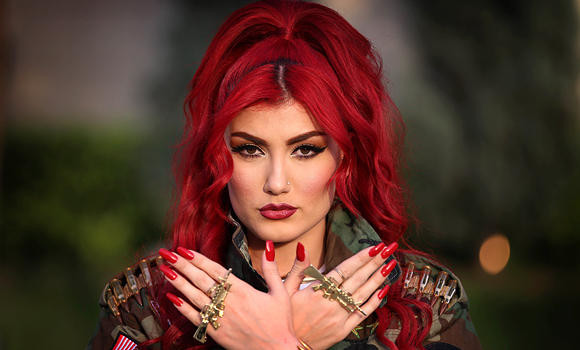
IRBIL: High heels, fatigues and gold rifle-shaped rings — singer Helly Luv’s blend of bang and bling has made her the most popular cheerleader for the Iraqi Kurds’ war against the Daesh.
She visits peshmerga forces fighting the Daesh, which overran a third of Iraq last year, and says she filmed her latest music video in Al-Khazr, not far from the enemies’ lines. “I want to give something to the peshmerga because I consider myself one of them,” the 26-year-old singer told AFP in the Kurdish regional capital Irbil.
“I wore peshmerga clothes in the song to support them.”
Her latest music video, for a song titled “Revolution,” opens with a peshmerga fighter looking at a picture of himself with a young boy, presumably his son, as shelling and gunfire are heard in the background.
He tucks the photo inside his helmet and goes to fight. The video then moves to a quiet village where children play and people sit drinking tea, but it soon comes under fire from black-clad militants driving armored vehicles like those captured from Iraqi security forces, including a tank.
A child screams and residents flee, but Helly Luv — wearing golden high heels with a white and red scarf covering her face — strides the other way to dramatic music, unfurling a banner before the tank that reads “STOP THE VIOLENCE.”
She sings and dances next to a car with “END WAR” spray painted on its side, but footage that includes peshmerga forces counterattacking and lyrics such as “We gon’ keep on fighting” make clear she means the violence will stop once the Daesh is defeated.
The video and English lyrics are over the top and sometimes cringe-worthy, but also apparently popular, garnering 700,000 views on YouTube barely two weeks after its release.
With plenty of hip-swinging and hair-swishing, the rock-chick style of the “Kurdish Shakira” is in stark contrast with the somber and pious “nasheeds” — both for and against Daesh — that have blossomed on social media over the past year.


‘Kurdish Shakira’ sings anti-Daesh anthem
‘Kurdish Shakira’ sings anti-Daesh anthem

Second doctor in Matthew Perry overdose case sentenced to home confinement
- Dr. Mark Chavez, 55, a onetime San Diego-based physician, pleaded guilty in federal court in October
- Judge Sherilyn Peace Garnett also sentenced Chavez to 300 hours of community service
LOS ANGELES: A second California doctor was sentenced on Tuesday to eight months of home confinement for illegally supplying “Friends” star Matthew Perry with ketamine, the powerful sedative that caused the actor’s fatal drug overdose in a hot tub in 2023.
Dr. Mark Chavez, 55, a onetime San Diego-based physician, pleaded guilty in federal court in October to a single felony count of conspiracy to distribute the prescription anesthetic and surrendered his medical license in November.
Judge Sherilyn Peace Garnett also sentenced Chavez to 300 hours of community service. As part of his plea agreement, Chavez admitted to selling ketamine to another physician Dr. Salvador Plasencia, 44, who in turn supplied the drug to Perry, though not the dose that ultimately killed the performer. Plasencia, who pleaded guilty to four counts of unlawful drug distribution, was sentenced earlier this month to 2 1/2 years behind bars.
He and Chavez were the first two of five people convicted in connection with Perry’s ketamine-induced death to be sent off to prison.
The three others scheduled to be sentenced in the coming weeks — Jasveen Sangha, 42, a drug dealer known as the “Ketamine Queen;” a go-between dealer Erik Fleming, 56; and Perry’s former personal assistant, Iwamasa, 60.
Sangha admitted to supplying the ketamine dose that killed Perry, and Iwamasa acknowledged injecting Perry with it. It was Iwamasa who later found Perry, aged 54, face down and lifeless, in the jacuzzi of his Los Angeles home on October 28, 2023.
An autopsy report concluded the actor died from the acute effects of ketamine,” which combined with other factors in causing him to lose consciousness and drown.
Perry had publicly acknowledged decades of substance abuse, including the years he starred as Chandler Bing on the hit 1990s NBC television series “Friends.”
According to federal law enforcement officials, Perry had been receiving ketamine infusions for treatment of depression and anxiety at a clinic where he became addicted to the drug.
When doctors there refused to increase his dosage, he turned to unscrupulous providers elsewhere willing to exploit Perry’s drug dependency as a way to make quick money, authorities said. Ketamine is a short-acting anesthetic with hallucinogenic properties that is sometimes prescribed to treat depression and other psychiatric disorders. It also has seen widespread abuse as an illicit party drug.


