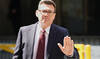
Malaysia’s Mahathir to launch party to challenge PM Najib

Former Malaysian Prime Minister Mahathir Mohamad
Updated 15 July 2016
Follow

Malaysia’s Mahathir to launch party to challenge PM Najib

KUALA LUMPUR: Former Malaysian Prime Minister Mahathir Mohamad on Thursday announced plans for a new party that would join an opposition alliance in a bid to oust the ruling Barisan Nasional (BN) coalition led by scandal-tainted Prime Minister Najib Razak.
Speculation had been rife over the past week that Mahathir, 91, Malaysia’s longest serving prime minister, was planning to start a party with three other former leaders of the United Malay National Organization (UMNO) which Najib now leads.
“We who oppose Najib cannot achieve victory unless we work together as a coalition,” said Mahathir.
He added that he would not contest the next general election, due to be held in 2018, or position himself as a candidate for prime minister.
Mahathir has been critical of Najib’s handling of the 1MDB state fund scandal and called on him to resign.
Mahathir was coy when asked if the three former UMNO leaders — Muhyiddin Yassin, Mukhriz Mahathir and Shafie Apdal — would join him in the new party, just saying that he was “very open” to the idea.
Mahathir said he and colleagues had yet to decide if the new party would represent the Malay-Muslim majority or eschew racial lines. He also did not give a time frame for when the party will be formed.
Last month, Najib announced the UMNO’s supreme council’s decision to sack Muhyiddin, who was then deputy president, and Mahathir’s son, former Kedah Chief Minister Mukhriz, from the party.
Both have been tough critics of Najib, calling for his resignation following allegations of graft and mismanagement at 1MDB.
UMNO vice president Shafie later quit the party in protest against his suspension pending an investigation into his conduct in questioning Najib’s handling of 1MDB.
In February this year, Mahathir quit UMNO, saying it was seen as “supporting corruption” under Najib’s leadership.
The Wall Street Journal has reported that global investigators believed more than $1 billion entered Najib’s personal bank accounts, much of it from 1MDB. None of the information publicly disclosed about the 1MDB investigations across the world has shown any connection between alleged misappropriation of money linked to 1MDB and the prime minister.
Barisan Nasional coasted to victory in two by-elections earlier this month.


Macron to set out how France’s nuclear arms could protect Europe

Updated 3 sec ago
Follow

Macron to set out how France’s nuclear arms could protect Europe

PARIS: France will on Monday unveil how it could use the European Union’s only atomic arsenal to protect the continent in an unstable world, with Russia becoming increasingly aggressive and the United States turning away.
The speech by French President Emmanuel Macron, at France’s Ile Longue nuclear submarine base, comes after the launch of US and Israeli attacks against Iran in a campaign that risks destabilising the Middle East.
“What we are experiencing demonstrates that in the world to come, power and independence will be two indispensable forces for dealing with the proliferation of threats,” said a member of Macron’s team.
Macron is set to update France’s nuclear doctrine as Russia’s war against Ukraine grinds into a fifth year and NATO allies worry about Washington’s wavering commitment to Europe.
“There will undoubtedly be some significant shifts and developments,” a source said of the speech set to be delivered from 1415 GMT Monday.
European nations, which have relied on the US nuclear deterrent throughout the Cold War and in the decades since it ended, are increasingly debating whether to bolster their own atomic arsenals.
Paris has been in talks with countries including Germany and Poland over how France could use its atomic arsenal to help protect the continent.
Last year, Macron said he was ready to discuss possible deployment of French aircraft armed with nuclear weapons in other European countries.
Macron said in February he was considering a doctrine that could include “special cooperation, joint exercises, and shared security interests with certain key countries.
France maintains the world’s fourth-largest nuclear arsenal, estimated at around 290 warheads. Britain, which is no longer a member of the EU, is the only other European nuclear power.
By contrast, the United States and Russia, the world’s two main atomic powers, have thousands of nuclear warheads each.

‘27 buttons’

Reassurances from US officials that Washington’s deterrent would continue to cover Europe under the NATO alliance have done little to quell European fears of fickleness under US President Donald Trump.
“It is clear that we will need to reflect together on how French and British deterrence can fit into a more assertive European defense,” Bernard Rogel, who served as top military adviser to Macron, told AFP.
But how exactly nuclear cooperation would work between the EU’s 27 states is another story.
Rogel insisted that control over the launch decision will remain in French hands.
“I can’t see us having 27 buttons. From a credibility standpoint, that just doesn’t work,” he said.

‘Only a good thing’

Rafael Loss, a policy fellow at the European Council on Foreign Relations, said leaders should find confidence in European support for strengthening nuclear deterrence.
He said people in Denmark, Estonia, Germany, Portugal, Spain and Switzerland now tend to support rather than oppose the idea of developing an alternative European nuclear deterrent.
“If there’s going to be some kind of bigger European investments in France or UK’s nuclear deterrence, that’s only a good thing,” Finland’s defense minister Antti Hakkanen told AFP in February.
Florian Galleri, a historian specializing in nuclear doctrines, warned that Macron would have to tread carefully, pointing to his low approval ratings one year before the end of his presidency.
Macron’s address could also spark a backlash ahead of the 2027 presidential election, in which Marine Le Pen’s euroskeptic far-right is seen as having its best chance yet at winning the top job.
“There is a consensus on possessing nuclear weapons in France, but not on nuclear policy,” Galleri said.
The far-right has already issued a warning.
“If Mr. Macron thinks he can give France’s nuclear weapon to the EU, he will face impeachment proceedings for treason,” Philippe Olivier, an adviser to Le