PAMPLONA, Spain: Two Spanish men were in serious condition after being gored during the fourth day of the running of the bulls at Pamplona’s San Fermin festival on Sunday, officials said. Three others sustained head injuries.
The two gored men were from the southeastern town of Valencia, aged 29 and 34, and were injured in an alleyway leading to the bullring. No further details were revealed.
The three others with head injuries, also Spaniards from Murcia, Madrid and Barcelona, were hospitalized. The latter, aged 36, was under observation and the two others were in fair condition.
More than 1,000 participants packed the narrow cobblestoned streets of Pamplona’s old town. The bulls came out strong from the starting gate and completed the 930-yard (850-meter) run within 2 ½ minutes.
Slips and falls, however, were constant by bulls and runners, and some participants were stampeded by the 1,300-pound (590-kilogram) animals on the way to the bullring.
One of the runners, on a fence, was charged head-on by a bull but was still able to clear the running lane by rolling under a railing after falling. Another runner avoided goring but was flipped violently and hit head his head hard against the ground.
Initial medical reports said that there were three head injuries but no gorings. Some participants at Sunday’s bull run wore black armbands in honor of 29-year-old matador Victor Barrio, who was fatally gored Saturday during a bullfight in eastern Spain.
Bull runs are a traditional part of summer festivals across Spain. The nine-day San Fermin fiesta became world famous with Ernest Hemingway’s 1926 novel “The Sun Also Rises” and attracts thousands of foreign tourists.
Ten people, including four Americans, were gored in the San Fermin festival last year. In all, 15 people have died from gorings in the festival since record-keeping began in 1924.


2 more gored, 3 injured in Spain bull run

2 more gored, 3 injured in Spain bull run
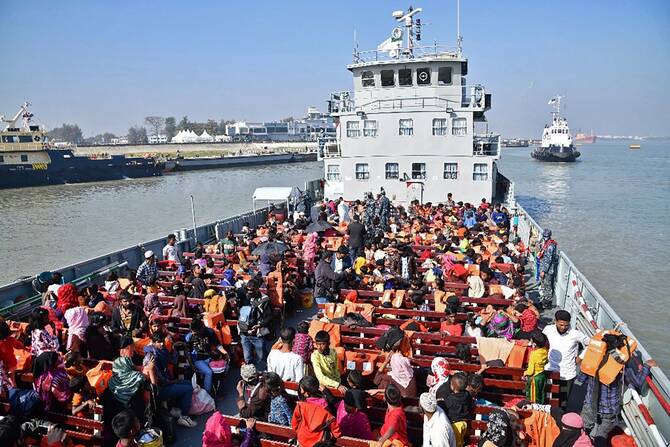
Bangladesh halts controversial relocation of Rohingya refugees to remote island
- Administration of ousted PM Sheikh Hasina spent about $350m on the project
- Rohingya refuse to move to island and 10,000 have fled, top refugee official says
DHAKA: When Bangladesh launched a multi-million-dollar project to relocate Rohingya refugees to a remote island, it promised a better life. Five years on, the controversial plan has stalled, as authorities find it is unsustainable and refugees flee back to overcrowded mainland camps.
The Bhasan Char island emerged naturally from river sediments some 20 years ago. It lies in the Bay of Bengal, over 60 km from Bangladesh’s mainland.
Never inhabited, the 40 sq. km area was developed to accommodate 100,000 Rohingya refugees from the cramped camps of the coastal Cox’s Bazar district.
Relocation to the island started in early December 2020, despite protests from the UN and humanitarian organizations, which warned that it was vulnerable to cyclones and flooding, and that its isolation restricted access to emergency services.
Over 1,600 people were then moved to Bhasan Char by the Bangladesh Navy, followed by another 1,800 the same month. During 25 such transfers, more than 38,000 refugees were resettled on the island by October 2024.
The relocation project was spearheaded by the government of former Prime Minister Sheikh Hasina, who was ousted last year. The new administration has since suspended it indefinitely.
“The Bangladesh government will not conduct any further relocation of the Rohingya to Bhasan Char island. The main reason is that the country’s present government considers the project not viable,” Mizanur Rahman, refugee relief and repatriation commissioner in Cox’s Bazar, told Arab News on Sunday.
The government’s decision was prompted by data from UN agencies, which showed that operations on Bhasan Char involved 30 percent higher costs compared with the mainland camps in Cox’s Bazar, Rahman said.
“On the other hand, the Rohingya are not voluntarily coming forward for relocation to the island. Many of those previously relocated have fled ... Around 29,000 are currently living on the island, while about 10,000 have returned to Cox’s Bazar on their own.”
A mostly Muslim ethnic minority, the Rohingya have lived for centuries in Myanmar’s western Rakhine state but were stripped of their citizenship in the 1980s and have faced systemic persecution ever since.
In 2017 alone, some 750,000 of them crossed to neighboring Bangladesh, fleeing a deadly crackdown by Myanmar’s military. Today, about 1.3 million of them shelter in 33 camps in the coastal Cox’s Bazar district, making it the world’s largest refugee settlement.
Bhasan Char, where the Bangladeshi government spent an estimated $350 million to construct concrete residential buildings, cyclone shelters, roads, freshwater systems, and other infrastructure, offered better living conditions than the squalid camps.
But there was no regular transport service to the island, its inhabitants were not allowed to travel freely, and livelihood opportunities were few and dependent on aid coming from the mainland.
Rahman said: “Considering all aspects, we can say that Rohingya relocation to Bhasan Char is currently halted. Following the fall of Sheikh Hasina’s regime, only one batch of Rohingya was relocated to the island.
“The relocation was conducted with government funding, but the government is no longer allowing any funds for this purpose.”
“The Bangladeshi government has spent around $350 million on it from its own funds ... It seems the project has not turned out to be successful.”


