JEDDAH: The General Organization for Social Insurance (GOSI) has revealed that it plans to suspend all services to expatriates if they are abroad for over a month, with reinstatement occurring only once they return.
The organization had not yet worked out the manner in which this would occur, but talks were taking place with the Ministry of Interior, said Abdul Aziz Al-Habdan, GOSI’s deputy governor, during a briefing at the Eastern Province Chamber of Commerce and Industry recently.
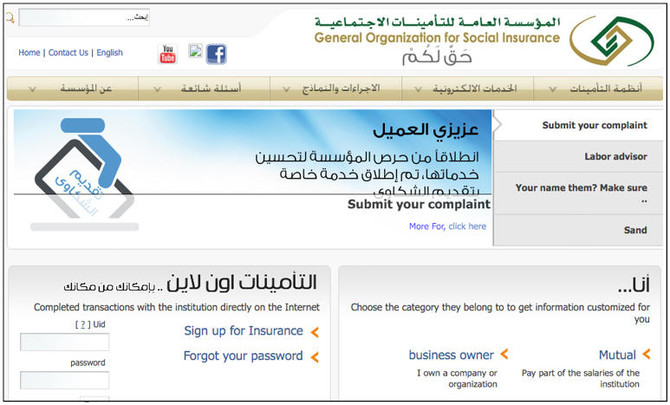
Al-Habdan was quoted as saying by a local publication that because of the large number of foreign workers in the country, the organization was working to introduce electronic services for companies and their employees. Currently 50 percent of subscribers conduct their transactions in person, he said.
On the wage protection issue, Al-Habdan said that there were some employers registering workers earning less than they do in reality, in an attempt to pay less to the fund. This also affects eventual payouts to workers, he said.
He dismissed reports that children of Saudi women married to foreigners do not benefit from the social insurance system, in reference to the decision taken by the government recently to include them as beneficiaries.
Al-Habdan said that people taking early retirement was having a negative financial impact on GOSI. However, changes were in the pipeline to change this situation, he said.
In response to the organization not disclosing and publishing its financial results, he said: “The rights of subscribers are guaranteed and maintained by the state. Our policy is heading toward further clarification and disclosure.”
He said GOSI now covers 400,000 companies compared to 25,000 over 12 years ago, with 8.5 million workers, compared to 2 million going back over the same period.
According to the GOSI website, the scheme covers workers in the private sector and a group of workers in public sector.
It provides contributors and their families “with a decent life after leaving work due to retirement, disability or death; medical care for contributors afflicted with work injuries or occupational diseases; and compensation in the event of occupational disability or death.”


Expats face GOSI cuts if they stay abroad for over one month
Expats face GOSI cuts if they stay abroad for over one month

Saudi Arabia led green building performance regionally in 2025: Report
- Saudi Arabia achieved the highest regional score of 76.31 points and certified more than 1.03 million sq. meters of sustainable building space
- Results reflect measurable efficiency gains across 6,662 projects completed since 2010, marking a new regional benchmark for measurable sustainability progress
RIYADH: Saudi Arabia led the region in sustainable building performance and environmental impact in 2025, according to the Saaf index developed by the Saudi Green Building Forum.
Saudi Arabia achieved the highest regional score of 76.31 points and certified more than 1.03 million sq. meters of sustainable building space, the Saudi Press Agency reported on Wednesday.
These results reflect measurable efficiency gains across 6,662 projects completed since 2010, marking a new regional benchmark for measurable sustainability progress and institutional excellence.
The achievement underscores Saudi Arabia’s growing influence in advancing sustainable construction across the Middle East and supports the Kingdom’s Vision 2030 objectives for cleaner growth, resource efficiency and climate resilience through data‑driven environmental performance.
Faisal Al‑Fadl, secretary‑general of SGBF, said that 2025 represented a major turning point toward a measurable, institutional sustainability strategy that united policy, technology and practice.
He added that the approach extended beyond renewable energy, clean water and eco‑friendly materials to embed sustainability in economic planning and public development programs, made possible through integrated efforts with regional governments and public institutions.
The Saaf index provides a specialized regional framework for measuring efficiency and resilience through the Sufficiency and Resilience Composite Index, or SCI, enabling precise performance assessments.
Findings show that the sector has evolved into a cohesive strategy integrating project delivery, professional capacity building, market innovation and climate action.
According to the SGBF review, Saudi Arabia’s achievements reflect its ability to combine quality implementation, institutional maturity and scale.
Environmentally, green building projects achieved an estimated 62,800 tonnes of carbon‑equivalent annual reduction and earned 29 professional recognitions, reinforcing growing international acknowledgment of Saudi leadership in sustainability.
The data also underscore SGBF’s role as a professional partner in advancing methodologies, applications and impact measurement within non‑governmental frameworks that link policy and practical execution.
More than 7,300 professionals across 22 Arab countries engaged with the Saaf platform in 2025, alongside numerous business‑driven initiatives expanding the region’s sustainable‑development footprint.
Al‑Fadl said that the period from 2025 to 2026 would act as a bridge toward Vision 2030, strengthening a model in which sustainable buildings were managed by impact, measured through indicators and implemented via lasting partnerships.
SGBF serves as the Kingdom’s leading platform for advancing sustainable construction and green design. It unites experts, innovators and practitioners dedicated to building environmentally responsible and high‑performance structures.
Through continuous education, certification and collaboration, SGBF drives the transformation of Saudi Arabia’s building sector — minimizing environmental impact, promoting resource efficiency and improving overall quality of life for communities nationwide.