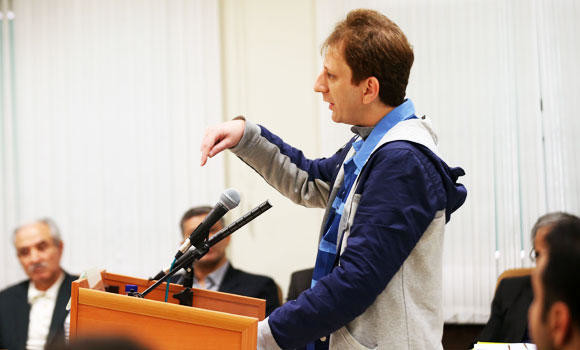
TEHRAN: Iran’s billionaire tycoon Babak Zanjani has been sentenced to death for corruption, a judicial official said Sunday, after a long trial in which he was accused of fraudulently pocketing $2.8 billion.
Zanjani became notorious during the era of President Mahmoud Ahmadinejad, finding ways to channel hard currency from oil sales to Tehran despite financial sanctions imposed on the Islamic republic’s banks as punishment for its nuclear program.
The 41-year-old was convicted of fraud and economic crimes and as well as facing the death penalty he must repay money to the state, judiciary spokesman Gholam Hossein Mohseni-Ejeie said at his weekly press conference.
The trial was held in public, a rarity for such a major case in Iran, and two other accused were also convicted of “corruption on earth,” the most serious offense under the country’s criminal code, meaning they too will face the death penalty.
“The preliminary court has sentenced these three defendants to be executed, as well as paying restitution to the plaintiff,” Mohseni-Ejeie said, adding that that was the Oil Ministry.
They must also pay a “fine equal to one fourth of the money that was laundered,” the spokesman said, without specifying the sum.
Zanjani, who can appeal, had denied any wrongdoing, insisting that the only reason the money had not been paid to the ministry was that sanctions had prevented a planned transfer from taking place.

Iran to hang corruption-tainted billionaire tycoon Babak Zanjani
Tunisian police clash with youths in Kairouan after man’s death
- Tunisia President Kais Saied shut down parliament and began ruling by decree in 2021 in what he called a move to root out rampant corruption and mismanagement, but which the opposition called a coup
TUNIS: Clashes erupted for a second night on Saturday between police and youths in the central Tunisian city of Kairouan after a man died following a police chase, according to his family, fueling authorities’ fears that protests could spread across the country. As Tunisia prepares to mark the January anniversary of the 2011 revolution, which sparked the Arab Spring uprising, tensions have risen amid protests, and a powerful UGTT union call for a nationwide strike next month. Thousands have been protesting for weeks in the southern city of Gabes, demanding the closure of a chemical plant on environmental grounds.
Witnesses said demonstrators in Kairouan threw stones, petrol bombs and flares, and blocked streets by burning tires, prompting police to disperse crowds with tear gas.
The family said the man, riding a motorcycle without a license, was chased by police, beaten, and taken to a hospital. He later fled and died on Friday from a head injury.
The government was not immediately available to comment. Relatives of the deceased said they will not remain silent and will spark major protests if those responsible are not held accountable.
In a bid to defuse tensions, Kairouan’s governor visited the family on Saturday evening and pledged to open an investigation to determine the circumstances of the death and establish accountability, witnesses said.
Tunisia President Kais Saied shut down parliament and began ruling by decree in 2021 in what he called a move to root out rampant corruption and mismanagement, but which the opposition called a coup.
Rights groups accuse Saied of using the judiciary and police to stifle criticism, something that Saied denies.