OTTAWA: Canada withdrew on Monday its appeal to the high court of a decision that struck down a popular ban on the niqab and swayed the outcome of recent legislative elections.
Attorney General Jody Wilson-Raybould said she has notified the Supreme Court that the government has “discontinued its application for leave in the case.”
“Canada’s diversity is among its greatest strengths, and today we have ensured that successful citizenship candidates continue to be included in the Canadian family. We are a strong and united country because of, not in spite of, our differences,” she said in a joint statement with Immigration Minister John McCallum.
A lower court ruling in support of a Muslim woman’s right to wear the veil, which covers all of her face except the eyes, had become a hot-button issue four weeks before last month’s legislative elections.
The prohibition against newcomers wearing the veil during citizenship ceremonies had been introduced by the previous Tory administration in 2011. But it was quashed by a lower court in September.
The ruling marked a pivotal turn in the election campaign.
The Tories’ anti-niqab position helped swing the party back in the lead for a brief moment while the leftist New Democrats fell from first to third place in public opinion polls after coming out in favor of a woman’s right to wear whatever she wants.
The Liberals shared the New Democrats’ view on the issue but managed to avoid the backlash, and ended up winning the election in a landslide.
The court battle at the center of the controversy was brought by Toronto-area resident Zunera Ishaq, who argued successfully that the ban violated her religious freedoms under Canada’s rights charter.
Originally from Pakistan, Ishaq arrived in Canada in 2008 and passed her citizenship test in 2013. But she refused to participate in the oath-reciting ceremony because she did not want to do it with her face uncovered.
She was sworn in as a Canadian citizen 10 days before the October 19 election, in time to vote.


Canada government ends legal fight to ban niqab
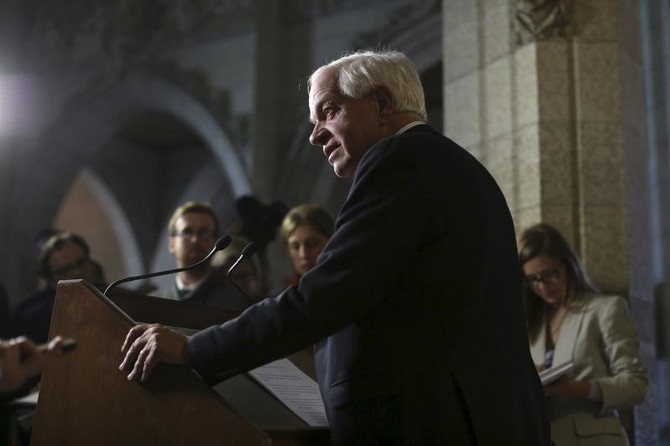
Canada government ends legal fight to ban niqab

North Korean leader Kim inspects new warship, claims progress toward nuclear-armed navy
- Kim has hailed the development of Choe Hyon as a significant advancement toward his goal of expanding the operational range and preemptive strike capabilities of his nuclear-armed military
SEOUL, South Korea: North Korean leader Kim Jong Un inspected his new destroyer for two straight days ahead of its commissioning and observed a test of cruise missiles fired from the warship, vowing to accelerate the nuclear-armament of his navy, state media said Thursday.
The North’s official Korean Central News Agency said Kim, during his visits to the western shipyard of Nampo on Tuesday and Wednesday, also inspected the construction of a third destroyer of the same class as his 5,000-ton warship, the Choe Hyon, first unveiled in April 2025.
Kim has hailed the development of Choe Hyon as a significant advancement toward his goal of expanding the operational range and preemptive strike capabilities of his nuclear-armed military. State media says the ship is designed to handle various weapons systems, including antiair and anti-naval weapons, as well as nuclear-capable ballistic and cruise missiles. South Korean military officials and experts say Choe Hyon was likely built with Russian assistance amid deepening military ties, but some have raised doubts about whether it’s ready for active service.
North Korea unveiled a second destroyer of the same class in May last year, but it was damaged during a botched launching ceremony at the northeastern port of Chongjin, triggering a furious reaction from Kim, who called the failure “criminal.” North Korea has said the new destroyer, named Kang Kon, was relaunched in June after repair, but outside experts have questioned whether the ship is fully operational.
After observing Choe Hyon’s sea trials on Tuesday, Kim said the ship met operational requirements and called it a symbol of the country’s expanding naval capabilities. He called for building two warships a year over the next five years of the same or higher class as the Choe Hyon.
Kim came back Wednesday to observe a test launch of cruise missiles from the Choe Hyon. State media published photos of him watching from shore as several projectiles rose from the vessel in plumes of white smoke and described the weapons as “strategic,” a term used for nuclear-capable systems.
After years of spurring ballistic missile development, Kim has shifted his focus more toward naval capabilities, including an ongoing construction of a nuclear-powered submarine. KCNA said the third destroyer under construction at the Nampo shipyard is expected to be completed by the ruling Workers’ Party’s founding anniversary in October.
Naval capabilities were also a key focus when Kim outlined his five-year military goals at last month’s Workers’ Party congress, which included calls for intercontinental ballistic missiles capable of being launched from underwater.
Kim on Tuesday claimed that his efforts to arm his navy with nuclear weapons were “making satisfactory” progress. He said those purported advancements would “constitute a radical change in defending our maritime sovereignty, something that we have not achieved for half a century.”
KCNA did not elaborate on what Kim meant. Some analysts say North Korea may be preparing to formally declare a maritime boundary that could encroach on waters controlled by rival South Korea.
As inter-Korean tensions worsen, Kim has repeatedly said he does not recognize the Northern Limit Line, drawn by the US-led UN Command at the end of the 1950-53 Korean War. The poorly drawn western sea boundary has been the site of several deadly naval clashes in past years.
At the party congress, Kim doubled down on plans to expand North Korea’s nuclear arsenal, which already is equipped with various weapons systems threatening the United States and US allies in Asia, and confirmed his hard-line view of rival South Korea.
But he left the door open for dialogue with the Trump administration, reiterating Pyongyang’s demand that Washington drop its insistence on denuclearization as a precondition for resuming long-stalled talks.


