MOSCOW: President Vladimir Putin on Friday suspended Russian air traffic with Egypt and ordered assistance in bringing Russian nationals home as investigators probe why one of its passenger jets crashed in the Sinai.
The dramatic decision came after Britain and the US said they suspected a bomb was responsible for Saturday’s air disaster in which an Airbus jet crashed in the Sinai Peninsula, shortly after taking off from the Red Sea resort of Sharm El-Sheikh.
All 224 people on board were killed, most of them Russian tourists.
Putin’s spokesman insisted that the decision did not mean that Russia believed the crash was caused by a deliberate attack, saying that “not one theory could dominate” until the investigation reports its results.
Putin’s order came shortly after the director of Russia’s FSB security service recommended halting flights to Egypt at the start of an emergency meeting of Russia’s anti-terrorist committee.
The head of Russia’s federal tourism agency Oleg Safonov told TASS state news agency that some 45,000 Russian tourists were currently estimated to be in Egypt.
An analysis of black boxes from the plane point to a bomb attack, sources close to the probe said Friday.
The flight data and voice recorders showed “everything was normal” until both failed at 24 minutes after takeoff, pointing to “a very sudden explosive decompression,” one source said. The data “strongly favors” the theory a bomb on board had brought down the plane, he added.
But US President Barack Obama said: “I think there is a possibility that there was a bomb on board and we are taking that very seriously,” while emphasizing it was too early to say for sure.
British and US spies intercepted “chatter” from suspected militants and at least one other government suggesting that a bomb, possibly hidden in luggage in the hold, downed the airliner, Western intelligence sources said. The sources said some of the assessment about the bomb came from intercepted communications both from suspected militants and from one or more governments involved in the investigation.
Two sources with knowledge of the matter said the bomb may have been hidden in luggage in the hold of the Russian plane.
Dutch airline KLM Friday banned checked luggage on an early flight from Cairo to Amsterdam.
Air France is stepping up security checks in Cairo and France is warning its citizens to limit travel around Egypt.
The Dutch foreign minister says his government’s decision to issue a negative travel advisory this week for Sharm El-Sheikh airport was linked to lax security.
Belgium is advising its nationals not to travel to Sharm El-Sheikh, until the reasons for the crash are determined.
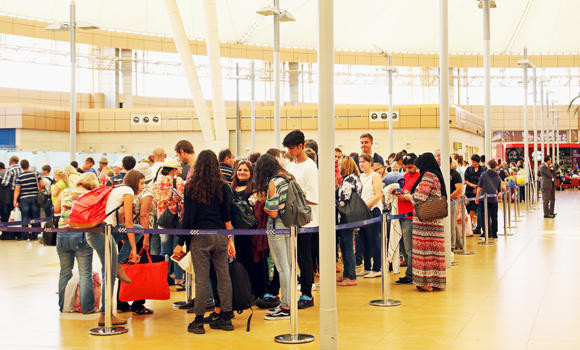
Exasperated British tourists who have waited for hours at the Sharm El-Sheikh airport heckled UK Ambassador John Casson after reports of more flight delays and cancellations. Planes began bringing back UK tourists but Egypt said only eight of 29 flights planned for Friday would operate.
Two Easyjet flights which left Egypt earlier landed in Britain on Friday.
Meanwhile, Moscow is outraged at a cartoon in the French weekly Charlie Hebdo mocking the Russian plane crash in Egypt.


![]()
Putin halts Egypt flights; 45,000 stranded
Putin halts Egypt flights; 45,000 stranded
Latest updates


© 2026 SAUDI RESEARCH & PUBLISHING COMPANY, All Rights Reserved And subject to Terms of Use Agreement.