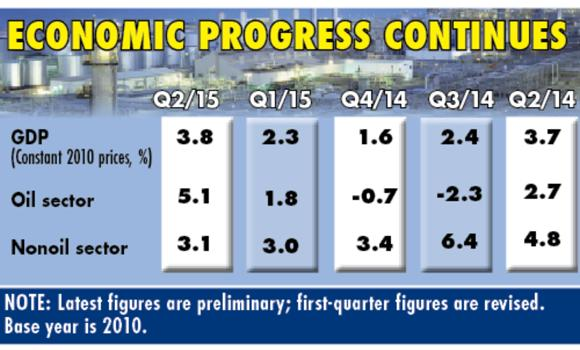
JEDDAH: Saudi Arabia’s gross domestic product (GDP) grew at its fastest pace in over a year at 3.79 percent during the second quarter of this year, reaching SR617.88 billion compared to SR595.31 billion for the same quarter of the previous year.
However, at current prices the GDP value fell by 11.93 percent to SR631.03 billion but the figure is still up from a revised 2.3 percent in the first quarter, according to a report by the Department of General Statistics and Information.
Commenting on the GDP figures, John Sfakianakis, Middle East director at Ashmore Group, told Arab News: “It is unlikely for the economy to maintain for the remainder two quarters growth of 3.8 percent. There would be a deceleration in growth especially as seasonal effects kick in such as the prolonged summer and Haj holidays in September. This would have an impact on the bottom line of business activity.”
He added: “The economy is coping well with cheaper oil prices. Oil prices have fallen by more than 50 percent yet economy has not decelerated by an equal amount. It is expected that the economy should grow by 3 percent this year which is not bad at all.”
The Saudi private sector recorded a rise in its value in real terms by 3.09 percent, and at current prices traded higher in value by 5.28 percent, rising to SR293.19 billion in the second quarter of this year, compared to SR278.49 billion in the corresponding quarter of the previous year.
Fahad M. Alturki chief economist and head of research at Jadwa Investment,said: “The Saudi growth is higher but dynamics of growth are different than last year. Oil sector takes the lead this time.”
He added: “Despite some moderation in the private sector, the nonoil sector continues to grow at a healthy rate compared to regional and emerging economies. We expect this growth to remain solid for the rest of the year.”
The Saudi Press Agency, quoting the statistics department report, said the electricity and gas activity and water witnessed the biggest increase among the activities of this sector, where the value at current prices increased by 11.20 percent compared with the corresponding period of the previous year. It said the value of gross domestic product of the oil sector decreased at current prices during the second quarter of this year by 39.07 percent, while its real value prices rose at the rate of 5.1 percent, compared with its value during the same period of the previous year.
Mohamed Ramady, senior adviser, Partner-Energy, said: “The Saudi economy will still remain hostage to the vagaries of oil prices and as these are expected to remain weak within the $45-$55 range for the rest of the year. Saudi oil GDP growth will be hard pushed to achieve an average growth rate of less than 4 percent with the nonoil sector dragging GDP down if the private sector confidence falters in the face of project cutbacks, cost savings and potential capital investment cuts in next year’s budget.”
However, he said: “Non-hydro carbon diversification is a must to sustain economic growth,”
The GDP of the government sector also achieved a rise in its value in real terms by 3.04 percent during the second quarter while its current prices increased by 22.6 percent, rising to SR138.03 billion compared to SR112.59 billion in the same period of the previous year.
The report showed that the value of oil exports at current prices decreased by 41.74 percent and the value of commodity imports at current prices fell by 9.64 percent compared with the corresponding period of the previous year.
Commenting on whether Saudi Arabia will maintain the current GDP growth for the rest of the year, London-based James Reeve, deputy chief economist and assistant general manager of Samba Financial Group, said: “No, it will not. The government is already slowing spending and is likely to cut investment spending in 2016. There is a very close correlation between nonoil growth and government spending.”

Saudi GDP growth accelerates to 3.8%
IMF approves $2.3bn for Egypt amid recovery, as lender reengages with Syria’s resurgent economy
RIYADH: The International Monetary Fund has approved the disbursement of $2.3 billion to Egypt following the completion of combined reviews under its Extended Fund Facility and Resilience and Sustainability Facility.
The lender announced on Feb. 25 that the funds, comprising about $2 billion under the EFF and $273 million under the RSF, will support the country’s ongoing stabilization efforts.
The approval extends Egypt’s 46-month EFF arrangement to Dec. 15, and brings total disbursements under the program to roughly $5.2 billion.
The move will bolster the engine of the Arab world’s third-largest economy. With a population exceeding 112 million and a nominal gross domestic product of roughly $400 billion, Egypt’s economic stability is crucial for the region.
The country’s consumer market and strategic position, anchored by the Suez Canal, make its fiscal health a leader for emerging markets in the Middle East and North Africa.
According to the IMF, Egypt’s macroeconomic landscape has shown marked improvement as policy measures take hold.
Real GDP growth accelerated to 4.4 percent in fiscal year 2024-2025, driven by a broad-based recovery. Inflation has cooled significantly to 11.9 percent as of January, supported by tight monetary and fiscal policies.
Nigel Clarke, IMF deputy managing director and chair, said: “The authorities’ stabilization measures continue to take effect. However, further progress on deeper reforms, particularly in divestment in non-strategic sectors and debt management, is needed to reduce risks to attaining key program objectives.”
The external position has also strengthened considerably. The current account deficit narrowed to 4.2 percent of GDP, buoyed by robust remittances and tourism revenues.
Market confidence has rebounded, evidenced by successful international bond issuances, foreign direct investment inflows, and record non-resident investments in domestic debt markets.
This has helped swell gross international reserves to approximately $59.2 billion as of December, up from $54.9 billion a year earlier.
The IMF noted that progress on deeper structural reforms has been “uneven.” While macroeconomic stability has improved, efforts to reduce the state’s economic footprint, particularly regarding the divestment of state-owned assets, have lagged behind targets.
Clarke emphasized the need for sustained domestic revenue mobilization, maintaining exchange rate flexibility, and decisive efforts to reduce state dominance to crowd in private investment and secure durable, inclusive growth.
Separately, the Washington-based lender said Syria’s economy is “continuing to recover” following a staff visit to Damascus, signaling deeper engagement with the country.
An IMF team led by Ron van Rooden visited the Syrian capital from Feb. 15 to 19 to assess the economic situation and discuss reform priorities. It was the latest in a series of intensive engagements as Syria reintegrates regionally following years of isolation.
“Activity has picked up further in recent months, supported by improved consumer and investor sentiment, the continuing return of refugees, increased electricity provision and rainfall, and Syria’s steady regional reintegration,” Rooden said in a statement.
Preliminary data indicate the central government budget ended 2025 with a small surplus, a feat attributed to prudent spending and the Ministry of Finance refraining from central bank financing, a significant shift from previous years.
Inflation has slowed to the “low double digits” by the end of 2025, supported by a tight monetary stance.
The IMF said that Syria has prepared a 2026 budget aimed at increasing spending on healthcare, education, and infrastructure rehabilitation. It stressed that while revenue targets are ambitious, the budget includes safeguards should financing fall short.
The fund agreed to an extensive technical assistance program to support Syria’s economic rehabilitation. This includes capacity building in public financial management, revenue mobilization, and banking sector supervision.
The IMF noted that improving statistics and economic governance could help “pave the way for the resumption of Article IV consultations with Syria,” the Fund’s regular health check of member economies, which have been suspended for years.
IMF staff will continue to work together with multilateral, regional, and bilateral donors to support the authorities’ capacity building efforts, Rooden added.