

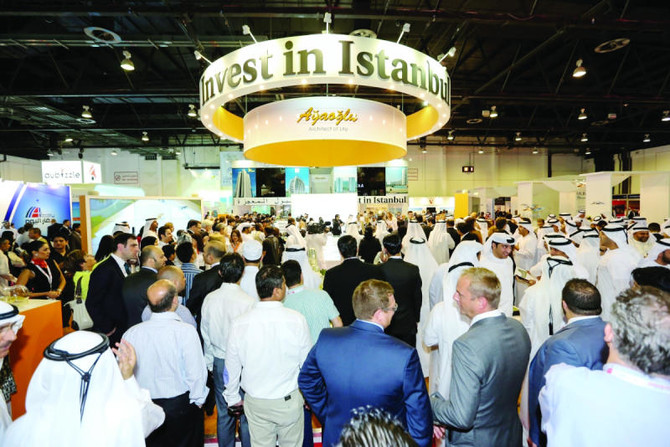
DUBAI: Turkey’s booming real estate sector remains a hotspot for GCC investors, as transactions made by foreign buyers continues to rise in the popular tourist destination.
According to data released by the Turkish Statistical Institute, the number of house sales to international investors increased 22 percent in the first half of 2015, compared to the same period last year.
This will be welcome news for the 50 Turkish exhibitors gearing up to showcase their latest developments at the Middle East’s largest and most influential property event next month, Cityscape Global.
Covering 4,200 sqm of exhibition space, Turkey represents the largest international pavilion at the three-day show, which takes place at Dubai World Trade Centre from Sept. 8-10.
Diana Dogan, head of research, CBRE Turkey, said: "In the second home holiday market, there has been a significant increase in private investors in the residential sector from the Middle East with activity firmly focused in the country’s northwest, particularly the Marmara Sea and Black Sea regions, as well as Istanbul, Bursa and Yalova.
“At the corporate investment level, this demand has in turn created a yet untapped potential opportunity to develop homes specifically tailored to the Arab market. The Turkish banking sector has seen the most active interest with Arab financial institutions looking to gain a foothold or expand their presence within Turkey’s lucrative banking industry.”
Due to the significant growth of Turkish participation in events across the Middle East, as well as numerous requests from Turkey’s largest developers, Cityscape Turkey will launch next year, taking place from March 24-26, at the Istanbul Congress Centre, near Taksim Square.
Wouter Molman, director of Cityscape Group, said: “Turkish participation has grown by 50 percent this year and there are no signs of it slowing down. In 2014, Gulf investors spent $4.3 billion in Turkish real estate, reaching a total investment influx of $16.29 billion over the past six years.
“With Istanbul and Mediterranean coastal cities proving popular with GCC investors due to their close links with the region both geographically and culturally, Cityscape Global is the perfect platform for foreign investors to learn about the market and see what new projects are currently available.”
Prominent developers, including Agaoglu, Dumankaya, Is Gyo, NEF, Garanti Koza, Kuzu Toplu, Piyalepasa, Vadistanbul, Ofton, DKY Insaat, Eroglu, Torunlar and many others will be hoping to capitalize on the influx of visitors from around at the world at the 14th edition of Cityscape Global.
Dumankaya Construction management believes its Horizon and Miks projects in the heart of Istanbul will be huge successes among the Arab community. Ugur Dumankaya, Board of Directors Chairman Dumankaya said: “Istanbul is an attractive real estate market for foreign investors. With its economic stability, social welfare, geographical position and return on investment all pointing in the right direction, buyers from around the world are flocking to take ownership of prime developments in the city and surrounding areas.
“Thirty percent of our total sales are to foreign investors, the majority from the Middle East and Gulf countries. Cityscape Global will enable us to reinforce our activities and competencies with our clients and widen our horizons.”
According to data released by Istanbul's Culture and Tourism Directorate, almost 20 percent of the seven million-plus visitors to Istanbul are Arab tourists, nearly doubling their market share from 10 percent of the total in 2010.
Fatih Erguven, managing partner at Reality Port Istanbul/ Emlakport Gayrimenkul Yatırım, another Turkish exhibitor at the event said: “Turkey's strategic location and favorable climate have made it an attractive hotspot for investors. In the last three years, real estate investment has become the center of attention for both domestic and overseas investors and it has now established itself as one of the leading real estate markets in the world.”
Continuing its strong international feel, participation from Chinese exhibitors has also grown at Cityscape Global, as thousands of visitors, investors and developers from around the world prepare to descend upon the show. Other countries represented include Canada, Egypt, Kuwait, Latvia, Nigeria, Portugal, Thailand, the UK and the United States.
Taking a new format this year, the Cityscape Global Conference will be staged the day before the exhibition at Conrad Hotel Dubai. The new format is expected to facilitate more than 800 senior real estate professionals and government officials who will explore opportunities and find solutions to key challenges affecting the industry today.
Also running in tandem with the exhibition is the Cityscape Awards for Emerging Markets. The awards program attracts hundreds of entries from developers and architects behind real estate developments across emerging markets globally. Winners will be announced at an elaborate ceremony taking place at the Conrad Hotel, Dubai on Sept. 8.
Cityscape Global 2015 returns with support from Dubai Land Department and Foundation Partners Emaar Properties, Dubai Properties and Nakheel; Gold Sponsor Arma Properties; Garanti Koza and Al-Marjan Island; Silver Sponsor Sobha LLC; District Operator Sponsor Ejadah Asset Management; Project Marketing Sponsor Aqua Properties and Property Registration Trustee Partner Tamleek Property Transfer.


