ABU DHABI: The UAE Ministry of Interior, represented by the Naturalization, Residency and Ports Sector, has launched an online service to allow GCC residents and their escort to get their UAE entry permits (visas) via the various ports across the country, through the “Fawri” portal on the ministry’s website www.moi.gov.ae.
These measures are in line with the Ministerial Decree No. 377 of 2014, and in accordance with the required conditions and procedures.
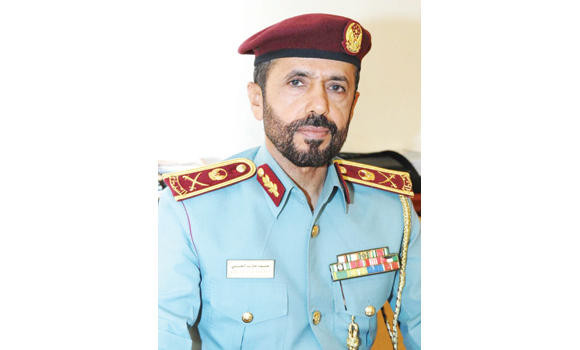
Major General Khalifa Hareb Al-Khaili, assistant undersecretary of the Ministry of Interior for Naturalization, Residency and Ports, indicated that the new service comes in line with the Ministry of Interior’s keenness to keep pace with technology advances in order to expedite passenger movement at the various ports and streamline the visa issuance procedure for passengers before arriving to the country, ultimately save time and effort for travelers.
He said: “The Naturalization, Residency and Ports Sector constantly seeks to elaborate an advanced method to further keep pace with the development and progress witnessed by the UAE in all areas. ”
He also said that additional smart solutions will be rolled out in the future, in order to provide distinguished services that exceed customers’ expectations in record time and in accordance with the highest advanced standards.
Major General Al-Khaili added: “Launching the online visa issuance service for GCC residents and their escort is a paradigm shift in upgrading services’ efficiency, within an integrated strategy toward smart transformation of services and ensure their availability through the Ministry of Interior’s website and smart phones.”
He added: “This approach is in line with the vision of the government aimed at upgrading services provided to the public and empowering the concept of fast, high-quality services.”
For his part, Lt. Col. Matar Kharbash, head of E-services Department at the Naturalization, Residency and Ports Affairs sector, head of the team supporting smart e-transition at the Naturalization, Residency and Ports Sector, stressed the the Interior Ministry’s diligent pursuit to develop smart e-services so as to enhance public satisfaction while maintaining a high level of professionalism that exceeds all expectations in various police sectors in the country.
This is in line with the smart government initiative aimed at increasing and boosting awareness of government entities about the benefits of mobile phone services and the need to implement the optimal techniques in the provision of government services to improve performance, based on the creativity and innovation factors and consistent with the need to cater to the requirements of all society segments and achieve their aspirations.
Major General Al-Khaili also pointed out that the visit visa is issued at the various ports in the country, in accordance with Article 42 for GCC expats (not obtaining a prior visa or permission), allows him to enter into the territory of the country if he belongs to any of the following categories:
l Businessmen, investors, partners, and company managers and representatives;
l Accountants, Auditors, doctors, engineers, lawyers and legal advisers;
l Public sector workers other than workers and laborers;
l Family members of the above-mentioned individuals or entities and their escort, namely the helpers, and individuals sponsored by them;
l Foreign family members of GCC nationals, their sponsored helpers and escorts;
l GCC truck drivers transporting goods from any of the GCC countries. They are required to submit a sponsor’s letter of no objection (NOC) from the sponsoring entity in the country of issuance;
l Sponsored of citizens who have residence permits in GCC countries.

Online UAE visa service for GCC residents to boost trade
Using space science to protect Saudi Arabia’s environment
- Kingdom is harnessing satellite technology to forecast disasters, boost agriculture
RIYADH: Learning space science has delivered significant environmental benefits worldwide, helping many countries better understand and manage climate challenges.
Saudi Arabia is now taking steps not only to explore the galaxy but also to invest in future generations who can apply space science to pressing environmental issues at home.
Last November, the Space Academy, part of the Saudi Space Agency, launched a series of seminars designed to enhance knowledge and develop skills in space science and technology, with a particular focus on Earth observation.
Running for nearly a month, the program formed part of a broader strategy to nurture national talent, raise scientific awareness, and build data capabilities that support innovation and research across the Kingdom.
As efforts to strengthen the sector continue, important questions remain: How can space science translate into tangible environmental benefits? And how large is the global space economy?
In an interview with Arab News, Fahad Alhussain, co-founder of SeedFord, highlighted the scale of the opportunity and its environmental impact.
“To be frank, the slogan that we always use in space is that ‘saving the Earth from the space.’ It is all about this,” Alhusain told Arab News.
“You can recall a lot of related environmental issues like global warming, related to forests, related to the damage that happens to the environment. Without space, it would be almost impossible to see the magnitude of these damages.”
According to Alhussain, satellites have transformed how experts observe environmental changes on Earth, offering a comprehensive view that was previously impossible.
He said that “the transformation of technology allows even the non-optical ways of measuring, assessing, and discovering what is going on in the environment … you can even anticipate fire before it happens in the forest.”
“You can detect the ice-melt down, you can get huge amount of information and can see it through the weather maps…there is a huge section in the economy for the environment,” Alhussain commented.
A 2022 report by Ryan Brukardt, a senior partner at McKinsey & Company, published by McKinsey Quarterly, found that more than 160 satellites currently monitor Earth to assess the impacts of global warming and detect activities such as illegal logging.
Brukardt cited NASA as an example of how advanced satellite tools are used to track environmental changes, including shifts in ocean conditions, cloud cover, and precipitation patterns. He also noted that satellite data can help governments determine when immediate action is needed, particularly in response to wildfires.
FASTFACT
Did You Know?
- Satellites collect massive amounts of data, and AI is used to help interpret this information more efficiently and predict future outcomes.
- The global space economy surpassed $600 billion in 2024 and is projected to exceed $1 trillion by 2030.
- Saudi Arabia has established three key entities: the Supreme Space Council, the Saudi Space Agency, and the Communications, Space, and Technology Commission.
Beyond disaster response, satellites offer vital insights for agriculture. According to Brukardt’s report, scientists can use space-based data to monitor crop development and anticipate threats to harvests, such as drought or insect infestations.
These wide-ranging applications explain the rapid growth of the global space economy.
According to World Economic Forum research, the sector is projected to reach $1.8 trillion by 2035, nearly tripling from $630 billion in 2023.
For Saudi Arabia, expanding space science capabilities could help address the country’s arid conditions by monitoring desertification and identifying sources of air pollution. Early detection of droughts, heatwaves, and crop stress could support more effective environmental planning and response.
Space-based data could also play a critical role in tracking environmental changes in the Red Sea and surrounding coastal ecosystems, strengthening marine conservation efforts and supporting the Sustainable Development Agenda.
As Alhussain emphasized, advancing knowledge in space science and satellite technology enables experts to measure environmental damage accurately and predict disasters before they occur, allowing for more effective responses.

By investing in space science education and research, the Kingdom can build national expertise, strengthen environmental protection policies, enhance food and water security, and contribute to global efforts to combat climate change—while also benefiting from the rapidly expanding space economy.
Ultimately, a deeper understanding of space and its applications offers Saudi Arabia, and the world, better tools to anticipate climate challenges, protect ecosystems, and safeguard biodiversity.
“By collecting data and using satellites, you can better analyze and measure so many things that help the environment,” said Alhussain.
“There will be patterns where you can warn people, scientists and decision makers to do something about it.”