System to monitor health of Red Sea

Updated 11 June 2015
Follow

System to monitor health of Red Sea

JEDDAH: A top environmental body based here has launched a high-tech system that will monitor the health of the Red Sea.

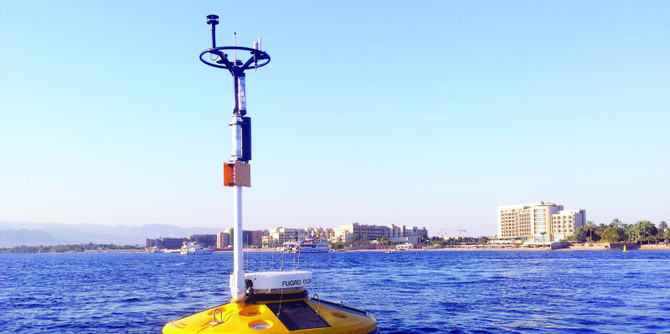
The Regional Organization for the Conservation of the Environment of the Red Sea and Gulf of Aden (PERSGA) set up the first phase of the project in Aqaba, Jordan, with plans to complete it in five years.
The station would supply environmental data on the northern part of the Red Sea. It would be the nucleus of a regional network along the Red Sea and Gulf of Aden, said Ziad Abu Gharara, secretary general of the PERSGA.
Abu Gharara said the solar-powered system has been installed on a floating platform 200 meters off the coast in an area where the water is 25 meters deep. It records water levels, physical and chemical characteristics of the sea, and radiation levels in the water and air.
It would also record the height of waves and other factors related to global climate change. The data would also be displayed publicly to visitors and residents on a screen installed in the city center, he said.
Abu Gharara said this was a major development in environmental protection and would enable decision makers and scientists in the region to take speedy and appropriate action if serious problems are detected.
The PERSGA is an intergovernmental body dedicated to the conservation of the coastal and marine environments in the Red Sea, Gulf of Aqaba, Gulf of Suez, Suez Canal, and Gulf of Aden surrounding the Socotra Archipelago and nearby waters. The PERSGA’s member states are Djibouti, Egypt, Jordan, Saudi Arabia, Somalia, Sudan and Yemen.
The organization was formally set up in September 1995 after the signing of the Cairo Declaration. It is an affiliate of the Arab League and recognized as one of the leading marine conservation organizations operating in the Red Sea region.


Saudi Arabia, Estonia strengthen cyber defense cooperation

Updated 09 February 2026
Follow

Saudi Arabia, Estonia strengthen cyber defense cooperation

  • Renowned for its leadership in digital governance, Estonia sees cybersecurity as central to its partnership potential with Saudi Arabia, building on years of regional engagement through its technology firms

RIYADH: Estonia aims to deepen defense, cybersecurity, and artificial intelligence cooperation with Saudi Arabia as both nations look to advance technology‑driven defense and cybersecurity capabilities.

Hanno Pevkur, Estonia’s minister of defense, told Arab News at the World Defense Show in Riyadh on Monday that Estonia’s defense industry is eager to contribute to the Kingdom’s fast‑growing defense ecosystem.

“In the modern world, cooperation built on trust and technology is the best defense,” he said. “It is important for us to be here because we clearly see there is a possibility to increase cooperation, not only bilaterally between Saudi Arabia and Estonia, but across the region.”

At Estonia’s pavilion, a cooperation agreement was signed between an Estonian company and a Saudi firm during the show, he noted.

Pevkur also said Estonia’s defense sector has expanded rapidly in recent years, driven by technological innovation and partnership.

“Our defense industry is growing very rapidly, and we continue to see strong momentum,” he said.

He said Estonia’s strengths lie in digital and smart‑system integration rather than large‑scale weapons production.

“We will not build airplanes or tanks, but what we can do is integrate robotics, automation and drones to make existing systems smarter,” he said.

The minister said effective defense collaboration must link businesses and governments to achieve meaningful results.

“When we want to have real cooperation, we need it on all levels,” he said. “The biggest client for any defense company is the government, so we must treat this as one ecosystem where the public and private sectors work hand in hand.”

Renowned for its leadership in digital governance, Estonia sees cybersecurity as central to its partnership potential with Saudi Arabia, building on years of regional engagement through its technology firms.

Pevkur said several Estonian companies, including Nortal, have already assisted Gulf governments in developing open IT and digital‑service systems.

“As the most digitalized nation in the world, almost every service in Estonia can be done online, except getting married,” he said. “But with such digitalization, we also need strong cyberdefense.”

He said data protection and digital resilience are treated as matters of national sovereignty in Tallinn, the capital of Estonia.

“Data is what we own. When someone steals that data, it becomes a serious threat,” he added. “That is why cyberdefense is not just about technology, it is about trust, sovereignty and protection.”

Pevkur said Saudi Arabia’s advances in AI offer promising opportunities for collaboration.

“I know that Saudi Arabia is doing great work when it comes to AI,” he said. “For us, as a small country with limited human resources, AI is essential not just for defense but for everyday life.”

Pevkur added that Estonia has launched a national AI strategy to promote responsible development and closer coordination between government and industry. One Estonian company, he said, has developed a system that allows a single operator to control hundreds of drones through AI.

“It is quite easy to put a weapon into the hands of a robot, but we also need to define who is accountable for its actions,” he said.

“The big question for the future is whether we can allow a war to be fought entirely by AI, or if humans must always make the final ethical decisions.”

He said in his conclusion that governments must reach a common understanding on how AI will be used and regulated on the battlefield.