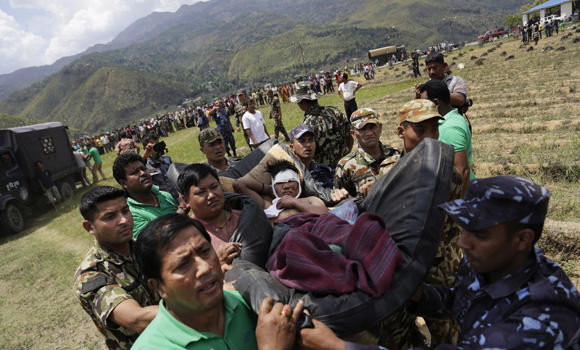
KATMANDU: Shelter, fuel, food, medicine, power, news, workers — Nepal’s earthquake-hit capital was short on everything Monday as its people searched for lost loved ones, sorted through rubble for their belongings and struggled to provide for their families’ needs. In much of the countryside, it was worse, though how much worse was only beginning to become apparent.
The death toll soared past 3,700, even without a full accounting from vulnerable mountain villages that rescue workers were still struggling to reach two days after the disaster.
Udav Prashad Timalsina, the top official for the Gorkha district, where Saturday’s magnitude 7.8 quake was centered, said he was in desperate need of help.
“There are people who are not getting food and shelter. I’ve had reports of villages where 70 percent of the houses have been destroyed,” he said.
Aid group World Vision said its staff members were able to reach Gorkha, but gathering information from the villages remained a challenge. Even when roads are clear, the group said, some remote areas can be three days’ walk from Gorkha’s main disaster center.
Some roads and trails have been blocked by landslides, the group said in an e-mail to The Associated Press. “In those villages that have been reached, the immediate needs are great including the need for search and rescue, food items, blankets and tarps, and medical treatment.”
Timalsina said 223 people had been confirmed dead in Gorkha district but he presumed “the number would go up because there are thousands who are injured.” He said his district had not received enough help from the central government, but Jagdish Pokhrel, the clearly exhausted army spokesman, said nearly the entire 100,000-soldier army was involved in rescue operations.
“We have 90 percent of the army out there working on search and rescue,” he said. “We are focusing our efforts on that, on saving lives.”
Saturday’s magnitude 7.8 earthquake spread horror from Katmandu to small villages and to the slopes of Mount Everest, triggering an avalanche that buried part of the base camp packed with foreign climbers preparing to make their summit attempts.
Aid is coming from more than a dozen countries and many charities, but Lila Mani Poudyal, the government’s chief secretary and the rescue coordinator, said Nepal needed more.
He said the recovery was also being slowed because many workers — water tanker drivers, electricity company employees and laborers needed to clear debris — “are all gone to their families and staying with them, refusing to work.”
“We are appealing for tents, dry goods, blankets, mattresses, and 80 different medicines that the health department is seeking that we desperately need now,” Poudyal told reporters. “We don’t have the helicopters that we need or the expertise to rescue the people trapped.”
As people are pulled from the wreckage, he noted, even more help is needed.
“Now we especially need orthopedic (doctors), nerve specialists, anaesthetists, surgeons and paramedics,” he said. “We are appealing to foreign governments to send these specialized and smart teams.”
More than 6,300 people were injured in the quake, he said, estimating that tens of thousands of people had been left homeless. “We have been under severe stress and pressure, and have not been able to reach the people who need help on time,” he said.
Nepal police said in a statement that the country’s death toll had risen to 3,617 people. That does not include the 18 people killed in the avalanche, which were counted by the mountaineering association. Another 61 people were killed in neighboring India, and China reported 20 people dead in Tibet.
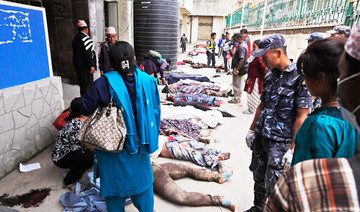
Well over 1,000 of the victims were in Katmandu, the capital, where an eerie calm prevailed Monday.
Tens of thousands of families slept outdoors for a second night, fearful of aftershocks that have not ceased. Camped in parks, open squares and a golf course, they cuddled children or pets against chilly Himalayan nighttime temperatures.
They woke to the sound of dogs yelping and jackhammers. As the dawn light crawled across toppled building sites, volunteers and rescue workers carefully shifted broken concrete slabs and crumbled bricks mixed together with humble household items: pots and pans; a purple notebook decorated with butterflies; a framed poster of a bodybuilder; so many shoes.
“It’s overwhelming. It’s too much to think about,” said 55-year-old Bijay Nakarmi, mourning his parents, whose bodies recovered from the rubble of what once was a three-story building.
He could tell how they died from their injuries. His mother was electrocuted by a live wire on the roof top. His father was cut down by falling beams on the staircase.
He had last seen them a few days earlier — on Nepal’s Mothers’ Day — for a cheerful family meal.
“I have their bodies by the river. They are resting until relatives can come to the funeral,” Nakarmi said as workers continued searching for another five people buried underneath the wreckage.
Katmandu district chief administrator Ek Narayan Aryal said tents and water were being handed out Monday at 10 locations in Katmandu, but that aftershocks were leaving everyone jittery. The largest, on Sunday, was magnitude 6.7.
“There have been nearly 100 earthquakes and aftershocks, which is making rescue work difficult. Even the rescuers are scared and running because of them,” he said.
“We don’t feel safe at all. There have been so many aftershocks. It doesn’t stop,” said Rajendra Dhungana, 34, who spent Sunday with his niece’s family for her cremation at the Pashuputi Nath Temple.
Acrid, white smoke rose above the Hindu temple, Nepal’s most revered. “I’ve watched hundreds of bodies burn,” Dhungana said.
The capital city is largely a collection of small, poorly constructed brick apartment buildings. The earthquake destroyed swaths of the oldest neighborhoods, but many were surprised by how few modern structures collapsed in the quake.
On Monday morning, some pharmacies and shops for basic provisions opened while bakeries began offering fresh bread. Huge lines of people desperate to secure fuel lined up outside gasoline pumps, though prices were the same as they were before the earthquake struck.
With power lines down, spotty phone connections and almost no Internet connectivity, residents were particularly anxious to buy morning newspapers.
Pierre-Anne Dube, a 31-year-old from Canada, has been sleeping on the sidewalk outside a hotel. She said she’s gone from the best experience of her life, a trek to Everest base camp, to the worst, enduring the earthquake and its aftermath.
“We can’t reach the embassy. We want to leave. We are scared. There is no food. We haven’t eaten a meal since the earthquake and we don’t have any news about what’s going on,” she said.
The earthquake was the worst to hit the South Asian nation in more than 80 years. It and was strong enough to be felt all across parts of India, Bangladesh, China’s region of Tibet and Pakistan. Nepal’s worst recorded earthquake in 1934 measured 8.0 and all but destroyed the cities of Katmandu, Bhaktapur and Patan.
The quake has put a huge strain on the resources of this impoverished country best known for Everest, the highest mountain in the world. The economy of Nepal, a nation of 27.8 million people, relies heavily on tourism, principally trekking and Himalayan mountain climbing.
___
Associated Press writers Muneeza Naqvi and Tim Sullivan in New Delhi contributed to this report.


![]()
Quake-aid need acute in Nepal; toll still soaring
Quake-aid need acute in Nepal; toll still soaring
Related


Latest updates


Recommended


© 2026 SAUDI RESEARCH & PUBLISHING COMPANY, All Rights Reserved And subject to Terms of Use Agreement.