PESHAWAR: Pakistani children returned on Monday to the school where Taleban gunmen killed 150 of their classmates and teachers last month.
The children clutched their parents’ hands tightly in a poignant symbol of perseverance despite the horrors they had endured.
The Dec. 16 attack on the Army Public School in Peshawar claimed the lives of 150 people, mostly children, and prompted a bout of national soul-searching even in a country used to high levels of violence.
Across the country, schools had remained shut for an extended winter break as authorities strengthened security and announced new measures including the death penalty to combat insurgents.
Most reopened Monday along with the army school in the northwestern city.
For 16-year-old Shahrukh Khan, who was shot in both legs while pretending to play dead in his school’s auditorium, going back was traumatic.
“I have lost 30 of my friends. How will I sit in the empty class, how will I look toward their empty benches?” he told AFP before the school reopened.
“My heart has been broken. All the class fellows I had, have died. Now my heart does not want to attend school,” he added.
At least 20 soldiers were seen at the main entrance of the Army Public School, with an airport-style security gate installed at the front.
Elevated boundary walls with steel wire fencing have been put in place in some schools around Peshawar and nationwide.
Raheel Sharif, the head of Pakistan’s powerful army, made an unannounced visit with his wife, greeting and hugging students dressed in green blazers.
Parents spoke of having to sit down with their children and mentally prepare them for their return to the school, which has undergone a complete renovation to remove all traces of the bloody attack.
“He was terrified but we talked him up. We cannot keep him imprisoned between four walls and we must stand against militancy,” Muhammad Zahoor said as he walked his son along the city’s main Warsak Road.
“I want to go to school to see my friends. I will join the army after my schooling and will take revenge,” said Muhammad Zaid, his son.
Of the 150 victims killed in Pakistan’s deadliest-ever militant attack, 134 were children.
Survivors recounted Taleban gunmen moving from room to room hunting for students and teachers. Sometimes the militants toyed with them and pretended they would let them go, before lining them up and shooting them in front of their peers.
Like Muhammad Zaid, many struck a defiant note.
“I am not scared. No force can stop me from going to attend my school. I will go and will tell the attackers, ‘We are not afraid of you’,” 16-year-old Zahid Ayub, who sustained minor wounds, told AFP.
A teacher said rows of empty seats, especially in the 9th and 10th grade classes, had made the first day back at school a surreal experience.
“Students were greeting each other and saying ‘You’re alive?’ They were taking their parents to different spots and explaining to them where they were during the time of the attack and how it happened,” he said, on condition of anonymity.
“Photographs of the martyred are pasted on a noticeboard in the school. Students and teachers were placing flowers in front of it and weeping,” he added.
Parents across Pakistan spoke of their fears in what was widely seen as a key moment for the country.
“Driving to school in the light of a quietly subdued rising sun. There’s a kind of stillness in the air. It sounds like a million mothers saying a silent prayer as they drop their babies to school. Stay safe. Stay safe,” wrote Saima Jamil Ashraf, a parent in Karachi, on Instagram.
Pakistan has strengthened its offensive against the Taleban since the Peshawar attack, ending its six-year-old moratorium on the death penalty in terror cases.
It plans to set up nine military courts to hear terrorism-related cases, prompting concern from rights groups who believe the army will use the crisis to wrest more powers from civilian authorities.
The country’s liberals have held protests to pressure the government into arresting clerics who praise the Taleban, and into cracking down on sectarian and anti-India militant groups who operate with relative impunity.
It was the first time the school had reopened since the assault and security was tight. The nation has been reeling from the Dec. 16 terrorist attack in Peshawar, one of the worst Pakistan has experienced. The violence carried out by seven Taleban militants put a spotlight on whether the authorities can end the stubborn insurgency that kills and maims thousands every year.
The massacre also horrified parents across the nation and prompted officials to implement tighter security at schools.
For Peshawar parents like Abid Ali Shah, Monday morning was especially painful as he struggled to get his sons ready for school, something his wife used to do. She was a teacher at the school and was killed in the violence. Both of his sons attended the school. The youngest was shot in the head but survived after the militants thought he was dead.
“A hollowness in my life is getting greater. I am missing my wife,” Shah said. He said he had wanted to shift his children to a different school or city but decided not to because they still have to take exams this spring: “Everything is ruined here, everything.”
His older son, Sitwat Ali Shah, 17, said it wasn’t until he saw his brother break down in tears as they prepared to go to school that he did as well. Sitwat said both he and his brother have trouble sleeping and often wake up, crying for their mother.
“Those who have done all this to all of us cannot be called humans,” Sitwat said, adding he still wanted to go back to school and become an air force officer.
A ceremony was held at the school to mark its reopening, but classes were to restart on Tuesday. Security was tight, part of a countrywide effort to boost safety measures at schools in the wake of the attack. Schools around Pakistan have raised their boundary walls, added armed guards and installed metal detectors, although many have questioned why it took such a horrible attack to focus attention on school safety.
The government has stepped up military operations in the tribal areas, reinstated the death penalty and allowed military courts to try civilians — all attempts to crack down on terrorism. But in an attack on Monday, gunmen killed seven paramilitary soldiers in the southwestern Baluchistan province, underscoring the dangers the country still faces.
In Peshawar, media and vehicles were kept hundreds of meters (yards) away from the Army Public School, which had coils of barbed wire freshly installed on top of the compound’s walls, and two helicopters circled overhead. The chief of Pakistan’s army, Gen. Raheel Sharif, was on hand with his wife to greet and console the students.
Some women brought garlands of flowers and draped them around the children. Passages from the Quran were read and the national anthem was sung while parents, students and teachers were given a pamphlet about the psychological impact of terror attacks on children.
On social media, some Pakistanis questioned why top government officials were not at the ceremony.
Teacher Andleeb Aftab, who lost her 10th grade son, Huzaifa, in the attack, came in a black dress and head scarf, walking to the place where she had last seen her son alive. She said she chose to go back to school rather than sit at home and keep mourning.
“I have come here because the other kids are also my kids,” she said. “I will complete the dreams of my son, the dreams I had about my son, by teaching other students.”
On Sunday night, 15-year-old Ahmed Nawaz said he is still in constant pain and being treated for his badly wounded left arm but that he was determined to go back.
For the militants, he said he had one message: “We are not scared of you.” But in many families, apprehension mixed with anger. Aurangzeb Khan lost his 16-year-old son in the attack while his other son survived.


![]()
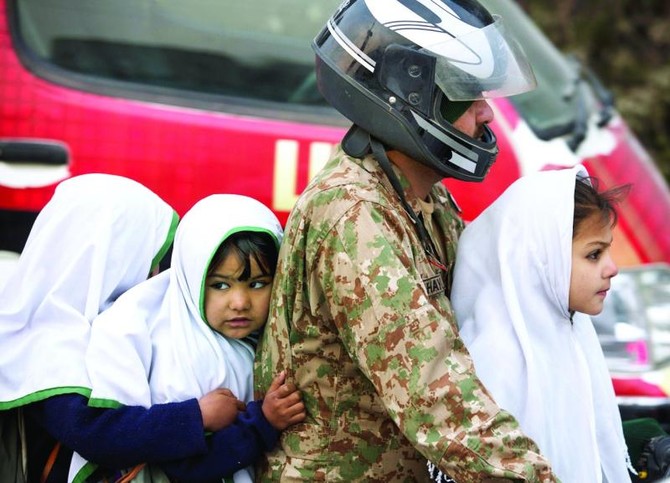
Defying terror, students return to Peshawar school
Defying terror, students return to Peshawar school
Latest updates




© 2026 SAUDI RESEARCH & PUBLISHING COMPANY, All Rights Reserved And subject to Terms of Use Agreement.