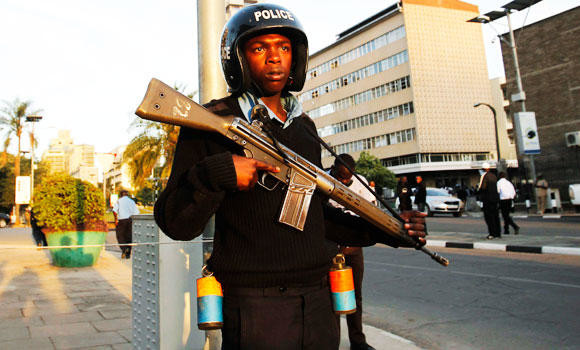
NAIROBI: The son of Kenya’s main opposition leader Raila Odinga was found dead Sunday in his home near Nairobi, prompting a major police investigation and minor unrest in the capital, police and media reports said.
Police said Fidel Odinga, 41, who was seen by political observers as a potential successor to his father, returned home on Saturday night after an evening out drinking with friends and was found dead in his bed on Sunday.
“The death... is being treated as unexplained,” a Kenyan detective said on condition he not be named.
Condolence messages were immediately sent to Raila Odinga by President Uhuru Kenyatta and Vice President William Ruto, Capital FM news said.
Odinga, a former prime minister, leads the opposition Coalition for Reforms and Democracy (CORD) and is an outspoken critic of Kenyatta’s government. Last month he spearheaded a challenge of controversial anti-terror laws.

Son of Kenyan opposition leader found dead at home
Argentine lawmakers approve historic labor reform promoted by President Javier Milei
BUENOS AIRES: Argentine President Javier Milei scored a crucial victory in congress Friday with the approval of a sweeping labor reform aimed at radically altering labor relations in the South American country.
With 42 votes in favor, 28 against and two abstentions, the Senate passed the government-backed initiative into law. The reform seeks to modernize labor relations, lower labor costs and limit the historical power of unions.
“Historic! We have a labor modernization,” Milei said after the overhaul was approved.
Shortly before the debate began in Argentina’s upper house, clashes broke out between police and protesters participating in a demonstration organized by unions, opposition political groups and left-wing social organizations outside the Parliament building to oppose the reform. At least three people were arrested.
The bill, which grants employers greater flexibility in matters of hiring, firing, severance and collective bargaining, has drawn fierce opposition from critics who argue it would roll back measures that protect workers from abuse and Argentina’s notoriously frequent economic shocks.
“It makes me incredibly angry. Passing a law is one thing, but implementing it is another,” said Ariel Somer, a 48-year-old railway worker protesting near Congress. “In Argentina, progress only happens when workers organize. We will find ways to resist.”
Supported by allies of the ruling La Libertad Avanza party, the initiative’s approval would provide Milei with a major legislative victory. He could then showcase these profound economic reforms during his Sunday address at the opening of the ordinary sessions of Congress.
The legislation won initial support from the Senate last week, but must go back for a final vote before becoming law. The government was forced to amend a clause that halves salaries for workers on leave because of injury or illness unrelated to work, after an outcry from opposition lawmakers.
The Senate on Friday may either accept the amendment — marking the final passage of the law — or insist on the original text to reinstate the article. The former outcome is widely anticipated.
The legislative process has been fraught with tension between the governing party and the opposition. The friction boiled over last week during the bill’s debate in the lower house of Congress, as the General Confederation of Labor — Argentina’s largest trade union group — launched a 24-hour nationwide strike, while demonstrators from various leftist groups clashed with police outside Congress.
Milei considers the changes to Argentina’s half-century-old labor code crucial to his efforts to lure foreign investment, increase productivity and boost job creation in a country where about two in five workers are employed off the books.
Unions argue that the law will weaken the workers’ protections that have defined Argentina since the rise of Peronism, the country’s dominant populist political movement, in the 1940s.
Roughly 40 percent of Argentina’s 13 million registered workers belong to labor unions, according to union estimates, and many are closely allied with Peronism.
With 42 votes in favor, 28 against and two abstentions, the Senate passed the government-backed initiative into law. The reform seeks to modernize labor relations, lower labor costs and limit the historical power of unions.
“Historic! We have a labor modernization,” Milei said after the overhaul was approved.
Shortly before the debate began in Argentina’s upper house, clashes broke out between police and protesters participating in a demonstration organized by unions, opposition political groups and left-wing social organizations outside the Parliament building to oppose the reform. At least three people were arrested.
The bill, which grants employers greater flexibility in matters of hiring, firing, severance and collective bargaining, has drawn fierce opposition from critics who argue it would roll back measures that protect workers from abuse and Argentina’s notoriously frequent economic shocks.
“It makes me incredibly angry. Passing a law is one thing, but implementing it is another,” said Ariel Somer, a 48-year-old railway worker protesting near Congress. “In Argentina, progress only happens when workers organize. We will find ways to resist.”
Supported by allies of the ruling La Libertad Avanza party, the initiative’s approval would provide Milei with a major legislative victory. He could then showcase these profound economic reforms during his Sunday address at the opening of the ordinary sessions of Congress.
The legislation won initial support from the Senate last week, but must go back for a final vote before becoming law. The government was forced to amend a clause that halves salaries for workers on leave because of injury or illness unrelated to work, after an outcry from opposition lawmakers.
The Senate on Friday may either accept the amendment — marking the final passage of the law — or insist on the original text to reinstate the article. The former outcome is widely anticipated.
The legislative process has been fraught with tension between the governing party and the opposition. The friction boiled over last week during the bill’s debate in the lower house of Congress, as the General Confederation of Labor — Argentina’s largest trade union group — launched a 24-hour nationwide strike, while demonstrators from various leftist groups clashed with police outside Congress.
Milei considers the changes to Argentina’s half-century-old labor code crucial to his efforts to lure foreign investment, increase productivity and boost job creation in a country where about two in five workers are employed off the books.
Unions argue that the law will weaken the workers’ protections that have defined Argentina since the rise of Peronism, the country’s dominant populist political movement, in the 1940s.
Roughly 40 percent of Argentina’s 13 million registered workers belong to labor unions, according to union estimates, and many are closely allied with Peronism.
© 2026 SAUDI RESEARCH & PUBLISHING COMPANY, All Rights Reserved And subject to Terms of Use Agreement.