BANDA ACEH, Indonesia: Crying onlookers took part in beachside memorials and religious services across Asia on Friday to mark the 10th anniversary of the Indian Ocean tsunami that left more than a quarter million people dead in one of modern history’s worst natural disasters.
The devastating Dec. 26, 2004, tsunami struck a dozen countries around the Indian Ocean rim, killing 230,000 people. It eradicated entire coastal communities, decimated families and crashed over tourist-filled beaches the morning after Christmas. Survivors waded through a horror show of corpse-filled waters.
As part of Friday’s solemn commemorations, survivors, government officials, diplomats and families of victims gathered in Indonesia, Thailand, Sri Lanka, India and elsewhere. Moments of silence were planned in several spots to mark the exact time the tsunami struck, a moment that united the world in grief.
“I cannot forget the smell of the air, the water at that time ... even after 10 years,” said Teuku Ahmad Salman, a 51-year-old resident who joined thousands of people in a prayer service in Banda Aceh, Indonesia.
“I cannot forget how I lost hold of my wife, my kids, my house,” he said sobbing, recounting that he refused to believe for years that they had died but finally gave up looking for them.
The disaster was triggered by a magnitude-9.1 earthquake, the region’s most powerful in 40 years, that tore open the seabed off of Indonesia’s Sumatran coast, displacing billions of tons of water and sending waves roaring across the Indian Ocean at jetliner speeds as far away as East Africa.
Indonesia’s Aceh province, which was closest to the quake’s epicenter, was hit first and hardest. Initially, the quake toppled homes and buildings and sent panicked communities rushing into the streets. About 20 minutes later, a wall of water up to 10 meters (33 feet) high surged inland for kilometers (miles) with seemingly unstoppable force, carrying along trees, houses, train cars — and thousands of people — in a churning rush.
More than 170,000 people died in Indonesia alone, more than three-quarters of total death toll.
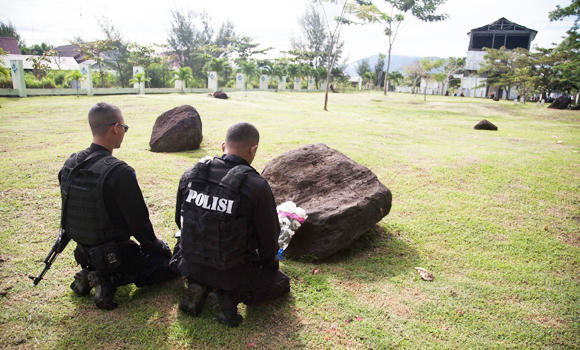
Indonesian Vice President Jusuf Kalla led a prayer ceremony in Banda Aceh, the capital of Aceh province, on Friday. He and other officials placed flowers at a mass grave where thousands of unknown tsunami victims were buried. A separate event was held to thank ambassadors from the many foreign countries that helped Aceh recover after the disaster.
“Here in this field 10 years ago ... we tearfully saw thousands of corpses lying,” Kalla said. “No words can describe our human feelings at that time — confused, shocked, sad, scared — in seeing the suffering of the people in Aceh. But we could not remain in sadness, Aceh had to rise again, and all Indonesians in this archipelago helped, people all over the world offered their assistance.”
“In this moment, we also say thanks to the world, which has helped Aceh from the post-disaster condition 10 years ago,” he said.
In Thailand, more than 5,000 people were killed, about half of whom were tourists celebrating the holiday season on the country’s renowned white-sand beaches. Foreigners from 38 nations were killed by the waves that struck southern Thailand.
More than 100 survivors of the tsunami along with bereaved relatives from Germany, Austria and Switzerland held a memorial service on a beach in Khao Lak, Thailand. They walked into the waves and lay flowers in the warm Andaman Sea, while diplomats placed wreaths on the sand.
“I didn’t expect it would touch me so much after 10 years again because I’ve come back every now and then in recent years,” said tsunami survivor Claudia Geist of Germany, who was so badly injured during the disaster she almost lost her leg. “But this has been a completely different experience now connecting with all the other people.”
Later in the day, Thai Prime Minister Prayuth Chan-ocha was to lead a ceremony at a beached police boat that was out at sea when the tsunami struck and was carried 2 kilometers (more than 1 mile) inland by the massive waves. It has become a permanent memorial to the power of the waves that day.
In Sri Lanka, the water swept a passenger train from its tracks, killing nearly 2,000 people in a single blow. A symbolic recreation of the train journey was planned as part of Friday’s ceremonies.


![]()
![]()

Asia marks 10 years since Indian Ocean tsunami
Asia marks 10 years since Indian Ocean tsunami
Latest updates


Recommended


© 2026 SAUDI RESEARCH & PUBLISHING COMPANY, All Rights Reserved And subject to Terms of Use Agreement.