From only two employees in 1999, there are today more than 1,000 people employed by Huawei, a global ICT solutions provider, at its offices in Saudi Arabia. Seventy percent of the employees are locals.
Tony Shi, general manager, enterprise business, KSA, said this while speaking at the Huawei Day function to introduce its new Agile network solution (ANS) product Agile Business Services that claims to build a better connected nation.
“We believe Saudi Arabia is in the heart of the region with a lot of opportunities; Huawei is committed to bringing more added value partnership to the country,” he said.
With the Kingdom heading further into a new digital industrial era, Huawei — connected with KSA CIOs and business leaders — showcases how cloud and software defined networking (SDN)-enabled solutions can help the Kingdom be part of a better connected world.
“In recent years, Saudi Arabia has undertaken a rapid development of its ICT industry. Today, the IT market within the Kingdom is one of the largest in the Middle East and is undergoing changes that will impact nearly all sectors of the economy,” Shi said, adding Huawei aims to empower businesses in the Kingdom and aims for them to be more agile by utilizing cloud-based and virtualized networking solutions.
The event seeks to explain how the cloud and the move toward a more agile network will offer local businesses and the government the opportunity to achieve operational excellence through more agile service innovation.
According to Huawei, among the primary drivers for SDN adoption there is now the need of businesses to support virtualization of IT applications, the ability to deliver new applications across the network, and increased speed for provisioning application workloads on the network.
To that end, technology research and advisory firm, Gartner, recently predicted that worldwide public cloud services will witness a compound annual growth rate of 17.1 percent by 2018 with a predicted $4.7 billion being spent in the MENA region.
In this context, Huawei deployed the cloud virtual desktop (VDI) solution in labs across 35 of Technical and Vocational Training Corporation (TVTC’s) training colleges, building an infrastructure that makes it easier for the IT team to manage and maintain centralized Virtual desktop platform using a single user interface.
The solution has been able to create seamless integration with college applications and help reduce the level of energy consumption by 80 percent; that has ultimately saved on costs thanks to less need for hardware deployment.
Students attending TVTC classes are now able to learn from anywhere in the country on almost any smart device or computer. No longer will physical distance or other obstacles create hurdles for students that may live in rural areas or be unable to reach their local campus.
In addition to validating the business benefit of its cloud and virtualized solutions, Huawei also demonstrated its software defined networking (SDN) capabilities by showcasing its ANS.
Huawei maintains that as an organization’s network grows, CIOs need to pay closer attention to how to better accommodate the inevitable challenges to ensure that there is uninterrupted business in times of transition.
Huawei’s ANS is ready to accommodate the future mode of SDN that allows networks to be easily built and programmed for businesses to make faster decisions on a software-based infrastructure that is more flexible than ever before.
Since its global rollout in 2013, Huawei’s ANS has been deployed by over 200 partners in the fields of government, finance, health care, education, etc. The latest unveiling of the Agile controller, which forms part of the wider Huawei ANS, enables organizations to benefit from more orchestrated, real-time connections between their services and their IT network.


![]()
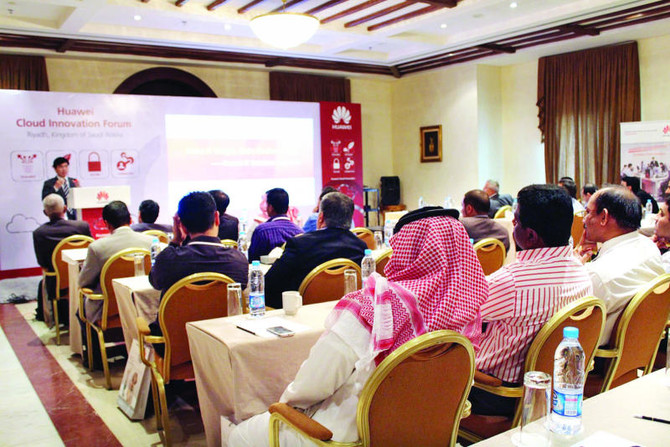
Saudi IT market changes to impact all economic sectors
Saudi IT market changes to impact all economic sectors
Latest updates


© 2026 SAUDI RESEARCH & PUBLISHING COMPANY, All Rights Reserved And subject to Terms of Use Agreement.