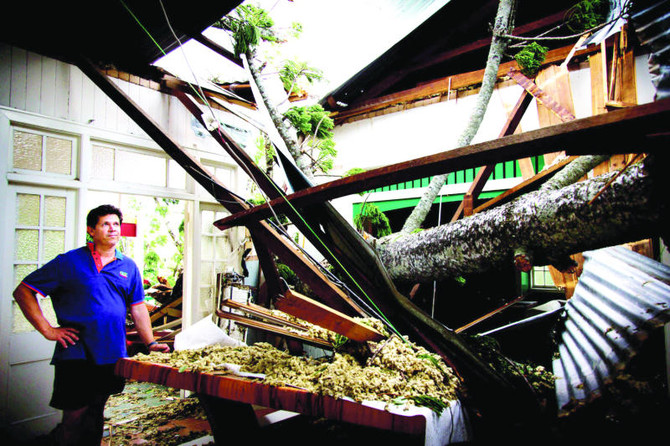
Planes flipped, roofs ripped as ‘Supercell storm’ batters Brisbane

Updated 28 November 2014
Follow

Planes flipped, roofs ripped as ‘Supercell storm’ batters Brisbane

BRISBANE: Planes were flipped and roofs ripped off when hail and powerful winds tore through Australia’s east coast, leaving a damage bill of more than Aus$100 million ($85 million) as the army helped clear up on Friday.
The storm, which officials said was one of the worst seen in the country and the strongest to hit the city of Brisbane in three decades, rained hailstones the size of tennis balls on cars and buildings late Thursday, flooding streets and injuring 39 people.
Gusts of up to 140kmh (87 mph), as strong as a Category Two cyclone, also uprooted trees and brought down power lines.
In one of the more dramatic scenes, at least four light planes were flipped over at Archerfield Airport, 11 km from Brisbane’s central business district.
“It looks like the apocalypse,” one resident of an apartment building that had its metal roof wrenched off by the storm and blown more than 100 meters (330 feet) told reporters.
Another Brisbane resident said the hailstones were traveling “like bullets.”
“My daughter was crying. It was like a freight train coming straight at you, just like a roar, it was that loud,” John Arthur told national radio. “The size of the hailstones were decimating everything in its path.”
Queensland Premier Campbell Newman said it was the “biggest storm that has hit Brisbane since 1985” but was grateful no one was seriously hurt.
“It was a terrible storm, but thankfully no one’s been seriously injured or worse,” he told ABC radio.
The tempest started as a routine storm south of Brisbane on Thursday afternoon and tracked north, encountering moist air from sea breezes that helped it develop into a supercell, the Bureau of Meteorology’s Pradeep Singh said.
“A supercell has a vortex — the air is spinning around it as it moves up. When that happens, it takes the moisture above the freezing level and keeps it there for a long time,” the senior meteorologist said.
“Rain particles keep developing bigger and bigger into hail. And because the draft is so strong in supercells, they tend to stay for a long time up in the air and when they reach the right weight, they start dropping down.”
Queensland’s Transport Minister Scott Emerson said Brisbane had received an “extraordinary” battering, as the insurance bill rose sharply through the day.
The Insurance Council of Australia declared it a catastrophic weather event. A spokeswoman said it had so far received 15,060 claims for insured losses of Aus$109.2 million.
Insurer Suncorp said it fielded some 1,000 home and 1,600 motor claims following the storm.


Furious farmers roll hundreds of tractors into Paris in fresh protests

Updated 4 sec ago
Follow

Furious farmers roll hundreds of tractors into Paris in fresh protests

  • “We won’t leave without measures that allow us to catch our breath a little,” said another protester, Guillaume Moret

PARIS: Around 350 tractors rolled into Paris on Tuesday, driving down the Champs-Elysees avenue and setting up camp near the parliament building, as farmers protested a litany of woes including a trade deal the EU has struck with four South American countries.
The protests reflect a deep sense of malaise afflicting France’s agricultural sector, with the planned signing of an accord between the EU and the Mercosur bloc seen as the last straw.
French farmers have complained of climate and economic uncertainties and have since December staged protests and set up roadblocks over the government’s handling of a lumpy skin disease outbreak.

BACKGROUND

The protests reflect a deep sense of malaise afflicting France’s agricultural sector, with the planned signing of an accord between the EU and the Mercosur bloc seen as the last straw.

“We’re at the end of our tether,” said one of the activists, Guillaume Moret, 56.
“We haven’t made any money from our farms for three years. Politicians are incapable of giving us any direction,” said the head of the FNSEA union for the region of Ile-de-France around Paris.
The FNSEA, France’s leading agricultural union, and another union, Jeunes Agriculteurs, are demanding “concrete and immediate action” from the government.
Arriving from towns around Paris but also from the Hauts-de-France region of northern France, the protesters parked their tractors not far from parliament’s lower house, the National Assembly, in central Paris.
“The peasant revolt continues,” read a banner unfurled in front of the legislature.
In an apparent attempt to pacify the protesters, Prime Minister Sebastien Lecornu has allowed the activists to set up camp near the National Assembly building, a source close to the matter said.
Government spokesperson Maud Bregeon told broadcaster TF1 that “dialogue” with farmers continued.
The first convoy of about fifteen tractors rolled into the French capital shortly before 6:00 am (0500 GMT). Joined by dozens of others, they drove down the Champs-Elysees honking their horns.
“We won’t leave without measures that allow us to catch our breath a little,” said another protester, Guillaume Moret.
Some, equipped with trailers, had brought mattresses and duvets.
Several days before the planned signing of the EU-Mercosur agreement in Paraguay, the FNSEA union reiterated its opposition to the deal and also listed several national “priorities” to be defended on Tuesday.
The union is calling on the government to address a number of issues including wolf predation and the use of fertilizers.
French police said some 400 protesters had gathered near the building housing the National Assembly.
Most of the European Union’s 27 nations back the Mercosur trade deal, which supporters argue is crucial to boost exports, help the continent’s ailing economy and foster diplomatic ties at a time of global uncertainty.
The deal, more than 25 years in the making, would create one of the world’s largest free-trade areas, boosting commerce between the EU 
and the Mercosur bloc comprising Brazil, Paraguay, Argentina and Uruguay.
It would see the European Union export machinery, chemicals and pharmaceuticals with lowered tariffs applied.
But farmers in France and several other countries fear being undercut by an influx of cheap beef and other agricultural products from South America.
Thousands of farmers in France and Ireland staged protests over the weekend.
In France, politicians across the divide have also been up in arms against the deal, which they view as an assault on the country’s influential farming sector.
Last week, protesters from Coordination Rurale, the second largest union, also brought their tractors into Paris.