COLOMBO, Sri Lanka: A hard-line Buddhist monk from Myanmar known for his anti-Muslim stance said his movement would join hands with a like-minded Sri Lankan group to “protect” Buddhists, whom he called an endangered world minority.
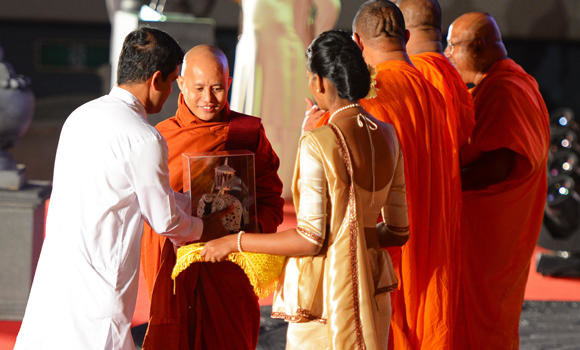
Ashin Wirathu, leader of 969, a fundamentalist movement, was a special invitee Sunday at a rally of Bodu Bala Sena, or Buddhist Power Force, a Sri Lankan group accused of instigating deadly violence against the country’s minority Muslims in June.
Joining 969 could further boost an already soaring support base for Bodu Bala Sena, an ultranationalist group that has enlisted thousands of youth and Buddhist monks in just two years of existence. This, in turn, could exacerbate mistrust and tensions between Sri Lanka’s majority Sinhalese-Buddhists and its Muslims.
Politically, President Mahinda Rajapaksa’s credibility among Muslims stands to erode further after his government allowed Wirathu to visit Sri Lanka despite opposition from Muslim groups, including his own allies. Rajapaksa is already under criticism for not taking action against Buddhist monks whose inflammatory speeches are blamed for anti-Muslim violence in June that killed two people and wounded dozens, and saw many shops and homes set on fire in three western towns.
Three local body guards accompanied Wirathu as he walked onstage for his speech Sunday at a packed indoor stadium in Colombo, Sri Lanka’s capital.
“Buddhists are a world minority. If we don’t protect this small group, remember, it will be the end of the Buddhists,” Wirathu said. “To achieve this ... my 969 organization will work hand in hand with Sri Lanka’s Bodu Bala Sena.”
Sri Lankan Muslim groups urged the government not to allow Wirathu to visit the country, warning it could lead to religious tensions. However, in his speech, Wirathu thanked Rajapaksa for granting him a visa despite “attempts of sabotage by extremists.”
Muslim leaders were not immediately reachable for comment.
Bodu Bala Sena accuses Sri Lanka’s Muslims, who comprise about 10 percent of the population, of trying to take over the country by having more children, marrying Sinhalese-Buddhist women and taking over businesses. Buddhists account for more than 70 percent of the country’s 20 million people.
Wirathu’s 969 started on the fringes of society, but now boasts supporters nationwide in Myanmar.
Hundreds of people died in 2012 sectarian violence in Myanmar, with about 140,000, mostly Muslims, forced from their homes. Buddhist monks were accused of instigating and sometimes actively participating in the violence.


Myanmar, Sri Lanka Buddhist extremists join hands
Myanmar, Sri Lanka Buddhist extremists join hands

US bars five Europeans it says pressured tech firms to censor American viewpoints online
WASHINGTON: The State Department announced Tuesday it was barring five Europeans it accused of leading efforts to pressure US tech firms to censor or suppress American viewpoints.
The Europeans, characterized by Secretary of State Marco Rubio as “radical” activists and “weaponized” nongovernmental organizations, fell afoul of a new visa policy announced in May to restrict the entry of foreigners deemed responsible for censorship of protected speech in the United States.
“For far too long, ideologues in Europe have led organized efforts to coerce American platforms to punish American viewpoints they oppose,” Rubio posted on X. “The Trump Administration will no longer tolerate these egregious acts of extraterritorial censorship.”
The five Europeans were identified by Sarah Rogers, the under secretary of state for public diplomacy, in a series of posts on social media. They include the leaders of organizations that address digital hate and a former European Union commissioner who clashed with tech billionaire Elon Musk over broadcasting an online interview with Donald Trump.
Rubio’s statement said they advanced foreign government censorship campaigns against Americans and US companies, which he said created “potentially serious adverse foreign policy consequences” for the US
The action to bar them from the US is part of a Trump administration campaign against foreign influence over online speech, using immigration law rather than platform regulations or sanctions.
The five Europeans named by Rogers are: Imran Ahmed, chief executive of the Center for Countering Digital Hate; Josephine Ballon and Anna-Lena von Hodenberg, leaders of HateAid, a German organization; Clare Melford, who runs the Global Disinformation Index; and former EU Commissioner Thierry Breton, who was responsible for digital affairs.
Rogers in her post on X called Breton, a French business executive and former finance minister, the “mastermind” behind the EU’s Digital Services Act, which imposes a set of strict requirements designed to keep Internet users safe online. This includes flagging harmful or illegal content like hate speech.
She referred to Breton warning Musk of a possible “amplification of harmful content” by broadcasting his livestream interview with Trump in August 2024 when he was running for president.
Breton responded Tuesday on X by noting that all 27 EU members voted for the Digital Services Act in 2022. “To our American friends: ‘Censorship isn’t where you think it is,’” he wrote.
French Foreign Minister Jean-Noël Barrot said France condemns the visa restrictions on Breton and the four others. Also posting on X, he said the DSA was adopted to ensure that “what is illegal offline is also illegal online.” He said it “has absolutely no extraterritorial reach and in no way concerns the United States.”
Most Europeans are covered by the Visa Waiver Program, which means they don’t necessarily need visas to come into the country. They do, however, need to complete an online application prior to arrival under a system run by the Department of Homeland Security, so it is possible that at least some of these five people have been flagged to DHS, a US official said, speaking on condition of anonymity to discuss details not publicly released.
Other visa restriction policies were announced this year, along with bans targeting foreign visitors from certain African and Middle Eastern countries and the Palestinian Authority. Visitors from some countries could be required to post a financial bond when applying for a visa.


