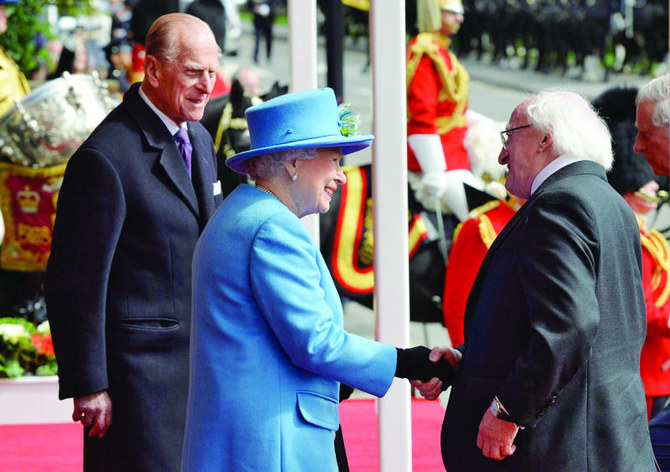
Queen welcomes Irish president on historic visit

Updated 09 April 2014
Follow

Queen welcomes Irish president on historic visit

LONDON: Queen Elizabeth II welcomed the Irish president to Britain on Tuesday for the first time since the republic became independent, in a historic state visit consolidating ties between the once hostile neighbors.
The four-day trip by President Michael D. Higgins follows the queen’s groundbreaking visit to Ireland in 2011, which helped put British-Irish relations on a new footing.
One of the highlights will be a royal banquet at Windsor Castle on Tuesday evening attended by Northern Ireland Deputy First Minister Martin McGuinness, a former IRA commander.
Before leaving Ireland, Higgins said the challenge was not to “wipe the slate clean” of all the distrust and difficulties of the past, but to look to the future.
“We are at a very interesting point in history, when we have, following Her Majesty’s visit to Ireland, such good relations between our people,” the president said.
“My hope for the visit, at the end of it all, is that people will, in ever more numbers, come to share in experiencing the history, the present circumstances and culture.”
He added: “The challenge is to hand to a future generation all of the prospects of the future. You are not inviting them to an amnesia about any deep dispute.”
The president was greeted in London by Prince Charles, the heir to the throne, followed by a ceremonial welcome by the 87-year-old queen and her husband Prince Philip at Windsor Castle, west of London.
Higgins, 72, was also due to address lawmakers at the Houses of Parliament, before returning to Windsor for the banquet.
It would once have been unthinkable for McGuinness to attend such an event, although the Sinn Fein politician has already met the queen. The pair shook hands in a highly symbolic moment in Belfast in June 2012.
As a commander of the Irish Republican Army (IRA), McGuinness had a prominent role in the bloody battle for Northern Ireland to be part of the Republic of Ireland to the south.
The province remained part of the United Kingdom when Ireland gained independence in 1922, and was a source of huge tension between Dublin and London.
The violence was largely ended by the 1998 Good Friday peace accords, which paved the way for a power-sharing government in Belfast, but only after an estimated 3,500 people died.
Relations have steadily improved between Britain and Ireland since then, although an exchange of state visits would have been impossible even at the turn of the millennium.
For some, the pace of change is too rapid.
Stephen Gault, whose father was killed by an IRA bomb in 1987, said the presence of McGuinness at Windsor was “another nail in the coffin of the innocent victims.”
“If Sinn Fein/IRA want peace, why don’t they come forward now and tell the authorities who was responsible for these heinous crimes in the past,” he told BBC radio.
However, Conor Murphy, a Sinn Fein lawmaker, said McGuinness’s invitation to the banquet was “another step on that journey toward reconciliation and better relationships.”
The state visit has reignited a debate about how to deal with Northern Ireland’s violent past, including over whether there should be amnesties for crimes committed before 1998, both by paramilitaries and British security forces.
Issues such as community parades and the flying of the British flag also remain highly contentious, and an attempt last year by former US diplomat Richard Haass to reach an agreement failed.


UN report says Ugandan troops helped South Sudan with deadly airstrikes

Updated 5 sec ago
Follow

UN report says Ugandan troops helped South Sudan with deadly airstrikes

  • Ugandan troops are deployed in South Sudan to help the government of President Salva Kiir against forces loyal to opposition figure Riek Machar
  • The attacks cited in the UN report involved widespread use of “improvised incendiary devices,” it said

NAIROBI: Uganda helped South Sudan carry out airstrikes that killed and badly burned civilians a year ago, according to a UN inquiry.
Joint aerial bombardments by South Sudan and Uganda “targeted civilian-populated areas predominantly affecting Nuer communities in opposition-affiliated areas,” said the report by the UN Commission on Human Rights in South Sudan, referring to South Sudan’s second-largest ethnic group.
Ugandan troops are deployed in South Sudan to help the government of President Salva Kiir against forces loyal to opposition figure Riek Machar, who was suspended as vice president in September after he faced criminal charges. Ugandan military authorities say troops are in South Sudan at the invitation of the South Sudan government and in accordance with a bilateral security agreement.
While Machar is currently on trial for offenses including treason, fighting has intensified in areas seen as his strongholds, where government troops are trying to disperse the rebels.
The attacks cited in the UN report involved widespread use of “improvised incendiary devices,” it said.
Ugandan forces entered South Sudan in March 2025 with military hardware, including tanks and armored vehicles. That happened shortly after a militia overran a military garrison near the Ethiopian border.
Weeks later, Machar was placed under house arrest for his alleged role in orchestrating the attack, charges that he denies. The government has since relied on aerial attacks to gain the upper hand in a widening conflict with Machar’s forces and other armed groups.
Ugandan President Yoweri Museveni sent his army to intervene in South Sudan’s 2013-2018 civil war on multiple occasions on behalf of Kiir’s forces, helping to turn the tide in his favor. Ongoing fighting threatens a 2018 peace deal.
During one attack in March 2025 in Wunaliet, 15 kilometers (9 miles) from the capital of Juba, homes were engulfed after planes dropped “barrels of liquid that ignited,” witnesses told the UN commission. Survivors said they saw “civilians set alight, including a boy burnt beyond recognition.” A barracks, housing opposition soldiers, was also struck.
A day after the attack, Gen. Muhoozi Kainerugaba, Museveni’s son who also serves as the top military commander, posted on X that Uganda had bombed opposition forces.
“Our air offensive will not stop until Riek Machar makes peace with my uncle Afande Salva,” he wrote. While Kiir is not actually Kainerugaba’s uncle, the term shows the closeness of the two governments.
The post, which was later deleted, accompanied a video appearing to show fiery explosions captured from an in-flight aircraft.
Flight tracking data shows that a turboprop plane that circled the area during the bombing had arrived earlier that day from Uganda and was operated by the Ugandan army, the UN report said.
The report does not state conclusively how many operations Uganda was involved in or the exact nature of their involvement, only that there appeared to be “high degrees of planning, operational integration and command-level authorization.”
In November, Uganda denied participating in any combat operations in South Sudan. It has also denied using “chemical weapons and barrel bombs” and said it does not attack civilians.
Last year, Amnesty International said that Uganda had violated a 2018 UN arms embargo that prohibits member states from providing most forms of military assistance to South Sudan, including weapons and personnel. An UN panel of experts echoed that assessment in November.