JEDDAH: Jeddah civic officials have shut down a restaurant in Al-Andalus residential district for violating government health regulations and cracked down on an environmentally toxic operation in Briman Municipality where workers were burning car batteries to extract lead.
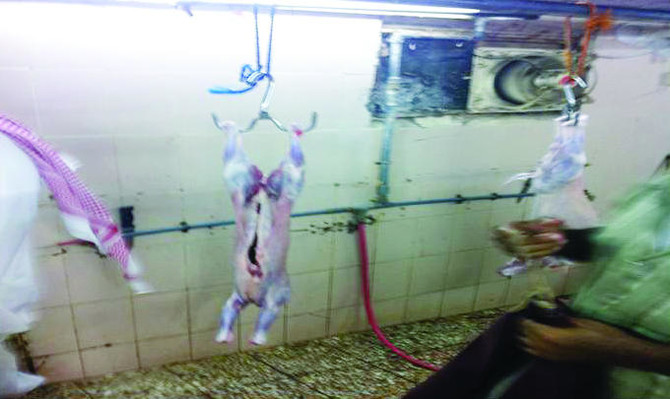
The restaurant was closed by a committee consisting of the General Administration of Licenses, Commercial Control, General Administration of Slaughterhouses, the Public Markets and Al-Azizia District Sub-Municipality. The traditional eatery was operating from inside some villas in the district. Officials confiscated 85 sheep.
The restaurant's violations included not having a regular license and 10 workers without health certificates. The food was prepared in unhygienic conditions with poor circulation and workers did not follow a proper dress code.
Officials also found that the owner was transporting, packaging and storing foodstuff in violation of health regulations. There was an accumulation of waste and the lack of a proper waste disposal system.
In addition, the owner was fined SR 30,200 for slaughtering outside the municipality slaughterhouses. Certain foodstuffs on sale were obtained from unidentified sources, particularly honey, it was discovered.
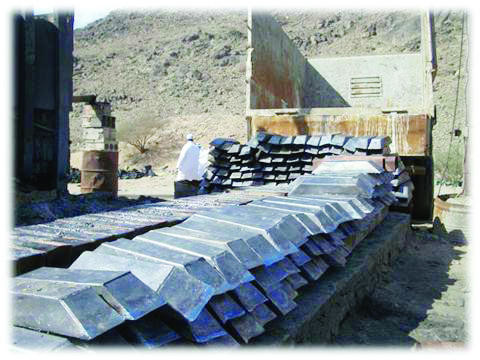
Meanwhile, in a raid by Briman district sub-municipality officials at a site in a new location at Umm Hablain, east of Jeddah, officials seized two tons of lead that was being sold by illegal workers. The workers were burning car batteries to extract the lead, causing a great deal of toxic fumes to spew into the air.
Abdullah Bin Saleh Al-Ajmi, head of Briman district municipality, said monitoring teams found four huge stoves used to burn the batteries. He said the municipality destroyed four residential rooms used by the illegal workers. Two large electric generators used for the site and a Dina car were confiscated.
Al-Ajmi said the raid took place over five hours, from noon until 5 p.m. He emphasized the fact that the owner of the operation will face legal action.
He called on residents to inform the authorities if they come across any suspicious or illegal operations in their neighborhoods. He said the municipality will continue to carry out inspections to shut down any illegal operations, particularly those polluting the environment in east Jeddah.


Jeddah eatery, toxic plant closed down
Jeddah eatery, toxic plant closed down

Red Sea Global unveils scientific model for regenerative tourism worldwide
- The report details the model’s rollout at “The Red Sea” and “AMAALA” destinations, backed by studies covering 8 marine habitats
TABUK: Red Sea Global (RSG) has unveiled a science-based model aimed at achieving a 30 percent net positive conservation benefit across its tourism destinations by 2040.
The framework is now available for global adoption, according to a statement released by RSG.
Owned by Saudi Arabia’s Public Investment Fund (PIF), Red Sea Global is the multi-project developer behind ambitious regenerative tourism destinations like “The Red Sea” and “AMAALA.”
As a cornerstone of the Kingdom’s Vision 2030, the company aims to diversify the national economy while setting new global benchmarks for sustainable, nature-positive development.
CEO John Pagano stated that openly sharing this detailed approach will help elevate the global tourism sector and secure a healthier environment for future generations.

The cornerstone of this initiative is the proprietary SIIG Model, a four-step framework:
• Survey: Establish biodiversity baselines and monitor long-term changes.
• Identify: Assess risks to priority habitats and species.
• Intervene: Execute evidence-based actions, such as regulating fishing and enhancing natural habitats.
• Gain: Measure and verify biodiversity improvements.
The report details the model’s rollout at “The Red Sea” and “AMAALA” destinations, backed by extensive 2022–2023 environmental baseline studies covering eight marine habitats and priority species groups during 2022 and 2023.

A major intervention is the 5,015-square-kilometer Fishery Management Area in Al-Wajh Lagoon. The plan reserves 38 percent of the area for priority conservation—protecting 62 percent of local coral reefs—while allocating 61 percent for sustainable fishing.
According to scientific modeling, eliminating fishing in high-protection zones could increase reef fish populations by 113 percent, sharks and rays by 72 percent, and marine mammals by 24 percent. These measures are expected to boost coral resilience, support ecosystem recovery, and protect vulnerable species like sea turtles and seabirds.
Ihab Kindi, RSG’s Red Sea Destination Executive Director, called the data-driven model a practical roadmap for large-scale marine recovery. The complete methodology is available in the new report, “The SIIG Model: A Roadmap Toward Achieving Measurable Conservation Gains.”


