PARIS: Residents of a sleepy French village in Bordeaux have been left dumbfounded after discovering their local 18th-century chateau was completely bulldozed “by mistake.” The mayor’s office in Yvrac said Wednesday that workers who were hired to renovate the grand 13,000-square-meter (140,000-square-foot) manor and raze a small building on the same estate in southwest France mixed them up.
“The Chateau de Bellevue was Yvrac’s pride and joy,” said former owner Juliette Marmie. “The whole village is in shock. How can this construction firm make such a mistake?" Local media reported that the construction company misunderstood the renovation plans of the current owner, Russian businessman Dmitry Stroskin, to clean up the manor and restore it to its former baroque glory.
Stroskin was away when the calamity occurred and returned home to discover his chateau, a local treasure boasting a grand hall that could host some 200 people, as well as a sweeping stone staircase — was nothing but rubble. “I’m in shock ...I understand the turmoil of the community,” local media quoted Stroskin as saying. He told them he plans to build an exact replica of lost manor on the site.


18th-century French chateau razed ‘by mistake’

18th-century French chateau razed ‘by mistake’
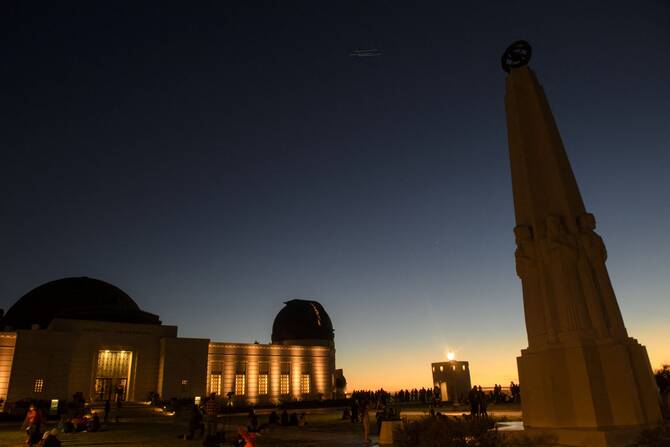
6 planets will parade across the night sky at the end of February
NEW YORK: Six planets are linking up in the sky at the end of February, and most will be visible to the naked eye.
It’s what’s known as a planetary parade, which happens when multiple planets appear to line up in the sky at once. The planets aren’t in a straight line, but are close together on one side of the sun.
Skygazers can usually spot two or three planets after sunset, according to NASA. Hangouts of four or five that can be glimpsed with the naked eye are less common and occur every few years. Last year featured lineups of six and all seven planets.
When will they be visible?
On Saturday, Mercury, Venus, Jupiter and Saturn will be visible to the naked eye if clear skies allow. Uranus and Neptune can only be spotted with binoculars and telescopes.
What time is optimal for viewing?
Go outside about an hour after sunset and venture away from tall buildings and trees that will block the view. Look to the western sky and spot Mercury, Venus and Saturn close to the horizon. Jupiter will be higher up, along with Uranus and Neptune.
How to know if you’ve spied a member of the parade?
“If it’s twinkling, it’s a star. If it is not twinkling, it’s a planet,” said planetary scientist Sara Mazrouei with Humber Polytechnic in Canada.
The parade should be visible over the weekend and in the days after. Eventually, Mercury will bow out and dip below the horizon.
At least one bright planet is visible on most nights, according to NASA.
Glimpsing many in the sky at once is a fun way to connect with astronomers of centuries’ past, said planetary scientist Emily Elizondo with Michigan State University.
Ancient astronomers used to make sense of the universe “just by looking up at the stars and the planets,” Elizondo said, “which is something that we can do today.”


