BEIJING: China’s all-powerful Communist Party on Thursday unveiled a new seven-man leadership council steered by Xi Jinping to take command of the world’s number two economy for the next decade.
After striding out in Beijing’s Great Hall of the People as the party’s new general-secretary, succeeding President Hu Jintao, Xi vowed to fight official corruption and build a “better life” for the nation’s 1.3 billion people.
Xi’s long-expected ascent to the apex of national politics was confirmed when he emerged onto the stage in the hall on Tiananmen Square in front of the rest of the elite Politburo Standing Committee, after a week-long party congress.
Xi, 59, has an impeccable political pedigree as the son of a lieutenant to revolutionary leader Mao Zedong. He will formally replace Hu as state president when the rubber-stamp legislature confirms the appointment in March.
“We are not complacent, and we will never rest on our laurels,” Xi said in his first address to the nation, standing in front of his six colleagues on the new elite committee — all men, who all bar one wore red ties.
The previous committee had nine men, and analysts said the lower number would ease decision-making at the consensus-driven heights of the Communist Party for the next decade as China shapes up to rapid change on a host of fronts.
“Under the new conditions, our party faces many severe challenges, and there are also many pressing problems within the party that need to be resolved,” Xi said, highlighting corruption and “being divorced from the people.”
“We must make every effort to solve these problems. The whole party must stay on full alert.”
The speech marked the most significant appearance on the national stage for a man about whom still little is known.
He appeared confident and far more relaxed than his stiff predecessor Hu, starting out by apologizing for the speech’s late start.
Xi’s standing at the top of China’s opaque power structure was emphasised with Hu also handing him control of the Central Military Commission.
Hu’s predecessor Jiang Zemin had clung on to that job, which controls the world’s largest military, for two years after relinquishing the presidency.
In second place in the new elite line-up was current Vice Premier Li Keqiang, whose promotion puts him in line to be appointed the country’s premier in charge of China’s day-to-day economic administration in March.
The spectacle marked the climax of years of jockeying within the secretive party, which brooks little dissent to its monopoly on political power but which has had to take new account of the public’s demands in the age of social media.
Analysts said that despite calls from Xi, Hu and others for reform, the new Politburo Standing Committee appeared to have a conservative slant, but also stressed that continuity and stability reigned supreme in the communist system.
“I think that this is the result of compromise and consensus among different groups,” Chinese University of Hong Kong associate professor Tsao King Kwun said.
The process was essentially finalized Wednesday when the party ended its week-long congress by announcing a new 200-strong Central Committee. On Thursday it approved higher leadership bodies including the elite standing committee.
The seven men who hold innermost power are tasked with addressing a rare deceleration of economic growth that threatens the party’s key claim to legitimacy — continually improving the livelihoods of the country’s people.
China also bubbles with localized unrest sparked by public rage at corruption, official abuses, and the myriad manifestations of anger among the millions left out of the country’s economic boom.
China’s economy, which relies heavily on manufactured exports and heavy infrastructure investment, has been stunningly successful in lifting hundreds of millions out of poverty.
But the party acknowledges the model is becoming unsustainable as the economy matures and demands for higher living standards grow, and Hu last week called for a new approach with a robust private sector and stronger domestic demand.
How the new leadership under Xi will address these challenges in the world’s most populous nation remains unclear.
Analysts believed Xi’s assumption of military leadership from day one strengthens his hand.
But they said significant change was unlikely under Xi — even if he desired it, which is unclear — as he must first work to shore up his clout on the new leadership committee.
“Everything will depend on Xi Jinping and whether he exercises leadership. Will he be someone who can introduce reforms? I’m still very skeptical,” said Jean-Pierre Cabestan, an expert on Chinese politics at Hong Kong Baptist University.
Observers see two main factions, one centerd on pro-business proteges of Jiang and another linked to allies of Hu, who favored more equitable development.
The run-up to this year’s congress was unsettled by events surrounding former rising star Bo Xilai, who was brought low by scandal, and by new allegations about secret riches amassed by the families of top leaders.


China unveils new leadership with Xi at helm

China unveils new leadership with Xi at helm
Bangladesh halts controversial relocation of Rohingya refugees to remote island
- Administration of ousted PM Sheikh Hasina spent about $350m on the project
- Rohingya refuse to move to island and 10,000 have fled, top refugee official says
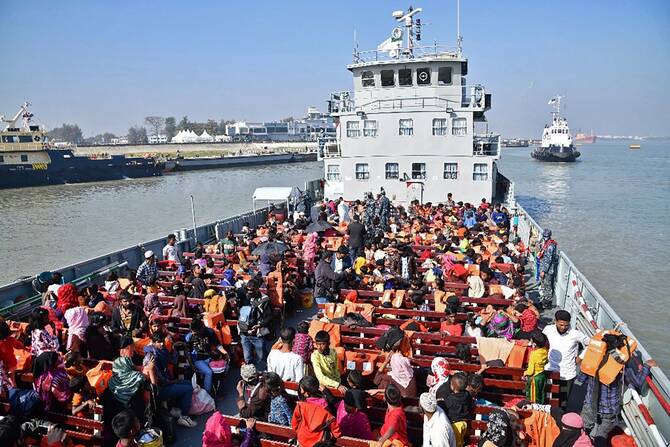
DHAKA: When Bangladesh launched a multi-million-dollar project to relocate Rohingya refugees to a remote island, it promised a better life. Five years on, the controversial plan has stalled, as authorities find it is unsustainable and refugees flee back to overcrowded mainland camps.
The Bhasan Char island emerged naturally from river sediments some 20 years ago. It lies in the Bay of Bengal, over 60 km from Bangladesh’s mainland.
Never inhabited, the 40 sq. km area was developed to accommodate 100,000 Rohingya refugees from the cramped camps of the coastal Cox’s Bazar district.
Relocation to the island started in early December 2020, despite protests from the UN and humanitarian organizations, which warned that it was vulnerable to cyclones and flooding, and that its isolation restricted access to emergency services.
Over 1,600 people were then moved to Bhasan Char by the Bangladesh Navy, followed by another 1,800 the same month. During 25 such transfers, more than 38,000 refugees were resettled on the island by October 2024.
The relocation project was spearheaded by the government of former Prime Minister Sheikh Hasina, who was ousted last year. The new administration has since suspended it indefinitely.
“The Bangladesh government will not conduct any further relocation of the Rohingya to Bhasan Char island. The main reason is that the country’s present government considers the project not viable,” Mizanur Rahman, refugee relief and repatriation commissioner in Cox’s Bazar, told Arab News on Sunday.
The government’s decision was prompted by data from UN agencies, which showed that operations on Bhasan Char involved 30 percent higher costs compared with the mainland camps in Cox’s Bazar, Rahman said.
“On the other hand, the Rohingya are not voluntarily coming forward for relocation to the island. Many of those previously relocated have fled ... Around 29,000 are currently living on the island, while about 10,000 have returned to Cox’s Bazar on their own.”
A mostly Muslim ethnic minority, the Rohingya have lived for centuries in Myanmar’s western Rakhine state but were stripped of their citizenship in the 1980s and have faced systemic persecution ever since.
In 2017 alone, some 750,000 of them crossed to neighboring Bangladesh, fleeing a deadly crackdown by Myanmar’s military. Today, about 1.3 million of them shelter in 33 camps in the coastal Cox’s Bazar district, making it the world’s largest refugee settlement.
Bhasan Char, where the Bangladeshi government spent an estimated $350 million to construct concrete residential buildings, cyclone shelters, roads, freshwater systems, and other infrastructure, offered better living conditions than the squalid camps.
But there was no regular transport service to the island, its inhabitants were not allowed to travel freely, and livelihood opportunities were few and dependent on aid coming from the mainland.
Rahman said: “Considering all aspects, we can say that Rohingya relocation to Bhasan Char is currently halted. Following the fall of Sheikh Hasina’s regime, only one batch of Rohingya was relocated to the island.
“The relocation was conducted with government funding, but the government is no longer allowing any funds for this purpose.”
“The Bangladeshi government has spent around $350 million on it from its own funds ... It seems the project has not turned out to be successful.”


