LONDON: ExxonMobil wants to leave its flagship Iraqi oil project after upsetting Baghdad by signing a deal last year with the autonomous northern Kurdish region, which the central government deemed illegal.
The US major was the first company to flex its muscles and challenge Baghdad's authority by signing up for six blocks to explore for oil with the Kurdistan Regional Government (KRG) in October last year.
Concerns over the likely profit margins on the estimated $50 billion West-Qurna-1 project could force Exxon to abandon its stake in this southern oil field, diplomatic sources said yesterday.
"Exxon is telling Baghdad: 'We are letting you know we're looking to leave,'" one of the diplomats said. "They are shopping around and looking at all the options."
Exxon stock barely budged on the news, indicating there may be more at stake for Iraq, Kurdistan and regional politics than for Exxon shareholders.
The oil contracts row is part of a broader battle between the Baghdad government and Kurdistan over oil rights, territory and regional autonomy, which is straining Iraq's uneasy federal union.
And Baghdad has been threatening to rip up the West Qurna-1 contract ever since.
The oil row is just the latest complication in a long-running and deep-ranging dispute between Iraq's Prime Minister Nuri Al-Maliki in Baghdad and Kurdistan's President Masoud Barzani based in its capital, Arbil.
Al-Maliki has gone as far as asking US President Barack Obama to force Exxon to pull out of the deal, claiming the firm's actions are a threat to peace.
Iraqi Deputy Prime Minister Hussain Al-Shahristani met ExxonMobil executives in Baghdad in the summer and threatened to kick the company out.
He declined to say yesterday whether Exxon was pulling out, but told Reuters in an email that Baghdad was sticking to its line that all contracts signed with the KRG without the approval of Baghdad were illegal.
"All companies that entered in such contracts were asked to cancel them or pull out," Al-Shahristani said. "ExxonMobil can be contacted about their decision."
Iraqi oil sources said Exxon has not informed Baghdad of its interest in exiting West Qurna.
Exxon declined to comment, as did the US State Department.
Despite Baghdad's tough talk, Exxon chief Rex Tillerson said in March the company was committed to expanding output at West Qurna, where it's in charge, as well as exploring in Kurdistan.
And it's been business-as-usual for Exxon at West Qurna-1, now pumping more than 400,000 barrels a day and earning a hefty chunk of Iraq's central government revenue.
Exxon, with minority partner Royal Dutch Shell, signed up for the project - which targets output of 2.825 million barrels per day by 2017 - in early 2010. By the end of last year, the pair had spent just under $1 billion.
But the pace of expansion has been slow. Exxon, like other foreign operators, has complained that infrastructure bottlenecks, payment delays and bureaucratic red tape are hampering progress.
It was that frustration, say oil executives, that led Exxon to make its bold move into Kurdistan, which offers more lucrative production sharing contracts and a safer operating environment.
A further setback came in February, when Exxon was stripped of its role as project leader for a multi-billion-dollar water injection scheme that is core to the development of Iraq's southern oil fields.
"That really pushed back the time line on development," said an industry source. "In their minds, that played with the profitability of the contract."
Exxon's departure from southern Iraq now hinges on its ability to find a company willing to buy out its stake in West Qurna-1, say industry sources.
"If they can find the right buyer, they will pull out," said an industry executive. "It's an unusual move for Exxon. They usually don't give up."
Exxon is meanwhile raising its profile in Kurdistan, with drilling set to begin in a few months. A senior Exxon delegation was last week in Arbil, where the company is setting up an office, they said.
Other majors such as Chevron, Total and Gazprom have joined Exxon with their own deals in Kurdistan, provoking warnings from Baghdad.


Exxon seeks to quit flagship Iraq oil project
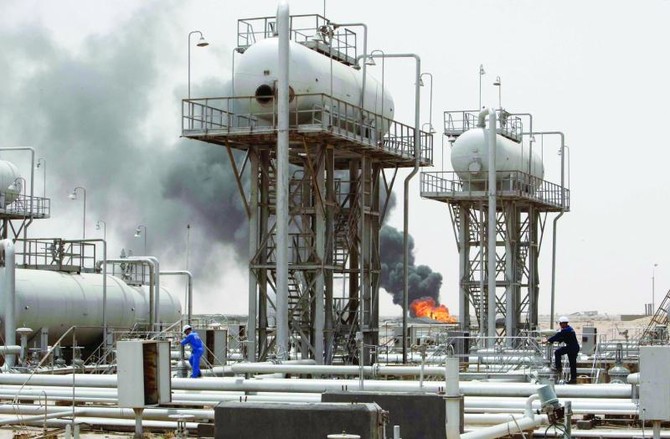
Exxon seeks to quit flagship Iraq oil project

Arab region on recovery path with 3.7% growth in 2026, but geopolitical risks persist: ESCWA
RIYADH: The Arab region is on a path of gradual economic recovery this year, according to a UN report that forecast growth reaching 3.7 percent and a gradual decline in inflation.
The UN Economic and Social Commission for Western Asia warned in its Macroeconomic Outlook for the Arab region that the persistence of geopolitical fog and risks to global trade remains a pressure factor on the region’s growth prospects.
ESCWA projected regional gross domestic product to have grown by 2.9 percent in 2025 before accelerating to 3.7 percent in 2026, supported by diversification efforts, fiscal reforms, and investment in non-hydrocarbon sectors.
Inflation across the region is expected to decline from 8.2 percent in 2025 to 5.4 percent by 2027, driven by easing commodity prices and the normalization of supply chains, the report said.
In its latest economic update, the World Bank said that regional GDP in the Middle East, North Africa, Afghanistan, and Pakistan is projected to grow by 3.3 percent in 2026, driven by stronger-than-expected performance in Gulf Cooperation Council countries and developing oil importers.
However, ESCWA warned that “ongoing conflicts, trade disruptions and elevated global tariff uncertainties continue to steer the economic outlook,” citing the spillover effects from the war on Gaza, tensions between Iran and Israel, and the volatile situation in several Arab countries, including Sudan, Yemen, and Syria.
The report highlighted a widening divergence in growth prospects among Arab economies. High-income Gulf countries are driving the regional recovery through diversification into manufacturing, tourism, and digital sectors.
For investors eyeing this shift, a key question is which specific non-oil industries offer the most resilient returns despite the persistent geopolitical risks. Ahmed Moummi, economic affairs officer at ESCWA, told Arab News that beyond the headline sectors, the most sustainable opportunities lie in the real economy.
“In general, real sectors have sustainable returns, particularly industry and agriculture. Investing in the latest technologies in the industrial or the agricultural sectors are likely to enhance returns and ensure sustainability of the business, like agri-business, food processing, fisheries, and tourism,” he said in an interview.
Saudi Arabia’s real GDP is projected to grow by an average of 3.3 percent during 2025-2027, supported by increased investment in manufacturing, real estate, and tourism, while the UAE is expected to achieve 4.5 percent average growth over the same period.
Middle-income countries face more significant challenges, including high debt burdens, inflation, and external shocks.
According to the ESCWA, the situation remains dire for conflict-affected low-income countries, including Somalia, Sudan, Syria, and Yemen. These economies are projected to contract by 0.9 percent in 2025 before modestly recovering to 1.7 percent growth in 2026, assuming conflicts de-escalate and reconstruction efforts begin.

With growth so uneven across high-income, middle-income, and conflict-affected economies, the question arises as to what business models or sectors are best positioned to succeed across this fragmented regional landscape. The answer, according to Moummi, lies in resilience through diversification.
“Diversified economies with diversified sources of income are the best models given the overall geopolitical and global landscape,” he said. “Investing in real sectors generates employment and realizes sustainable and inclusive economic growth. Also investing in knowledge economy and in skills’ development would ensure also that labor force would be agile and would fit for future jobs.”
The analysis warned that elevated tariffs announced by the US in April 2025 have increased trade uncertainty globally. While energy products are currently exempt, textiles, fertilizers, chemicals, aluminum, and electronics now face high US tariffs, affecting several Arab countries.
Jordan stands to be most impacted, with around 25 percent of its total exports directed to the US.
Bahrain, and Egypt, as well as Lebanon, Morocco, and Tunisia will be affected to a lesser extent, as their US exports average around 5 percent.
An indirect impact may emanate from potential slowdowns in the region’s main trading partners, particularly China and the EU, which together account for nearly one-third of Arab exports.
ESCWA has developed machine-learning-based “nowcasting” models piloted for Egypt and Saudi Arabia that integrate conventional and alternative data sources, including Google Trends and satellite imagery, to enable near-real-time GDP estimation.
“Nowcasting integrates conventional and alternative data sources and enables near-real-time GDP estimation, enhances policy responsiveness, and provides a scalable framework for evidence-based economic assessment in the region,” the report stated.
For Egypt, the models point to a 4 percent annual real GDP growth rate for 2025, while Saudi Arabia’s growth is nowcast at 4.3 percent for the same year.
The release concluded that achieving lasting peace and stability is fundamental for recovery and long-term development. It called for sustained aid and concessional financing to support reconstruction and human capital investment in conflict-affected countries.
“Diversification, fiscal consolidation and improved debt management are needed to preserve macroeconomic stability, decrease dependence on hydrocarbon revenues, generate employment, and create fiscal space for productive investment and social spending,” ESCWA said.


