BRUSSELS: European Union governments have imposed sanctions against major Iranian state companies in the oil and gas industry, and strengthened restrictions on the central bank, cranking up financial pressure over Tehran’s nuclear program.
More than 30 firms and institutions were listed in the EU’s Official Journal as targets for asset freezes in the EU, including the National Iranian Oil Company (NIOC), a large crude exporter, and the National Iranian Tanker Company (NITC).
Both are vital to the Iranian oil industry, the main source of revenue for the government.
Their importance has risen in recent months as the European Union and the US seek to reduce Tehran’s access to cash by forcing Western companies to halt trade with Iran.
Iran said the sanctions would not work.
“We recommend that, instead of taking the wrong approach and being stubborn and using pressure, ... with a logical approach they can return to discussions,” foreign ministry spokesman Ramin Mehmanparast told a news conference.
The US imposed restrictions on NIOC recently and has blacklisted the tanker company.
Justifying the decision, EU governments said that both NIOC and NITC provide financial support to Iran’s government.
A senior NITC official said this EU argument was “baseless,” saying that the group was privatized in 2000 and was owned by three pension funds. In addition, he said, the poor state of the tanker market mean the company did not have money to spare.
“It is nonsense and it does not add up,” the NITC official told Reuters from Tehran.
“Our shareholders have control of the company. There is no government interference and there is no connection.”
One expert in Washington said both NITC and NIOC served Tehran as fronts for nuclear procurement abroad.
“To shield NITC from sanctions, the Iranian regime concocted a fictitious privatization scheme in the early 2000s,” said Emanuele Ottolenghi of the Washington-based Foundation for the Defense of Democracies, which has advised the US government and lawmakers on sanctions. “But in truth, NITC was always a tool in the hands of the regime.”
Washington has argued the NIOC is linked with the Islamic Revolutionary Guard Corps, Iran’s elite force, which according to the US Treasury Department has recently been coordinating attempts to circumvent Western sanctions of Iranian oil sales.
The new listings follow a decision on Monday by the 27 EU governments to bring sweeping new sanctions against Iranian banking and energy sectors to try to draw Tehran into serious negotiations about its atom project.
A spokesman for EU foreign policy chief Catherine Ashton said six powers negotiating with Iran were hoping to resume talks soon but that no more meetings had yet been scheduled.
“We focus our sanctions on those who are responsible for the (Iranian) nuclear program, while at the same being open to talks,” Michael Mann told a regular news briefing in Brussels.
“We have always said we don’t do sanctions for their own sake.”
Iran denies its work has any military intentions and says it will not scale back activities unless sanctions are lifted.
But Europe and the US are increasing sanctions pressure amid fears of an Israeli attack on Tehran’s nuclear facilities, which could lead to a new war in the Middle East.
In yesterday’s list, the European Union also targeted NIOC subsidiaries, as well as the National Iranian Gas Company and National Iranian Oil Refining and Distribution. Several banks were also listed.
Neither the US nor Europe import Iranian oil, and both are trying to curb Iran’s sales elsewhere.
On Monday, the European Union also banned imports of natural gas and imposed broad measures against EU companies cooperating with Iran’s ship-building industry.


EU sanctions target Iran’s oil and gas companies
EU sanctions target Iran’s oil and gas companies
Ceer to sign deals worth $990m at PIF Private Sector Forum
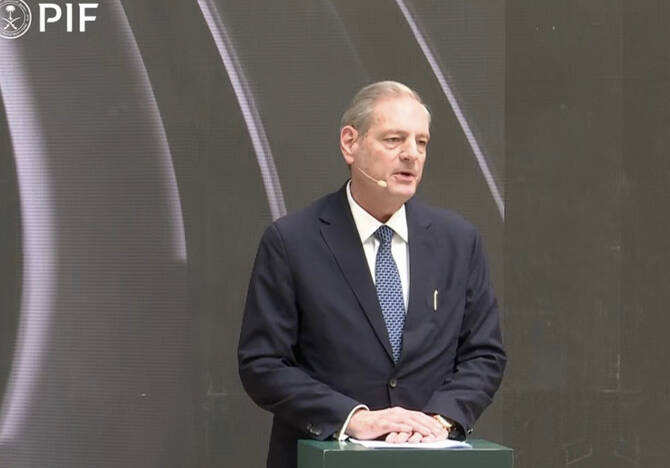
RIYADH: Saudi Arabia’s first homegrown electric vehicle brand Ceer is expected to sign 16 agreements valued at SR3.7 billion ($990 million) at the PIF Private Sector Forum, said the company’s CEO.
Speaking at the forum, James DeLuca said that 90 percent of these agreements are not memorandums of understanding, but are commercial contracts.
Saudi Arabia is focused on creating a comprehensive EV ecosystem, and the government is aiming for 30 percent of vehicles in Riyadh to be electrified by 2030.
The official added that the company is expected to contribute over SR30 billion to Saudi Arabia’s gross domestic product as well as creating approximately 30,000 direct and indirect jobs by 2034.
“The most important part is 90 percent of these agreements are not MoUs. They are in fact commercial contracts, because, we are moving from planning to execution,” said De Luca.
He added: “Ceer will contribute over SR30 billion by 2034, SR79 billion to trade balance improvement, and we will create approximately 30,000 direct and indirect jobs fulfilling our mandate of putting local nationals to work in value-added positions.”
Underscoring the progress of the company’s localization strategy, DeLuca said that the company is on track to reach 45 percent local content by 2034.
“Our robust localization strategy aims to leverage local raw materials, attract advanced technology and foreign investment and localize the production of bulky and labor intensive components to reduce carbon dioxide emissions and to create jobs for Saudi nationals. With the execution of these plans, we are on track to reach 45 percent local content by 2034,” said DeLuca.
DeLuca said that Ceer is the first automotive company which manages the entire process in car making — from designing and engineering to manufacturing, selling, and servicing a portfolio of battery electric vehicles.
“We will offer a portfolio of battery-electric sedans and SUVs in a variety of sizes for people in the region. I am absolutely confident that this will define electric mobility, not just in Saudi Arabia, but across the countries in the Gulf Cooperation Council region,” said DeLuca.
He concluded: “I believe, together, we are about to ignite an industry, inspire a nation, and absolutely amaze the world.”