CAMBODIAN villagers armed with a little medical know-how — and their mobile telephones — are the nation’s new foot soldiers in the fight against drug-resistant malaria.
In the small village of Phnom Dambang near the Thai border, locals know that early detection and treatment is crucial to containing the virulent strain of the mosquito-borne disease that is blighting the region.
“The malaria here... can kill people in a short period of time if we don’t have the right treatment,” said Long Vuthy, whose home doubles as a walk-in clinic. The village is dotted with bright yellow signs emblazoned with pictures of mosquitoes, warning that the disease is prevalent in the area.
Vuthy, 41, who is also the chief of the village in Pailin province — considered to be at the epicenter of drug-resistant malaria in Cambodia — is one of more than 3,000 volunteer malaria workers in the country.
They diagnose the disease with a quick blood test and provide treatment, free of charge, in remote parts of the impoverished nation, where access to health services can be difficult.
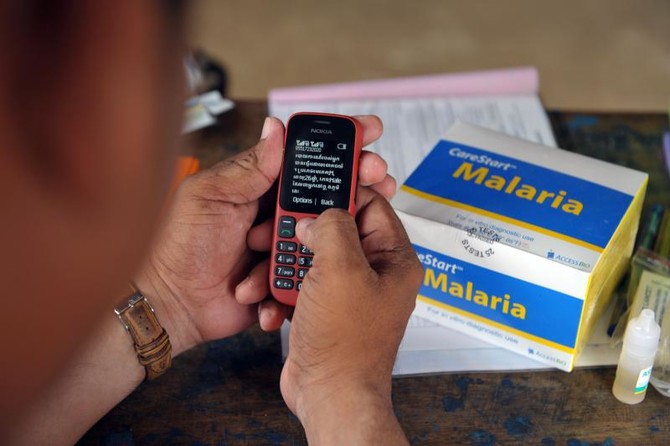
Under a new pilot project, he is now also using a dedicated text message service to report new cases, allowing health experts to monitor and respond to patients’ needs in real time.
“It’s a very good way to help the community,” said Vuthy, who was taught how to use the mobile phone service two months ago by the Malaria Consortium, a non-profit group working with the government and the World Health Organization (WHO) to eradicate malaria from the country by 2025.
Cambodia has already had success tackling malaria. In 2011, it reported over 108,000 cases, of which 96 were fatal, compared to 102,473 cases and 154 deaths the year before and over 600 deaths in 2000, according to government statistics.
But the prevalence of the drug-resistant strain has caused concern.
Malaria resistant to regular forms of treatment was confirmed in western Cambodia eight years ago, likely as a result of patients taking an incorrect or incomplete course of anti-malarial drugs.
To control the spread of this drug-tolerant form, health workers must catch cases early and ensure patients strictly follow the right treatment plan.
The alert system is simple. If Vuthy’s diagnosis test shows a person has malaria, he immediately starts them on medication and composes a message with the patient’s age, sex, location and the type of malaria.
Using a toll-free number, the text is sent instantly to the district health center, provincial health officials and a national malaria database in the capital Phnom Penh — a process that used to take a month.
The information is also fed into Google Earth to create a map of reported cases and of potential hotspots of resistance.
Together, the data helps officials track each case and make sure the right treatment is available or that more medication is supplied when stocks are running low.
“I think this system is very important in eliminating malaria in Cambodia because it provides information very fast,” said Pengby Ngor from the Malaria Consortium, which developed the database. “In this way there can be intervention and the patient can get treatment quickly.”
Malaria killed an estimated 655,000 people worldwide in 2010, although mortality rates have fallen sharply over the past decades, according to the WHO.
Researchers attribute this decline largely to the increased use of artemisinin drugs, seen as the most effective treatment, and the widening use of insecticide-treated bed nets — which have also been distributed by the Cambodian government.
Comprehensive data on resistance in the country is unavailable, although a study by international scientists published in The Lancet this year found that between 2007 and 2010, 42 percent of falciparum malaria cases, the most severe form of the disease, in western Cambodia were drug tolerant.
Resistance does not mean the disease will be fatal, but it typically takes longer to be cured using a combination of drugs.
Meas Tha, deputy director of the National Center for Parasitology, Entomology and Malaria Control, said the mobile pilot scheme was a “tool that could help us to achieve our 2025 goal” to eradicate malaria, alongside other key efforts such as education on prevention and medication.
It is part of a national malaria containment project on which the Global Fund, supported by The Bill and Melinda Gates Foundation, has spent some $ 30 million since 2010.
The system, using SIM cards provided free by Cambodian telecommunications firm Mobitel, was launched in three other provinces last year before coming to Pailin in July.
Some 230 volunteers have used the mobile phone service so far and there are plans to eventually include all volunteers in the project.
Vuthy knows that close monitoring of severe malaria cases is essential in his part of the country.
He makes sure his patients take their pills correctly and he carries out follow-up tests to check their blood is parasite-free after three days. If not, it could be a sign of drug tolerance, requiring further treatment.
Here too the text message alert service comes in handy, sending reminders to check on patients on set days. “It makes my job easier,” Vuthy said.


Cambodians use text messages to fight malaria
Cambodians use text messages to fight malaria

Recipes for Success: Chef Jolbi Huacho offers advice and an avocado Nikkei recipe
DUBAI: Jolbi Huacho started his culinary career in Peru at the age of 22. He has since worked in several countries and now heads up two kitchens — Clay and Sushiyaki — in Dubai.
“My earliest food memories are connected to traditional stews made with ají peppers. I grew up surrounded by different preparations where ají was the starting point, and I clearly remember how the aromas coming from the kitchen sparked my curiosity from a young age,” Huacho tells Arab News. “Those dishes were part of my childhood and shaped my first connection with cooking.
“During my time at culinary school, I didn’t just learn techniques, I truly fell in love with the profession. By the time I finished my studies, I understood that this would not just be my career, but the path I wanted to fully commit to for the rest of my life.”
When you started out, what was the most common mistake you made?
Trying to execute dishes without fully understanding their origin and the reasoning behind each process. Cooking is a step-by-step evolution, you first need to understand where a dish comes from — the product, its technique and logic — before putting it into practice. Combining studying with constant hands-on practice helped me build a strong foundation and grow as a chef.
What’s your top tip for amateur chefs?
My main advice is to connect with what they are about to cook. Using a recipe or a video as a reference helps to understand the process before putting it into practice. From there, it’s important to enjoy the experience, cook without pressure, and put care into what you prepare. Everyone can cook. Each person has their own style. And, in the end, cooking is about enjoying and sharing food. Cooking at home shouldn’t be stressful; taste as you go, adjust when needed, and have fun with it
What one ingredient can instantly improve any dish? (And why?)
More than a single ingredient, I believe what truly elevates any dish is a well-executed base. A properly made reduction — whether from a stock, jus, or sauce — adds depth, balance, and intensity of flavor. It’s not about adding more elements, but about using the right technique and respecting the process to bring out the best in a dish.
When you go out to eat, do you find yourself critiquing the food?
It’s not just about the food, but also the service, timing, atmosphere, and the overall feeling of the place.
What’s the most-common issue that you find in other restaurants?
When passion and professionalism doesn’t cross all areas. When every part of a restaurant is handled with care and commitment, the experience naturally comes together, regardless of the cuisine or concept.
What’s your favorite cuisine or dish to order?
I’m very drawn to fusion cooking and a wide range of flavors. I enjoy dishes like a good ramen or donburi for their depth and umami, as well as classics such as a well-made carbonara or a fresh ceviche. More than the cuisine itself, what matters most is proper execution and a strong sense of identity in the dish.
What’s your go-to dish if you have to cook something quickly at home?
I usually go for simple dishes such as a katsu sando, miso soup, gyozas, or even a ceviche. These are dishes that don’t take much time and deliver great flavor with minimal steps. It’s all about simplicity done well.
What customer behavior most annoys you?
As a chef — or just as a professional — you must be prepared for all kinds of situations. Issues and requests will always arise. What truly matters is not the problem itself, but how it is handled: being present, listening, and always focusing on finding a solution. When situations are managed with professionalism, it’s possible to reach an outcome where both the guest and the (staff) feel satisfied.
What’s your favorite dish to cook?
Ceviche. I enjoy it because of its freshness and the balance between acidity and umami. With just a few elements, you can achieve very intense flavors. Good quality fish, treated with care and cured at the right moment, combined with a well-made leche de tigre, says everything. It’s a simple dish, but it requires respect for the product, proper timing, and precision.
What’s the most difficult dish for you to get right?
Seemingly simple dishes can be very hard. Preparations where there is nowhere to hide mistakes, such as a proper ramen broth, a well-executed fried rice, or fish that is cured or cooked to the exact point. In these dishes, technique, timing, and respect for the product must be precise, because even the smallest mistake becomes immediately noticeable.
What are you like as a leader?
I consider myself balanced, but demanding. I strongly believe that without discipline, consistency, and high standards, there is no real growth. I enjoy bringing out the best in people, teaching — and also learning, because cooking is a constant evolution.
I am disciplined when it comes to standards, technique, and consistency. But, at the same time, I value respect and people’s development. I am direct and expressive, and I believe a chef must display character and leadership. But that doesn’t mean shouting. For me, a kitchen works best with discipline, consistency, clear communication, and strong leadership.
Chef Jolbi’s avocado Nikkei
The avocado Nikkei is a dish that brings together creaminess, acidity, smokiness, and umami in a single bite.
It is built around a rocoto chimichurri quickly stir-fried in very hot oil, delivering depth and intensity. This is combined with creamy avocado, a tiger milk rich in seafood and fish umami, and finished with a burnt tortilla oil that adds subtle smoky notes.
A bright, acidic chalacita balances the dish, resulting in a fresh, bold, and addictive preparation with clearly layered flavors.
Smoked Rocoto Chimichurri
(Rocoto, It’s a chili from Peru, but can be replaced with red Holland chili.
Avocado Nikkei
Ingredients:
• Rocoto (or red Holland chili), finely chopped – 100 g
• Red onion, brunoise – 100 g
• Garlic, finely chopped – 30 g
• Vegetable oil – 100 g
• Fresh coriander (cilantro), chopped – 30 g
• Fresh parsley, chopped – 30 g
• White vinegar – 20 g
• Sugar – 10 g
• Salt – 5 g
Preparation
Heat the vegetable oil in a pan over medium heat. Add the rocoto, red onion, and garlic, and sauté gently for about 5 minutes, until softened and aromatic, without browning. Remove the pan from the heat and allow the mixture to cool slightly. Once cooled, add the coriander, parsley, vinegar, sugar, and salt. Mix well until fully combined.
Let the chimichurri cool completely, then adjust seasoning if needed and set aside until ready to use.
Black Tortilla Oil
Ingredients
• Flour tortillas (wrap) – 600 g
• Vegetable oil – 180 g
• Salt – 5 g
Preparation
The flour tortillas are baked in the oven at 200–220°C until they are approximately 85–90% burnt, achieving a deep dark color without turning to ash. Once roasted, they are removed from the oven and slightly cooled, then blended together with the vegetable oil and salt at high speed until a smooth and well-emulsified oil is obtained. The mixture can be strained if a finer texture is desired, then transferred to a squeeze bottle or airtight container. Before use, the oil should be shaken well to re-emulsify the solids with the oil.
Tiger Milk
Ingredients
• White fish (fresh, skinless) – 50 g
• Lime juice – 200 g
• Fish stock (fumet) – 80 g
• Celery – 50 g
• Onion – 50 g
• Garlic – 20 g
• Ginger – 10 g
• Red Holland chili – 10 g
• Coriander (cilantro) – 20 g
• Salt – 5 g
Preparation
All vegetables are cut into mirepoix and placed in a bowl together with salt, then gently crushed using a mortar to release their juices and aromas, allowing them to rest for about five minutes. After resting, lime juice and fish stock are added to the vegetable mixture. Separately, the fish is lightly cured with a small amount of lime juice and salt. Once cured, the fish is added to the vegetable mixture, and everything is blended at full speed in short pulses three seconds at a time, repeated three times to avoid overheating and preserve freshness. The mixture is then strained, and the resulting liquid is adjusted for seasoning if needed. The tiger milk is ready to use.
Chalaquita
Ingredients
Red Holland chili, 50 g, fine brunoise
White onion, 50 g, fine brunoise
Coriander stems, 30 g, fine brunoise
Lime juice, 50 g
White vinegar, 10 g
Vegetable oil, 30 g
Salt, 4 g
White pepper, 2 g
Preparation
Finely dice all solid ingredients into a small brunoise. Place them in a bowl and add the lime juice, white vinegar, and vegetable oil. Season with salt and white pepper, mix well, and adjust seasoning if needed. Keep refrigerated until use.
Plating – Avocado Nikkei
In a bowl, place ½ avocado, 2 tablespoons of rocoto chimichurri, salt, and white pepper. Using a fork, gently mash and mix to achieve a rustic, creamy texture, leaving small avocado chunks (not a smooth purée). Adjust seasoning and set aside. Place this mixture in the center of the plate, forming the base, on top, place the remaining half of the avocado, keeping its natural shape.
Add a small amount of tiger milk in the center of the avocado and finish with a few drops of black tortilla oil. Top with fresh chalacita and finish with coriander cress, ensuring a clean, balanced, and elegant presentation.


