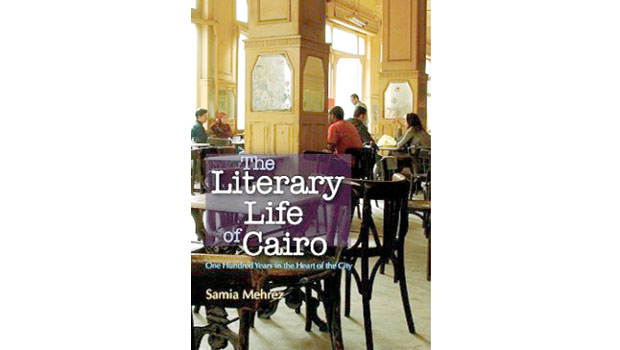
Mehrez explains in her introduction that she had gathered so much material that she eventually published two volumes, consisting of “two fairly independent yet complimentary literary maps of the city,” which she refers to as the literary atlas project.
The present volume characterizes Cairenes’ lives and human relations across the city over the last century. It is divided into seven sections, including “Icons of the City,” “Cairo Cosmopolitan,” “Going to School in Cairo,” “The Street is Ours” and “Women in the City.” The author has also provided summary biographies of the 48 authors of the 72 books from which she has chosen the extracts.
“The Literary Life of Cairo” is released in the wake of the political uprising sweeping the Middle East. Cairo, these days, is full of hope, tension and uncertainty. The sense of history-in-the-making is alive in Africa’s biggest city with an array of excitement it hasn’t seen in decades. The author recreates this atmosphere in the longest section of the book: “The Street is Ours.”
“Indeed, anyone familiar with the general quiet and calm that seemed to dominate Cairo streets during some of the most critical moments in recent Arab history will be struck by the over-representation of iconic scenes of public protest in literary texts of the period. It is as if the constraints that stifle political culture in Egypt on the real streets are undone within the imaginary text,” explains Mehrez.
“Cairo Cosmopolitan” is my favorite section. The literary extracts reflect Cairo’s unique cosmopolitan character. Cairo has always been a haven for many communities from different nationalities and religions. Until recently, it was also a center of learning, known for its prestigious secular and religious institutions, such as Cairo University and Al Azhar.
Ghazi Abdel Rahman Al-Qusaybi, born in Saudi Arabia in 1940, is a law professor who has held many ministerial positions. He is also a poet and author of several novels, such as “The Apartment of Freedom” where he describes the feeling of an Arab student going to Cairo:
“Displacement? Estrangement? But he didn’t feel he was about to be estranged. He was going to Cairo. How can Cairo be displacement? Cairo was the capital of all Arabs, the center of Islam, God’s jewel on earth, the ‘mother of the world’ as Egyptians (who also called it Egypt!) referred to it; the Cairo of Gamal Abdel Nasser, and Voice of the Arabs, resistance against colonial powers; the Cairo of hope, the Cairo of the nationalization of the Suez Canal.”
“Going to School in Cairo” highlights the deterioration of national education in Egypt. Cairo University is no longer the regional magnet that attracted students from all over the Arab world during the first half of the 20th century. Its decline began during Nasser’s political rule, which killed the very spirit of the university.
As state schools suffered the same fate, parents who can afford the fees began enrolling their children in private schools whose number has been steadily growing. The gap between an elite, who can afford private education and the best medical care, and the rest of the population, who have to put up with a decaying health and education system, is one of the main reasons behind the January 25 revolution.
In his thought provoking novel, “Taxi,” (reviewed in this column), Khaled Khamissi delights us with a feisty selection of conversations with Cairo’s taxi drivers. During one of his many taxi rides, the main protagonist has a lively discussion about education with a driver who complains that children don’t learn anything at school:
“In the end the parents are penniless and the kids don’t find jobs. Me personally and a few of my friends with me, we pulled our kids out of education after primary school, and we save their private lessons money for them…Today the only motto is ‘Get smart, make money’, and for your information ninety percent of people live off business, not from anything else…We’ll leave our kids some money to open a small shop or a kiosk or as an advance payment on a taxi.”
While this book is not a substitute for a trip to the land of the Pharaohs, it shows that Cairo still remains the cultural capital of the Arab world, thanks in part to its rich literary life. Tourism is down 65 percent from last year, amounting to a loss of $2.27 billion. With incredible offers and Egyptians overjoyed to welcome visitors, there has never been a better time to visit the iconic Tahrir Square and the Qasr al-Nil bridge — the venue of a clash between demonstrators and the police on February 28.
In the epilogue of “The Literary Life of Cairo,” Mehrez quotes a striking passage from Sonallah Ibrahim’s novel, “Cairo from Edge to Edge:”
“More than once I deserted my home city where I experienced the long and short ends of freedom. More than once I left it, embittered, enraged, determined never to see it again. More than once I abandoned it, haunted by its Citadel with its minarets, only to return again, meek and humble. To this very day, I cannot explain my inability to live in any other city on the face of the earth.”
There can be no better ending for this worthy tribute to Cairo’s rich literary life. Cairo grows on you surreptitiously until you can live nowhere else.