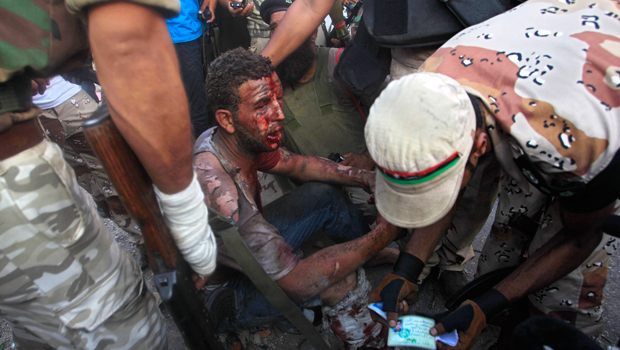
The bullet-riddled bodies of regime soldiers in military uniforms lay on the ground outside a fire station in the battle-scarred Abu Salim neighborhood and the bodies of rebel soldiers were wrapped in blankets nearby. The sewers ran red with blood.
A Reuters correspondent counted 30 bodies riddled with bullets, at least two of them bound with plastic handcuffs, indicating they had been executed. Five of the dead were at a field hospital nearby, with one in an ambulance strapped to a gurney with an intravenous drip in his arm.
Some of the dead wore military uniforms while others wore civilian clothes. Some were African men. Qaddafi is known to have recruited soldiers from neighboring countries.
Elsewhere in the city, a British medical worker said a hospital had received the bodies of 17 civilians believed to have been executed in recent days by government forces.
"Yesterday a truck arrived at the hospital with 17 dead bodies," Kirsty Campbell of the International Medical Corps told Reuters at Mitiga hospital.
"These guys were rounded up 10 days ago. They were found in Bab Al-Aziziya when the guys (rebel fighters) went in. These guys were shot in an execution there," she said. The wounds were not battlefield injuries, she said.
Deafening explosions of outgoing mortars and the whistle of sniper fire filled air clogged with smoke from burning buildings and weapons fire. A mother ran out of one the buildings under siege screaming for first aid for her wounded son. Behind her, the building's glass windows were shattered and black smoked poured out of a burning apartment.
Mahmoud Bakoush, a rebel commander at the site, said there were rumors that one of Qaddafi's sons might be in the buildings, but they are unconfirmed.
Abu Salim, which is adjacent to the Qaddafi compound seized by rebels on Tuesday, is thought to be the last major hotbed of regime fighters in Tripoli and after hours of fierce fighting, Associated Press reporters at the scene said rebels were making progress pushing them out.
However, the rebels know they will not be able to win the six-month-old civil war that has ravaged their country until Qaddafi is either captured or killed.
A regime spokesman told The Associated Press Qaddafi is safely in hiding and leading the battle against the rebels.
"Don't leave Tripoli for the rats. Fight them, fight them, and kill them," Qaddafi said in audio message broadcast on Al Arabiya television. "It is the time for martyrdom or victory," he said, calling tribes outside the capital "to continue their march to Tripoli."
He warned that the rebels will enter people's homes and rape their women.
Qaddafi spokesman Moussa Ibrahim, in a call to AP's Cairo office, said the longtime dictator was in Libya and his morale was high. Ibrahim refused to say where Qaddafi was hiding.
In Abu Salim, rebels were hammering blocks of low-rise, four and five story buildings with anti-aircraft fire, machine guns, and rocket-propelled grenades. Qaddafi forces responded with mortars and dynamite.
Huge explosions filled the air continually, as buildings burned.
"They are holding at least 10 tall buildings. They have heavy weaponry, maybe even a tank," Mohammed Karami, a rebel involved in the battle, said of the Qaddafi loyalists.
UN human rights spokesman Rupert Colville said the allegations of summary executions were alarming. "It is hard for us to confirm anything at this point, but incidents such as these will be looked into by the Commission of Inquiry on Libya which issued its first report in June and is still functioning," he told Reuters.
British Defense Secretary Liam Fox said NATO was playing an active role in efforts to locate Qaddafi. Fox declined to confirm Thursday whether troops from Britain's elite Special Air Service or Special Boat Service were involved in attempts to locate Qaddafi.
Italian Prime Minister Silvio Berlusconi said Italy was preparing to release 350 million euros ($505 million) in Libyan assets frozen in Italian banks. Berlusconi made the announcement following a meeting Thursday with the leader of Libya's rebel Cabinet on the second stop of a European diplomatic tour aimed at securing the release of billions of dollars in frozen Libyan assets.
The Libyan opposition says they urgently need at least $5 billion in frozen assets to pay state salaries, maintain vital services and repair critical oil facilities.