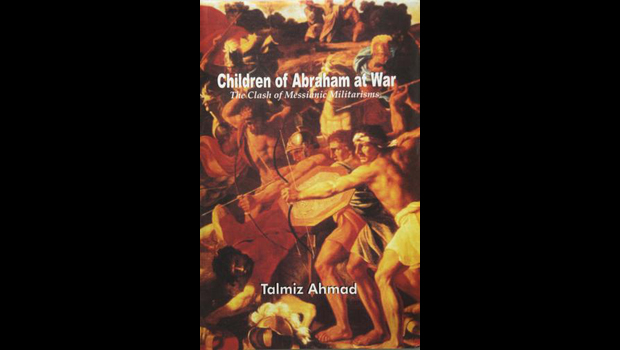
Following “Reform in the Arab World: External Influences & Regional Debates” (2005), Ahmad highlights in this second book the role of Jewish, Christian and Islamic messianisms in triggering hatred and violence among its followers.
Messianism refers to the belief in the appearance of a savior, the Messiah, who will wage a successful war against evil. Concerned by a Western backlash demonizing Islam and Muslims after 9/11, and the extreme violence spreading across the world, the author believes the common messianic tradition shared by the Jews, Christians and Muslims “constitutes the basis of much present-day animosity.”
Ahmad, who is presently the Ambassador of India to Saudi Arabia, thoroughly analyzes the influence of messianism on the political discourse of the religious-nationalists and the settler movements in Israel as well as the Christian Right and the Neocons in the United States. He excels in his study of resurgent Islam, contemporary Islamic messianism, Al-Qaeda, Global Jihad and of the current conflicts.
Besides an extensive and in-depth research, “Children of Abraham at War,” benefits from the author’s distinguished knowledge of the Middle East. During the last 40 years, Ahmad has been posted to Kuwait, Iraq, Yemen, the Sultanate of Oman and Saudi Arabia. He has also served in the Indian Missions in New York, London and Pretoria.
Despite the complexity of the book’s subject matter, the author manages to lead his readers across the dense forest of politics, thanks to useful explanations, a superb choice of quotations and an invaluable summary at the end of the chapters.
Incidentally, the term “messianic militarisms,” present in the book’s subtitle, was first coined by Ralph Nader. The American activist used those words to show how messianism influenced the way the Bush presidency responded to the conflict in Afghanistan, Iraq and against Al-Qaeda in the Global War on Terror.
Ahmad rightly believes that American messianism dates from the arrival of the first European settlers, during the 17th century in New England. Religion has always played a major role in American politics, identity and culture. A number of Americans even believe they have been singled out for a divine mission. While campaigning for the presidency in 1860, Abraham Lincoln famously said: “Americans are the chosen people.”
Ahmad begins the chapter on Christian messianism in the US with a telling quote from Herman Melville: “We Americans are the peculiar, chosen people, the Israel of our time; we bear the ark of the liberties of the worlds…Long enough have we been skeptics with regard to ourselves, and doubted whether, indeed, the political Messiah had come. But he has come in us, if we would but give utterance to his promptings.”
Incidentally, this Judeo-Christian alliance was preceded for many centuries by a fierce Christian-Jewish animosity, which even the Church sanctioned. It is with the rise of Islam and the enthusiasm triggered by the desire to liberate the holy lands from the Muslims that the Christians joined ranks with the Jews. Similarly, the Jews are denigrating 1,400 years of a “mutually advantageous cohabitation” with Islam and they see the Muslim as their archenemy.
It is interesting to know that Orthodox Jews are fundamentally opposed to the idea of a Jewish state, which they consider a sacrilege because it hastens the end of the world and the coming of the Kingdom of God. The creation of the state of Israel, besides the backing of Western states, was due to the alliance of religious Zionism with its secular branch, which gave birth to a “nationalized messianism.” For religious Zionists, Zionism was seen as the hand of divine providence offering the oppressed Jews a chance to return to the Promised Land.
The 1967 Six-Day War triggered the creation of a political movement, “Gush Emunim,” whose basic aim was to rekindle the belief in fulfilling the Zionist plan by secularizing and militarizing its messianic inspired policies. Its biggest achievement was the settlement enterprise. With only a few hundred Jewish settlers in the 1970s, there are now approximately 400,000 settlers. According to Neve Gordon, Jewish messianism does not require the arrival of a messiah but it needs to control the land of Israel. Hence, Israel’s state terrorism is considered self-defense.
However, there are some encouraging signs in Israel. A growing number of writers are breaking new ground as they criticize the Zionist policies. In the US, the Israel lobby represented by the American Israel Public Affairs committee, known as “AIPAC,” is no longer alone. Its once supreme authority is now being challenged by J Street, an organization founded to offer a new approach to the Middle East. Breaking away from AIPAC’s hardline ideas, J Street promotes the creation of a viable Palestinian State.
On the other hand, the US losses in Iraq and Afghanistan have highlighted the failures of neocon policies, the need to reassess its strategic priorities and shed its biased approach toward Islam and the Arab countries.
The second half of the book takes us right to the heart of the Muslim world. Ahmad is most at ease with this topic, since his intimate knowledge and understanding of resurgent and radical Islam, Al-Qaeda, as well as the political situation in Palestine, Iraq and Afghanistan shines through.
The subject of Afghanistan is particularly significant. Ahmad reminds us that the mujahideen struggle in Afghanistan gave a powerful boost to Islamic radicals who drew three main lessons. First, the jihadis stated that in Afghanistan they had witnessed the practical implementation of the blueprint for jihad described out by Maulana Maududi and Sayyid Qutb. The second lesson drawn by jihadis was that following the retreat and ultimate breakup of the Soviet Union, the destruction of the remaining superpower, the US, was a necessary pre-condition for an Islamic revolution in Muslim countries. Lastly, the core group of Islamic radicals around Bin Laden and Ayman Al-Zawahiri, also recognized the idea of a trans-national globalized jihad.”
The situation changed greatly after 2001 when US forces bombarded Afghanistan forcing out members of Al-Qaeda, hidden in mountainous caves, and destroying the Taliban political structure. Currently, Al-Qaeda doesn’t have a strong global structure, but it has given birth to individuals and groups with no links to Al-Qaeda, yet ready to kill innocent people anywhere in the world.
These isolated cases of violence, such as the suicide bombing which happened recently in Sweden, have only worsened people’s perception of Muslims in the West. However, according to the author, “the contemporary quarrel of Muslims with the West is neither inherent, nor historical nor even ideological. It emerges from contemporary concerns relating to certain specific issues, such as Palestine, and, more recently, Iraq and Afghanistan.”
The book ends on a hopeful note as Ahmad recalls President Obama’s reconciliatory speech to the Muslim world in Cairo. “The stage is now set for the rejection of messianic dreams and demonizations.” But, since that auspicious speech on June 4, 2009, nothing has happened. Obama has failed to fulfill his promises and the stage has remained remarkably silent.
“Children of Abraham at War,” offers a fresh look at the situation in the Middle East with its focus on the role of messianism in contemporary politics — a force too often unacknowledged. Insightful and well researched, this book not only helps us understand the present, but it also warns us about the dangers of unchecked messianisms.