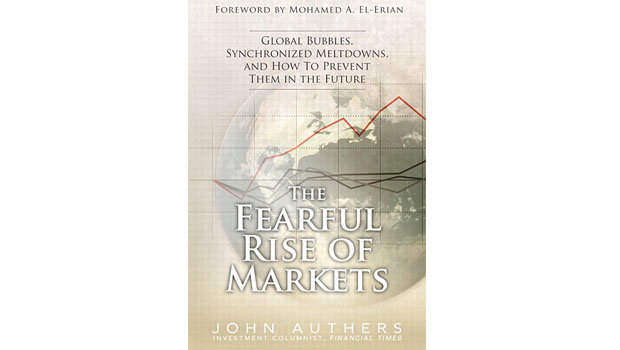
This book is a must read for anyone interested in markets, not just for investors, analysts or policy makers but also for all those who know little about the complex world of finance. Authers writes in a clear and concise manner; he has the knack to explain complicated financial terms in a simple way.
In his foreword, Egyptian born, Mohamed A. El-Erian, (CEO and co-CIO of PIMCO, and author of “When Markets Collide”), calls the book a “journey of discovery” where each stop introduces us to the drivers of the rise in markets, their collapse, and their re-emergence still vulnerable to failures.
John Authers reminds us that in October 2008 the value of global retirement assets lost about 20 percent of their total value in a week. However, this financial debacle, which should have caused important repercussions but evidently did not, implies that the threat of another synchronized collapse is a real possibility.
The author’s intentions for this book are clear: He wishes to explain “how the world’s markets became synchronized, how they formed a bubble, how they all managed to crash together and then rebound together, and what can be done to prevent another synchronized bust in the future.”
From the very first pages of this fast-moving book we are told that investment bubbles recur because they are grounded in human psychology. Markets are driven by the interaction of greed and fear. A perfect example is what happened to wealthy Dutch merchants during the 17th century: They became crazy over rare tulips creating what is known as “Tulip Mania.” During that period, many paid their life savings for just one tulip bulb.
History is repeating itself and people across the world are becoming greedier, but this greed is no longer moderated by fear so that investors are motivated by a gross overconfidence.
“When people make decisions about someone else’s money, they lose their fear and tend to take riskier decisions than they would with their own money,” Authers writes.
This loss of fear is also driven by the seemingly unlimited investment possibilities with the presence of assets that can be traded, such as emerging market stocks, currencies, credit, and commodities previously available to specialists only. This led to a novel situation in which capital markets took over the basic functions of banks, with money market funds even offering checkbooks. Consequently, banks were driven to invest money into areas that were new to them.
On the other hand, money-market funds did not have to operate a branch network. They also benefited from an absence of the regulated interest rates imposed on banks and, with no premiums to pay for deposit insurance, they had consistently lower costs than banks. But despite their appearances they were not similar to bank accounts; they simply took away power from banks and gave it away to markets. By 2008, banks used the same principles as money-market funds, borrowing in the short-term and putting the proceeds into longer-term bonds until they had set up what has been dubbed the “shadow banking system” accessible only to the world’s biggest bankers.
Money-market funds were prone to compete with each other, and they soon came up with the motto “more return for no more risk.” Making money seemed to be either devoid of risk, with the benefit of bailout if something went wrong. This no-lose situation encouraged funds’ managers and their investors to take even greater risks.
Furthermore, global mega-mergers left many banks “too big to fail” and “so important to the economy that governments could not let them collapse,” says Authers, who mentions that during the last crisis the United States and other European countries spent trillion of dollars to save these super banks. This reinforced the belief that risk-takers will always be rescued. However, Authers strongly believes that such banks must be regulated so tightly that they simply are not allowed to gamble, or they must be made smaller. A view shared by Alan Greenspan. The former chairman of the US Federal Reserve suggested in a recent interview given to Alan Beattie, the Financial Times’ international economy editor that “banks might have to be broken up by law if they become too big to fail without bringing down the whole financial system.”
Money markets should also follow the same regulations as banks. This, of course, would annihilate all their former advantages, enabling banks to do what they know best: lending money. Authers also rightly points out that in mutual funds it is far too easy for mediocrities to become rich. The solution is to pay investment managers a fixed fee so they are no longer rewarded solely for accumulating assets and funds would also be less likely to grow too big.
Another necessary reform, to save people from being tempted to make reckless investments, is to offer “a well-tailored default option covering a sensible distribution across the main asset classes, with both passive and active management,” rather than multiple choices.
Readers with scant knowledge about the history of finance will receive key information about the historic move from gold standard to oil standard in 1971. This opened the door to the ups and downs that consequently rocked the world markets.
In 1944, the victorious Allied powers agreed, during a summit held at Bretton Woods, to return to the practice that had been in place for many centuries. This system guaranteed that bank notes could be exchanged for a certain amount of gold. Gold being scarce, this limited the amount of paper money a government could have. During the Bretton Woods era, the world market stayed away from banking crises and investment bubbles. Once the United States abandoned the gold standard in 1971, it became tied to a novel “oil standard”.
The next important breakthrough happened in 1984 when the Reagan administration allowed banks to package mortgage loans into bonds and sell them to investors. Thus many countries from the United States to Spain in the 1970s to Mexico in the 2000s, funded their emerging middle class. Greenspan admits to having been “30 percent wrong” during his time as Fed chairman (1987-2006) in assuming that banks and financial institutions would closely monitor the credit worthiness of the people with whom they were doing business. He is also not only convinced that markets are safe, but also that the United States’ finance capitalism will not be replaced by the European model which is more regulated.
Authers, a staunch advocate of free enterprise, does not quite share Greenspan’s one-sided views. He concludes: “The cycle of greed and fear is hard-wired into human nature . . . Further, markets should distribute capital much more efficiently. They might even shower capital on technologies and innovations that can improve our well-being, rather than sending resources and talents to an artificially bloated financial services industry.”
In this decisive book, Authers uses his expert knowledge to explain in a style, devoid of financial verbiage, what caused the recent credit crunch and how to avoid an even more disastrous crash within the next years. It is a must-read.