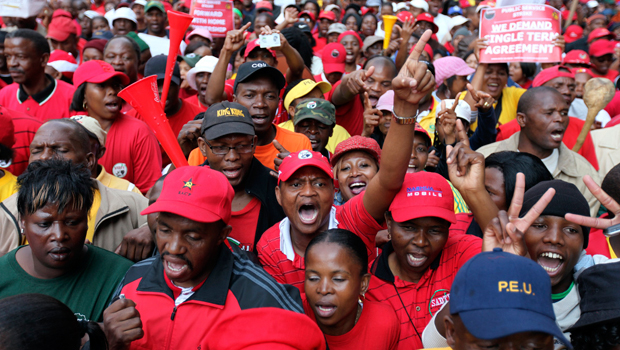
Thousands of striking state workers held marches in major cities nationwide calling on the government to meet their wage demands. About 1.3 million unionized employees have walked out in the standoff, shutting schools and cutting off medical treatment at hospitals.
"The alliance is again dysfunctional," COSATU Secretary-General Zwelinzima Vavi said in a statement. "The center cannot hold."
The comments were some of the strongest signals to date that organized labor, which helped President Jacob Zuma ascend to the presidency, may be ready to cut, or change, a relationship with the ANC that was forged in their struggle to end apartheid.
The state workers' strike has had no major impact on rand and bond trading but market players said worries would mount if it extended into September and other labor groups joined in.
Jasson Urbach, an economist with the Free Market Foundation, estimated the work stoppage was costing the economy 1.084 billion rand ($147.8 million) a day.
Police fired rubber bullets when protests turned violent in Kimberley, about 435 km (270 miles) southwest of Johannesburg, while rallies slowed traffic to a crawl in major cities.
COSATU said it filed 7-day strike notices on Thursday so that all its 2 million members could join the state workers in a strike they said would also target the mining and manufacturing sectors, a step which could grind the country to a halt.
Some analysts believe South Africa could ultimately benefit from a split between the ANC and COSATU because it would allow the government to ditch union-friendly policies and reform a rigid labor market, criticized for restricting investment and driving up production costs.
But not all are convinced that the long-time partners will abandon each other, despite growing acrimony.
"The reality of each of these factions is that it is very difficult for them to break with their ally, however tenuous that relationship is," said Mark Schroeder, a specialist on Africa for global intelligence company Stratfor.
NOT AFFORDABLE
On top of the wage dispute, the leader of the ANC's Youth League Julius Malema fired what amounted to a warning shot at Zuma on Wednesday, questioning his leadership and implying the ruling party's youth wing would not support Zuma for a re-election bid.
COSATU also wants the government to reverse a 9-billion-rand deal involving mining giant ArcelorMittal that transfers 26 percent of its local shares to employees and black investors including a consortium led by Zuma's son, Duduzane.
"We are heading rapidly in the direction of a full blown predator state, in which a powerful, corrupt and demagogic elite of political hyenas increasingly controls the state," Vavi said, as he took a swipe at Zuma over the heavily criticized deal.
The government has said it cannot afford the state workers' demand of an 8.6 percent wage rise, more than double the inflation rate, and 1,000 rand ($136) a month as a housing allowance. It has offered 7 percent and 700 rand.
Any agreement to end the dispute is likely to swell state spending by about 1 to 2 percent, forcing the government to find new funds just as it tries to bring down a deficit totalling 6.7 percent of gross domestic product.
An expanded strike would add to worries about prospects for growth after the economy slowed more than expected in the second quarter of 2010 as mining contracted and manufacturing expanded at a slower pace.
Separately, the National Union of Mineworkers said it would consider widening strikes at an Exxaro unit and at a Rio Tinto-BHP Billiton joint venture unless its demands for higher wages were met.