JEDDAH, 17 May 2007 — People with special needs in the Kingdom suffer from a type of imposed isolation due to a lack of public facilities and awareness among fully able members of the public. As a result, many special needs people refrain from going out in public to an extent that some foreigners question whether disabled and blind people even exist in the Kingdom.
Official reports show that people with special needs make up 13 percent of the Kingdom’s population and that nationwide there are over 200,000 people suffering from one sort of vision impairment or another. In addition, there are also 80,000 deaf and mute people and thousands more, who are paralyzed and suffer mental illnesses.
The question of why people with special needs are not seen in public is one that has been posed to many experts and members of the public. In relation to this, an Arab News reporter decided to first of all see what life with a white cane and dark shades is actually like in the streets of Jeddah.
The reporter borrowed a tracking cane and took a crash course on how to use it from the Ebsar Foundation, a Jeddah-based organization that works toward helping people suffering from vision problems.
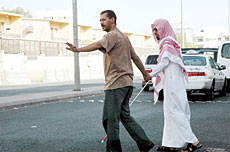
Followed by a photographer, the reporter — who pretended to be blind — visited a number of locations in Jeddah to gauge how much help he would receive and how difficult it is to walk in the city.
With his eyes shut tight to make the experiment absolute, the reporter began walking in Tahliah Street in front of McDonald’s. Youngsters who were hanging in the area offered to walk the reporter to his desired destination.
When the reporter walked into sidewalks, tripped in ditches and bumped into lampposts, members of the public would come forward to offer help. One young man even offered to give the reporter a ride in his car.
In the poorer areas of the city, especially toward the south, the response was even greater, with many people asking the reporter to sit down and join them for food and drink while they arranged for a car to drive him wherever he wanted.
Even beggars came out to help the reporter, with one African lady, who was begging by a sidewalk in the Al-Faisaliah district of the city, leading the reporter through roads filled with traffic.
Jeddah’s public was generally very helpful. However, the city’s roads and sidewalks are difficult to maneuver and are filled with obstacles that cause blind people stumble and fall.
Muhammad Towfik Bellow, general manager of Ebsar Foundation, said that people with special needs usually lead normal lives but remain mostly indoors because of a lack of appropriate civil planning and public awareness.
“I believe that if there were suitable places to go, they wouldn’t hesitate to visit them and a good example of that is the Ebsar Foundation, which has become a pleasant place to visit for people with vision impairments,” he said, adding that this is indicative of a big need for specialist clubs and other facilities to encourage visually impaired people to spend their time well.
Bellow added that there is a need for different government ministries to coordinate with each other to build good roads, curbs, streets and traffic lights that are blind people-friendly. This would allow them to “safely, independently and gracefully” carry on with their daily lives.
“There is a great need for widespread media involvement,” he said, adding, “It is essential to have a culture that meets the requirements of people with special needs. The public should understand that people with special needs have the right to live like others and to have jobs as normal people do.”
Roads and public facilities are designed in a way that ignores the needs of people with special needs. Unlike other well-developed countries, there are no facilities that would help a blind person walk in the city’s streets, he said, adding that there are no sound-warning traffic signals or path indicators on sidewalks.
“There are also no signs in Braille in basic places like elevators. With the lack of all these things, how do we expect such people to be seen in public,” he said.
Bellow added that one important issue is a lack of social rehabilitation centers for people with special needs that would help them understand their situation and provide them with the support to be independent and gain confidence to go out in public.
Ahmad Kamaluddin, an Indian who sells watches in the streets in the downtown Balad area, has serious visual problems. Kamaluddin walks using a cane and in spite of his disability is able to earn a living selling watches.
Speaking to Arab News, he said that sometimes people deceive him by giving him less money, something that has forced him to develop a special skill in differentiating the value of banknotes just by touching them.
Kamaluddin never leaves his area, which he is familiar with. “I can’t leave the area or I’d be lost. I’ve memorized the different landmarks and would be lost without them,” he said.
Dr. Sarfaraz Ali Khan, director of low vision services at Ebsar Foundation, said that according to the World Health Organization, around 90 percent of the world’s blind live in the developing world and that only five percent of them have access to or use services provided by organizations such as Ebsar.
He added that 1.5 percent of the Kingdom’s population suffer from some sort of blindness, while 7.8 percent have visual impairment problems.