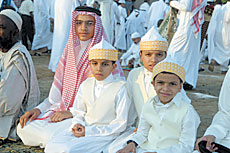
RIYADH/JEDDAH/MADINAH, 24 October 2006 — From Jeddah in the west to Dammam in the east, Saudi Arabia yesterday kicked off the three-day Eid Al-Fitr celebrations with much fanfare.
Riyadh Governor Prince Salman joined the citizens and residents in performing Eid prayers at Imam Turki ibn Abdullah Mosque in downtown Deira.
Eid prayers were also held in 56 other Eid mosques and grounds around Riyadh marking the conclusion of the holy month of Ramadan.
Later, the governor received princes, scholars, sheikhs, ministers, senior officials as well as commanders and officers of the armed forces, as well as groups of citizens who greeted him on the festive occasion.
In the Sulemaniya district mosque, the imam highlighted in his sermon the significance of fasting and the importance of Eid to Muslims.
There was brisk sale of wheat bags costing SR10 each, which the people bought in large numbers for distribution among the poor and the needy as part of their fitra. Those who could not buy the wheat bags gave away the equivalent amount in charity.
The city was virtually deserted as most of the people had flocked to hypermarkets and restaurants to buy clothes and gifts or to stock up on food. There was also a big rush outside “tamees” (leaven bread) vendors causing the customers to wait for an hour or more for their turn.
The Riyadh municipality has lined up a number of programs for evenings after Isha prayers. They include folklore dances from different regions.
The holy city of Madinah was a bee’s nest of activity after Isha prayer on Sunday night as last-minute shoppers rushed to stock up for Eid.
Shopping centers around the majestic Prophet’s Mosque were particularly crowded with vendors there saying children’s clothing was in high demand.
Despite the hustle and bustle in Islam’s second holiest city, many vendors said the shopping season was not as profitable as last year. Some blamed the stock market correction earlier this year.
A furniture-store owner said that he used to receive at least 32 orders to replace or renew old furniture in the last half of Ramadan. He said this year he only received nine orders in total for the whole Ramadan season.
Abdul Haq Khan, a Pakistani tailor, said that in the past many of his customers were buying five new outfits. This year, he said, many wanted only one dress that will get them through for the first day of Eid.
People from Egypt, Indonesia, Pakistan, Bangladesh, Syria, Turkey and many other nationalities were seen shopping for the Eid. Ezmeer Ismael, a visitor from Turkey, said that this is his fourth Eid in Madinah in the last 10 years. He said that Eid celebration in the Kingdom is very much close to the celebration back home.
“I feel as if am at home rushing to buy Eid clothing and decorations,” he said. “We came to Madinah in a group of 60 people and we will celebrate Eid with our Muslim brothers in Madinah.”
People started to flood the Prophet’s Mosque two hours before Fajr prayer just to find a place inside the mosque. The areas inside the mosque filled quickly and the pious people were seen spilling out onto the surrounding streets and sidewalks. The mosque was empty after the Isha prayer. The mosque was given a fresh look for Eid, with new carpets and the scent of oud.
Residents from Yanbu, Badr, Al-Akhal and Al-Ula arrived to the Holy Mosque with their families to pray. Some traveled over 200 km just to pray in Madinah and visit some relatives before going back again. This influx caused traffic to snarl. Some people parked their cars three kilometers away from the mosque just to avoid the huge traffic. Traffic department officials were present at the roads around the mosque even as tens of thousands of people walking on the main road added to the congestion.
Like elsewhere in the country, men, women and children gathered in main Jeddah mosques before dawn yesterday to perform Eid prayers. One of the most well-known locations, the municipal Eid prayer land located in Khozam area besides Makkah Road, was packed.
The locations were filled within an hour with gorgeously dressed people who came with their own mattresses and gathered in the area. Small boys and girls took the flashlights with their colorful and traditional clothing.
Some boys were dressed up in an authentic Hejazi dress, a turban and a white vest that is dressed over the thobe. The grown-ups also added to the color, as each authentic group came with their original cultural dresses.
A few blocks away from the Khozam area in Madain Al-Fahd, people also filed in to pray, with stragglers resigned to praying by the main road.
“I barely found a place for my family in the parking lot next to vehicles,” said Jeddah resident Muhammad Al-Garni.
The imam of Al-Rajhi Mosque in the area invited the people of the district for a breakfast in the mosque.
Many men and children went to the mosque, where they had their breakfast and listened to a speech about the blessings of Eid and its role to re-connect people who had been taken away by daily life’s issues.
Shortly after prayers, kids were rushing to knock the doors of neighbors for greetings and to have some of the Eid candies that are given away to children and guests as a traditional custom.