WASHINGTON, 24 June 2006 — The Bush administration says it wants to improve its image abroad, especially among Arabs and Muslims. But when it comes to “being there,” their absence was widely noted at one of the largest Arab-American events of the year.
The American-Arab Anti-Discrimination Committee, ADC, one of the nation’s largest and most powerful Arab-American organizations, hosted an all-star cast at its annual convention last week. The distinguished guest list included actor Omar Sharif, Golden Globe winning director Hany Abu-Assad (“Paradise Now”), “60 Minutes” anchor Mike Wallace, and Helen Thomas, dean of the White House press corps.
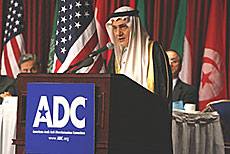
Prince Turki Al-Faisal, Saudi ambassador in the US, delivered the keynote address last Saturday while sharing the podium with Rep. John Conyers, D-Michigan, who presented the US flag that was flown half-staff over the US Capitol on Feb. 14, 2005, the day Lebanese Prime Minister Rafik Hariri was assassinated in Beirut, to a representative of the Hariri family. Hariri’s son, Mohlis, — who was scheduled to receive the flag — was unable to travel due to a death in the family.
Recognizing the effective outreach of the ADC, it was the charismatic Omar Sharif who told the audience that like-minded organizations are needed in every country in Europe.
Notably absent was Karen Hughes, undersecretary for Public Diplomacy at the State Department, and Dina Habib Powell, assistant secretary of Education and Cultural Affairs at the State Department. Habib-Powell, who is of Egyptian descent, and Hughes are both supposed to be working to improve the administration’s troubled public diplomacy effort and improve the US image abroad, particularly in the Muslim and Arab world where anti-Americanism has fueled extremist groups and terrorism. Pity they couldn’t make it.
For three days, the ADC sponsored intense panels and workshops on media issues, civil rights, charities, small-business programs, lobbying workshops, and Arab-American literature, youth, civil liberties and academic freedom. The program was so jammed with competing panel discussions that it was difficult to decide which ones to attend.
In addition, there was a film festival, exhibits and even nightly haflehs, which - one hears - ran well into the wee hours of the morning. Saudi Arabia’s presence was prominent throughout. The ADC’s opening reception was held at the Saudi Royal Embassy, with Prince Turki present and actively mingling with the crowd.
The ambassador also delivered the keynote address for the ADC’s banquet and surprised more than few attendees with his frank speech. When speaking with Arabs in the US, Prince Turki said he senses “great frustration — frustration that they are not being heard.”
Certainly neither Hughes nor Habib-Powell were there to listen. “I am here to celebrate the beautiful mosaic that is the Arab world,” he said as people settled back in their chairs. Stressing that he was speaking to the audience foremost as Arabs, he described his experiences since taking up the reins of the embassy last year. He then started off a volley of provocative comments that caught everyone by surprise.
“The voice of the Arab-American community in the US is either being drowned out or not expressed loudly enough,” he said. “And the needs and the rights of Arabs in America need to be emphasized to a greater extent — in both legislation and in the media.” He added: “I also see something else that gives me pause. I see that Arab-Americans — as a group — are holding themselves back.”
Prince Turki said he also senses anger amongst Arab-Americans — “as their progress Arab Americans throughout the years has been upended by terrorists and deviants who have no values in common with us.
“The accomplishments of all the Arab-Americans were so quickly washed over by the tidal wave of misinformation that followed Sept. 11,” he said. “Fear and suspicion suddenly replaced appreciation and respect.” It was a significant speech for any ambassador. As if saying American Arabs were “holding themselves back, frustrated and angry” wasn’t enough, he added defensiveness to the list.
“I sense defensiveness because the beliefs, culture, and heritage of Arab-Americans are under attack because they are misunderstood,” he said. “Again, because of terrorism, the already largely misunderstood Arab culture in the US was dealt a hand of prejudice” On a more positive note, the ambassador said that the Arab-American community “can help itself” through united activism. Prince Turki summarized objectives that Arab-Americans must achieve to win understanding and respect.
“Arabs need to find their voice in the discourse of American politics. Arabs need to get out there and get involved more,” he said. “Right now Arab-Americans are underrepresented relative to their numbers, their economic status, and their achievements. As an ethnic group with clear importance to American society, too few are heeding the call to action.” “There are over three million highly successful Americans of Arab descent in the US today, but only five Arab American members of Congress,” he added.
A previous speaker had made the audience squirm in their seats by explaining that the ADC’s annual donations are $1.8 million, compared to the $60 million in donations received by the American Israel Public Relations Committee, or AIPAC, one of the most influential lobbying groups in the US with over 100,000 active members. The group has been instrumental in isolating the Palestinian leadership by lobbying to place Hamas and Fatah on the most restrictive terrorist lists. “If Arabs want a greater voice, they must stand up. They must stand up and get involved,” he said. “Americans and Arabs interact more and learn more about each other.”
Too bad Hughes and Habib-Powell missed these suggestions, too. Noting that many American-Arabs tend to restrict their close contacts from those emigrating from their birth countries, Prince Turki again challenged the audience: “Whether you are from Palestine, Syria, Lebanon, Saudi Arabia, or any other part of the Arab world, you should be proud of your Arab heritage and legacy — which truly does extend here to the United States.”
The ambassador urged Arab-Americans to work to bridge to social gap between “the two great societies” by getting involved in the political process. “It can’t be done without you,” he said.