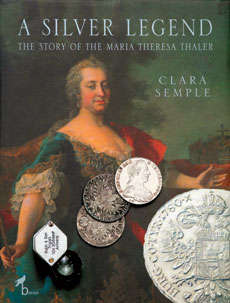
INCREDIBLY a connection exists between late 20th century headhunters in Borneo paying blood money to their victim’s relatives and a remarkably able and philoprogenitive 18th century Hapsburg Empress. That connection is a rather beautiful silver coin — the Maria Theresa thaler. The Maria Theresa thaler became, over two and a half centuries, an official and de facto currency as well as an integral part of the social and trading history of the Middle East and North Africa (MENA) and points east across India and Pakistan into Indonesia.
Clara Semple’s intriguing new book on the origins, trading life and legend of this iconic coin, bearing the image of a long-dead empress, presents years of research and intellectual rigor in an eminently readable form. Beautifully produced in hardback and illustrated in full color by the Anglo-Arab publishing house, Barzan Press, it is a fascinating insight into the history of a coin and the societies that refused to let it die.
Semple traces the rise of the coin from its first appearance as legal currency in Austria 1741 with the image of the young empress up to her death in 1780. During this period the thaler was widely circulated through her domains and beyond. It was when she died in 1780 that the coin, until then legal currency, took on a second life. The new emperor, her son Joseph, allowed minting of the coin with the image of his mother on the obverse with the date frozen at 1780.
The story of the thaler begins much earlier than the 18th century, however — with the first voyages of discovery in the 15th and 16th centuries. Merchants found that the peoples they wanted to trade with demanded silver bullion in exchange for their goods. The Spanish, with their Potosi silver mine in Bolivia, had a lead on the rest of the old world. Spanish silver dollars or reales — first minted in 1497 — were produced in assorted denominations, including one for eight reals, the famed ‘pieces of eight’ immortalized by Long John Silver’s parrot and beloved of pirates. By 1536 Spanish silver coins had developed a second form which bore the image of two pillars entwined in a ‘s’ shape in a brassard bearing the logo “ne plus ultra.” It was probably this which gave rise to the dollar sign — $. In the 16th century, a Bohemian nobleman discovered huge deposits of silver in the valley of St Joachimsthal. He obtained permission to mint coins which became known as Joachimsthalers — or colloquially “thalers” from the German for valley — “thal.”
As the coins spread into in Europe, the name changed according to local languages. The Dutch called them daler, the Swedish daalders and the English dollars.
When the Maria Theresa thaler came on the scene, the image of the young empress added value to the coin. The Austrian thaler had a very precise (83.3 percent) and invariable silver content and was, with the technology of the times, impossible to forge unless you had a mint. Later in its history, and after it ceased to be a currency in 1858, the thaler was minted as far away as Birmingham and Bombay, much to the annoyance of the Austrian mint. The easily identifiable marks of authenticity — the nine pearls in the brooch on her shoulder, for example — encouraged merchants and traders to take thalers as payment over other coins.
The real keys to the popularity were less technical and rather unexpected. The Victorian traveler Samuel Baker put it this way: “The effigy of the Empress with a very low dress and a profusion of bust is, I believe, the charm that suits the Arab taste.” Levantine traders rejected the modest image of her in widow’s weeds and begged the Gunzberg mint to return to its original form — which in the 1750s was just becoming established as a medium of exchange abroad. The outcry was more likely that in the more modest widow’s portrayal, after her husband died, the number of stones in her tiara and the all important pearls in the shoulder brooch — key points of authenticity — were absent. The mint acceded.
The “Levantine Thaler” as the redesigned coin was known, ceased to be legal tender in Austria after 1858; with commendable foresight, an imperial edict of 1857 allowed production to continue to the present day.
The striking coin, with its utterly reliable silver content, made a good source of bullion for the jewelry worn by women in the MENA countries. Largely due to the coffee trade that was developing rapidly at that time in the countries bordering the Red Sea, it represented portable wealth and security. The coins were also worn as jewelry.
It was this last aspect of the thaler that attracted Semple to the coin. She is an artist who spent many years recording the friezes and pottery in archaeological sites on the Nile living, as she said in Jeddah last week, “in wondrous splendor on a houseboat and, for a period, actually in the temple at Karnak.” Her particular skill was to reconstruct images of whole artifacts from pieces found during digs.
Having discovered the coin, Semple acted to record the story of the thaler. “It needed to be done immediately because the coin was finally on its way out here,” she said. “Another generation won’t know it.” Her eye for detail was drawn to the intricacy of the engraving on the thaler and the intriguing manner in which, what at base was a currency, refused to disappear because of the artistry with which it was made.
The need for a reliable international coin was intensified when coffee, first cultivated in Yemen and Ethiopia in the 1500s — became a popular beverage. The Austrians discovered it when the Turks left a sack behind after the siege of Vienna in 1683. Coffee exporters wanted reliable currency. When the thaler appeared, it quickly established itself as the sole medium of exchange. During the century after its introduction in North Africa and Arabia, the thaler bearing the image of the buxom empress became familiar and trusted in the Levant, north Africa and the Arabian Peninsula.
While the Hejazis tended to prefer the Spanish dollar ñ the real which later gave its name to Saudi, Yemeni and Omani currency — the annual Haj in Makkah established the thaler in Makkah and Jeddah where it was the acceptable medium of exchange for both coffee and slaves. Semple, quoting Prussian traveler Gustav Nachirgal, notes the prices of slaves in the 1870’s as “a robust man 12-14 thalers, a girl 20 — 25 and a eunuch in boyhood as 50 — 80 thalers.” A good horse, however, could cost 2,000 thalers.
The disadvantage of the thaler for large purchases was the weight. One hundred tons of coffee in Sudan in 1923 cost 20,000 thalers. Weighing 2,000 pounds without the packing, these had to be bought from sources in Addis Ababa, then transported on 30 mules to the producers.
As countries moved to the gold standard in the late 19th century, the price of silver fluctuated and the money speculators moved in. The Germans, Italians, Turks and Egyptians all tried to eliminate the thaler but with little success, confirming how deeply rooted in the trading culture the coin had become.
In Saudi Arabia, King Abdul Aziz introduced the riyal in 1928; thalers were no longer legal currency but still circulated in the interior among Bedouin tribes. In the same year the Vienna mint received an order for half a million from the Kingdom. Wilfred Thessiger carried 2000 of them on his expedition in 1947, “as the only form of money the Bedou would accept.”
Still the old empress persisted. When Barclays Bank opened a branch in Addis Ababa in 1941, the cashiers were inundated with deposits of thalers, often retrieved from buried hoards. The process of counting was so toxic that one teller devised a gas mask to survive. They were cashed up and counted in piles of twenty outside the building and carried in on trays. In this dusty corner of Africa, the term “cash and carry” was born.
“When I first came to Saudi Arabia in 1970, I was mainly interested in jewelry,” said Semple. “I saw the jewellery in the souk in Riyadh, ladies sitting with black veils over baskets. When they lifted the veils, a treasure trove of jewelry was revealed.”
The common thread in Semple’s investigation of the thaler is jewelry. The frequently recurring icon of the magnificent Maria Theresa triggered her interest and slowly developed into a passion for the coin. “I lived in fear of expert coin collectors,” she said, “but wanted to write a book that was readable and authoritative.” She has succeeded.
After a seven stop tour of the Kingdom, Clara Semple makes her final presentation at a public book signing to be held at Desert Designs in King Abdullah Street, Al Khobar today (Thursday).
Packed with anecdote, substantially referenced, usefully indexed and liberally illustrated, Semple has produced what promises to become a standard work for the general reader on the thaler. Anyone with an interest in the Middle East and Saudi Arabia should read it, if not for the erudition, then for the accompanying insights into the culture and society. When she was in Jeddah, Semple could not resist diving into the souks. Sure enough, she resurfaced, eyes bright and carrying a carrier bag bulging with thalers.
“I wonder if this is the last we’ll see of them,” she asked. Somehow I very much doubt it.