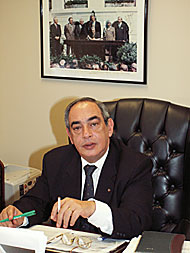
For many years, pro-Israel activists in the American capital have had it relatively easy, thanks to the failure of the Palestinians to organize an effective lobby or to station an effective spokesman in the United States.
But the fight just got tougher, with the recent appointment of Afif Safieh — one of the sharpest and most eloquent Palestinian representatives in the world — to head the Palestine Liberation Organization’s diplomatic mission in Washington.
— Ori Nir, Forward — Dec. 30, 2005
Ambassador Afif Safieh and his wife, Christ’l Leclercq, hit the ground running after arriving in Washington, DC on Oct. 26, 2005. The Palestinian diplomat has held meetings with Bush administration officials, US lawmakers, members of the clergy, Arab-American and Muslim-American groups, Jewish organizations, NGOs, think tanks, fellow diplomats and journalists. Christ’l Leclercq usually is at his side.
At his first public lecture, a Dec. 2 briefing at the Palestine Center, a standing-room-only crowd of Arab-Americans, community activists and reporters came to hear Ambassador Safieh on an unusually hot evening. No one moved a muscle during his impassioned speech as he discussed the history and challenges the PLO Mission Office now face in Washington, DC.
The audience was charged up and energized. “He’s like a breath of fresh air,” one activist said. “I think Americans will listen to this man.”
It’s hard to keep up with this gracious diplomat as he moves from one subject to the next, barely taking a breath in between. He’s a writer, an eloquent speaker, and a historian, as well as a political genius. Safieh’s boundless energy is very much needed at this time in the United States — from Capitol Hill to the White House, college campuses and places of worship. On Jan. 16 he spoke at a Dr. Martin Luther King Day commemoration held by Black Voices for Peace at Plymouth Congregational Church in Washington, DC. The next day he held a Capitol Hill briefing, sponsored by the Council for the National Interest, which was broadcast on C-SPAN. And he is willing to speak wherever he’s needed.
Afif Safieh was born in East Jerusalem in 1950. He says jokingly that, in his family’s narrative, his birth was his parents’ “consolation prize” for losing their West Jerusalem home in the Nakba, or catastrophe, of 1948. He turns serious again when he admits, “It is extremely painful to be a refugee in the same city.” After attending Collège des Frères in Jerusalem, Safieh left home in 1966 to study in Belgium, where he earned a degree in political science and international relations from the Catholic University of Louvain. He and his brother were studying abroad when Jerusalem fell in the 1967 war.
Any Palestinian who was overseas during the census Israel conducted in October 1967 became “legally non-existent” and forfeited his right to return, explained Diana Safieh, the ambassador’s sister, who lives in Jerusalem. Their father lost his home in 1948 and his sons in 1967. “It was the second loss that hurt him most,” she said, recalling, “It’s the only time I saw him cry.”
Safieh made his first trip back to Palestine in 1993. Over the years he has tried unsuccessfully to return to his birthplace, where his family still lives. He applied for resident status under a family reunification program, but in 1995 the Israeli Interior Ministry denied permission. He had hoped to launch a weekly magazine he was to call Palestinians.
He met and married the delightful Christ’l Leclercq, a Belgian writer, and the couple has two extraordinary daughters, Diana and Randa, now both in college.
Safieh continued his education at the Paris Institute of Political Studies, graduating in 1974 with a master’s degree in political science. He was a staff member in President Yasser Arafat’s office in Beirut, in charge of European Affairs and UN institutions, from 1978 to 1981. Next he became a visiting scholar at the Catholic University of Louvain from 1981 to 1985, and then at Harvard University from 1985 to 1987.
Safieh represented the Palestine Liberation Organization (PLO) in the Netherlands from 1987 to 1990, and in 1988 was involved in the Stockholm negotiations that led to the first official and direct American-Palestinian dialogue. In 1990 he became the Palestinian General Delegate to the UK, and in 1995 took on extra duties as PLO General Delegate to the Holy See.
“We’re having a lasting peace process, but what is lasting is the process and not the peace that is so desirable,” he says.
A Christian, Safieh said he often wonders why it is taking so long to return the land captured by Israel in the 1967 war. “What was occupied in six days can be evacuated in six days, so we can rest on the seventh!” he promised. “Palestinian demands are unreasonably reasonable. We’re asking for 22 percent of what was legitimately ours in the beginning of the century. We offer 100 percent peace for 100 percent of the land occupied in 1967.”
Safia quoted playwright Bertolt Brecht who, in his play on Galileo, has a marvelous scene in which a disciple says, “Unhappy are the people who have no heroes” — to which Galileo answers, “No, unhappy are the people who still have a need for heroes.”
“Obviously,” Safieh said, “our people still have a need for heroes. However, I would like to say that I have profound respect for the collective Palestinian hero, which is the Palestinian people, for their steadfastness and capability to endure pain and suffering. I bow in respect to this collective hero. I would say that we are now in a juncture in our history where we need to define and refine the concept of heroism.”
— Delinda C. Hanley is news editor/executive director of Washington Report on Middle East Affairs Magazine published from Washington, DC.