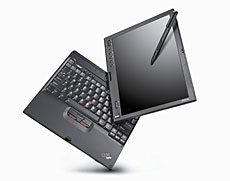
ALKHOBAR, 28 June 2005 — Back in December when the announcement was made that Lenovo was to acquire IBM’s Personal Computing Division, it was big news. And then there was silence. Now, that the acquisition details have been sorted out, Lenovo is moving full steam ahead. The company has just disclosed that it will be bringing the newest member of the ThinkPad portfolio — the ThinkPad X41 Tablet — to the Middle East in August.
Lenovo is touting the ThinkPad X41 Tablet as a “new alternative in tablet computing without compromises in weight or function.” Previous tablets required people and businesses to make a choice. Either they picked a heavy convertible — including both tablet slate and keyboard — or they picked a lighter tablet slate without a keyboard. The ThinkPad X41 Tablet offers a better choice in tablet innovation — writable slate, full-size keyboard and light weight. Starting at 3.5 pounds and 1.14-inches slim, the ThinkPad X41 Tablet is nearly 20 percent lighter than its closest competitor and delivers the longest standard battery life of any 12-inch convertible tablet.
A convertible tablet PC offers mobile professionals the choice of working in two ways — as a tablet with a digital pen or as a traditional notebook PC. The ThinkPad X41 Tablet provides 170-degree viewing, with standard anti-reflective and anti-glare coatings to maximize indoor viewability. However, the ThinkPad X41 Tablet relies on ThinkVantage Technologies which give mobile workers an edge. These include the Active Protection System, an integrated motion sensor that can detect sudden changes in movement and temporarily park the hard drive to help protect valuable data from some falls or drops. Also, Rescue and Recovery is a one-button solution that includes a set of self-recovery tools to help users diagnose, get help and recover from a software crash, even if the primary operating system will not boot. Wi-Fi wireless connectivity is provided through optional 802.11 a/b/g/ and Access Connections, a software utility that simplifies the management of wireless and wired connections. As for security, an integrated fingerprint reader is available and the Embedded Security Subsystem includes an integrated security chip and Client Security Software, helping to protect and encrypt vital proprietary information and security passwords, encryption keys and electronic credentials.
The ThinkPad X41 Tablet comes equipped with Microsoft’s newest operating system, Windows XP Tablet PC Edition 2005. This builds on Windows XP Professional, extending the core operating system with capabilities that support digital pen input, handwriting recognition, speech input and the tablet PC form factor. The ThinkPad X41 Tablet is available with the Intel Pentium M Low Volt or Ultra Low Volt processors for longer battery life, the Intel 915GM chipset, up to 1.5GB of PC2-4200 DDR2 memory and robust graphics capabilities through the Intel Graphics Media Accelerator 900.
“The launch of the ThinkPad X41 Tablet marks a significant milestone for the Tablet PC platform and is a well-timed response to the growing demand we’re seeing for Tablet PC functionality,” said Bill Mitchell, Corporate VP responsible for mobile PC computing at Microsoft Corporation.
Lenovo is receiving accolades in abundance for its innovative notebook designs. The most recent report by Technology Business Research found that quality remains a competitive strength for ThinkPad notebooks. Lenovo was found to be one of the only notebook vendors keeping pace with hardware quality expectations and whose satisfaction ratings for quality are advancing rather than declining. Thirty-five percent of the study’s respondents indicated seeing Lenovo as having differentiated itself in the notebook marketplace, based on product, support or services, making Lenovo the leading favorite.
TBR’s Corporate IT Buying Behavior and Customer Satisfaction Study is a quarterly report based on data collected from the previous six months. The recently published report includes data from October 2004-March 2005. Lenovo, Dell, HP and Toshiba were included in the study.
TBR concluded that Lenovo’s announcement to acquire IBM’s Personal Computing Division was the most distinguished achievement of the study. Additionally, the study found that following the announcement, loyalty and satisfaction to the ThinkPad brand remained solid.
“We are delighted by our performance in the latest TBR study, which shows that customers have confidence in both our ability to maintain the high-quality we are known for, and to deliver a ThinkPad notebook that will forever remain a solid, dependable productivity tool they can count on,” said Fran O’Sullivan, chief operating officer, Lenovo International. “Lenovo will continue to innovate and invest in the ThinkPad line and customers should come to expect even more from our passionate pursuit of innovation.”
The study ranked Lenovo the No. 2 leading notebook vendor, a distinction it shares with HP. Improvements in delivery time and parts availability resulted in Lenovo moving ahead in the mean overall satisfaction measurement by 0.9 percent to tie with Dell for the lead position. In the sales and product delivery category, Lenovo and HP were found to be closing the gap on Dell, whose improvement trend leveled off in 1Q2005. In addition, TBR reintroduced its design attribute category in the most recent report and ThinkPad notebooks received the highest mean score of all surveyed notebooks.
To stay ahead of the competition, Lenovo plans to establish a new Innovation Center that will enable customers, business partners, solution providers and independent software vendors to collaborate on new personal computing solutions. Intel, IBM, LANDesk, Microsoft, and Symantec are founding partners in the Innovation Center. The facility will be located in the United States and will be staffed by engineers, programmers, product developers and sales and marketing professionals from these companies to collaborate in multi-day developmental projects with customers throughout the world. The center will create an incubation environment for the design, creation, validation, proof of concept and deployment of new personal computing solutions.
“Lenovo and its partners will use this center to make innovation relevant to our customers,” said Deepak Advani, senior vice president, Lenovo. “It will create a hands-on facility dedicated to eliminating customer pain points — a place where professionals from numerous companies come together and focus on core business processes. Together, our companies offer a vast portfolio of expertise, hardware and software solutions, education and services. The center will focus those resources on resolving specific customer problems.”
The Innovation Center will include several components: Technology Incubation, Partner Collaboration, Solution Development, Imaging and Training Services, in addition to a Solution Showcase. The center will act as a collaboration facility for businesses pioneering the conception, development or deployment of new solutions, which often encompass technologies and services from numerous companies. Businesses currently solve these problems in a serial process, meeting one-on-one with multiple companies. At the Innovation Center, professionals from several companies will assemble together for sessions that brainstorm the possible, interlock components and resolve the actual details of deployment. These solution phases would be supported by the combined experience level of experts who draw from already-existing solutions in the creation of completely new models.
“The Innovation Center provides a direct way for the industry to test and implement real-world business solutions to issues our customers face every day,” said Sean Maloney, executive vice president and general manager, Intel Mobility Group. “The center takes a look at the entire platform — from hardware and software to services — to create solutions.”
Lenovo is emphasizing that a customer-centric model for innovation will be reflected in the center. Partners in the Innovation Center believe that in this Internet Age innovation is occurring faster, easily surmounting barriers of geography and enabling a shorter cycle between invention and implementation.
“Until recently, people hunkering down in a garage could create a new technology that would sweep the world,” Advani said. “But innovation today requires wider collaboration across disciplines and specialties. Combinations of technologies, expertise, business models and processes will now drive innovation.”
The Innovation Center is being built at Lenovo’s facilities in Research Triangle Park, North Carolina, USA within a 30-minute drive of the campuses of the University of North Carolina at Chapel Hill, Duke University and North Carolina State University. Construction is expected to be completed early in the third quarter of 2005 and proposals for initial customer projects are now being accepted.
(Comments to [email protected].)