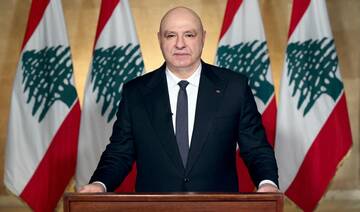
BEIRUT: A report prepared by Lebanon’s National Commission for International Humanitarian Law documenting Israeli violations is being revised almost daily as infringements continue in southern Lebanon and the Lebanese state remains unable to access some of the areas where Israeli forces have advanced.
While the file now contains thousands of pages of reports and documented evidence, that does not mean Lebanon will be able to bring Israel before an international court anytime soon.
At a closed discussion organized by the Arab Center for Research and Policy Studies in Beirut, Deputy Prime Minister Tarek Mitri, who oversees the documentation process under the National Commission for International Humanitarian Law, outlined the methods and mechanisms used to collect, verify and document alleged Israeli violations.
Mitri, who chairs the government commission, discussed the stages of the documentation process and the challenges it faced, particularly in recording incidents involving medical personnel, civilians, civilian infrastructure, forced displacement and other alleged violations, which ultimately formed the basis of the commission’s preliminary report.
He said that documenting the violations was also about “preserving the national memory.”
“We do not want to repeat the experience of Lebanon’s civil war,” Mitri said.
“Following the general amnesty in the 1990s, which exempted perpetrators from accountability, there was a loss of memory. The unity of peoples is built around a shared memory.”
According to Mitri, the report documents incidents from the latest Israeli military campaign in Lebanon, within the broader conflict that has continued since Oct. 8, 2023.
Its legal framework is based on the four Geneva Conventions of 1949 and customary international humanitarian law, while its findings draw on open-source evidence and information issued by official bodies and human rights organizations.
Nasser Yassin, director of the Arab Center, said at the start of the discussion that the world was becoming increasingly accustomed to mass destruction.
“We have entered a world that is normalizing genocide,” he said.
“We deal with what is happening as though it were something ordinary, while systematic Israeli destruction has affected hundreds of schools and hospitals, thousands of homes, and land that has been destroyed or burned, amounting to 22 percent of Lebanon’s cultivated area.”
Mitri said that the question of whether Israel had committed war crimes was, in his view, no longer seriously open to debate.
“Israel violates international humanitarian law and has a long record of doing so,” he added.
“Lebanon is not an exception, and the violations taking place here are increasingly resembling those in Gaza.”
A previous report on alleged Israeli violations during the 2023-2024 conflict outlined patterns of violations and provided a brief legal assessment.
The current report, however, offers more detailed documentation and legal analysis of individual incidents, making it a potentially important official reference for future efforts to pursue accountability for violations of international humanitarian law in Lebanon.
Mitri presented the still-unfinished report to the UN Human Rights Council during its 62nd session in June.
He said that there was a growing international consensus against Israel, claiming that about 60 states at the council regarded it as increasingly isolated.
“The Lebanese negotiator should have been aware of this before signing the framework agreement,” he said.
“I was surprised by the scale of criticism directed at Israel from international platforms. Even the International Committee of the Red Cross stepped beyond its usual restraint, and I found in its president a woman determined to convene a conference to renew states’ commitment to the laws of war.”
Mitri also explained his criticism of the framework agreement between Lebanon, Israel and the US, which he said included a provision preventing Lebanon from prosecuting Israel before international courts during the negotiation period.
He said that the agreement did not personally bind him because it had never been brought before the Cabinet.
“The framework agreement was not presented to the Council of Ministers, and we have not discussed it in any Cabinet session since it was signed on June 26,” he said.
“Therefore, we in the National Commission are continuing our documentation work with a view to using it in international forums.”
Mitri said that Lebanese Prime Minister Nawaf Salam had told him: “We do not want to prosecute Israel while negotiations are taking place.”
Speaking to Arab News, Mitri said that the documentation effort suffered from the absence of a clear institutional structure.
“The process is being carried out by volunteers and civil society organizations active on the ground, and there is an inability to access many of the places where violations are taking place,” he said.
“Relevant ministers do not always have verified information about the violations, while people close to Hezbollah have withheld from us the number of prisoners being held by Israel.”
He added that UNIFIL had been documenting incidents within its area of operations south of the Litani River and had provided the commission with reports.
Mitri said that he believed Lebanon had been compelled to accept the framework agreement and its restriction on legal action because Israel had threatened during negotiations to pursue Lebanon over what it described as the harboring of a terrorist organization.
The report, he said, nevertheless provided a structured body of evidence that could later form the basis for legal action.
It included legal analysis of alleged serious violations of the rules governing the conduct of hostilities and presented visual evidence and testimony relating to Israeli attacks on civilian areas in Lebanon.
It assessed the reliability of that evidence and analyzed incidents in light of the principles of distinction, proportionality and precaution, as well as the protections afforded to civilians, medical facilities and journalists.
The report also documented attacks on bridges and crossings over the Litani River in southern Lebanon.
According to Mitri, these were “not isolated incidents, but formed part of a pattern intended to isolate the area south of the Litani and disrupt the movement of residents and relief assistance between it and the rest of the country.”
Mitri also highlighted strikes on residential apartments outside southern Lebanon and Beirut’s southern suburbs, including in Beirut and Mount Lebanon.
“The objective was to strike densely populated civilian environments,” he said.
He claimed that attacks on Beirut alone killed more than 300 people and injured more than 1,200 within a 10-minute period.
Mitri also spoke of “cultural destruction” extending to intangible heritage, calling on institutions and individuals to assist the commission in documenting it.
The report, he said, already included documentation of civilian sites that were destroyed.
Mitri said that Lebanon could, in principle, seek proceedings against Israel before the International Court of Justice, which adjudicates disputes between states.
However, he noted that such cases generally required a jurisdictional basis, including consent by the states involved or a relevant international treaty provision.
He also said that matters could reach the court through UN mechanisms, although he cautioned that the legal path would be lengthy.
“In both cases, the road toward prosecuting Israel is a long one,” he said.
He distinguished this from proceedings before the International Criminal Court, which prosecutes individuals rather than states.
Lebanon is not a party to the Rome Statute, the treaty that established the ICC.
“The current Lebanese government, like those before it, has so far not reversed Lebanon’s decision not to join the Rome Statute,” Mitri said. “And I do not believe it will do so.”