

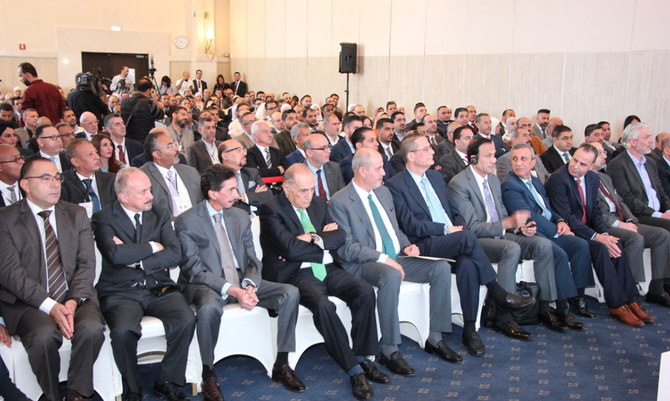
21st edition of Jordan Economic Forum conference kicks off

The 21st edition Jordanian Economic Forum in Amman. (Petra)
Short Url
Updated 01 November 2022
Follow

21st edition of Jordan Economic Forum conference kicks off

  • Conference theme in line with Jordanian efforts to launch finance-attractive projects through technology

AMMAN: The 21st edition of the Jordanian Economic Forum conference kicked off Tuesday under the theme “International Investment and Fintech,” the Jordan News Agency reported.

The forum is an economic platform that continuously monitors the major macroeconomic and microeconomic indicators that affect Jordan’s competitiveness and economic growth in a collaborative environment between the public and private sectors. 

During his opening remarks, Minister of Industry, Trade and Supply Yousef Shamali stated that the conference’s topics are intertwined with efforts to leverage international relations and harness technology to launch finance-attractive projects. 

Shamali emphasized the government’s commitment to attracting foreign investment and encouraging Jordanian entrepreneurs by involving the private sector, as evidenced by its launch of a comprehensive reform path along three main axes: political, economic and public sector modernization. 

He stated that the Public Sector Modernization Roadmap initiatives provide a view of the ministry’s aspirations for digital transformation by establishing alternative and innovative work mechanisms that support the government in carrying out its tasks. 


GCC states ‘face reliance on Saudi Arabia for food imports’

Updated 06 March 2026
Follow

GCC states ‘face reliance on Saudi Arabia for food imports’

  • With 70 percent of food coming through Strait of Hormuz, analysts warn of inevitable shortages

DUBAI: Some Gulf states may have to rely on overland food deliveries from Saudi Arabia if the US-Israel-Iran war continues to disrupt shipping through the Strait of Hormuz and restrict regional airspace, analysts warned on Thursday.
The region is up to 90 percent dependent on food imports, and price surges and scarcity of some goods are expected.
“With over 70 percent of GCC foodstuffs being imported through the Strait of Hormuz, Gulf states face shortages if the war persists,” said Neil ​Quilliam of the Chatham House think tank. 
“While GCC countries have taken steps to diversify suppliers and ensure sufficient stores to withstand disruption, this can only last several months. At this point, price increases ​and longer lead times will start to hit the markets.”
Commodities analyst Ishan Bhanu said: “The biggest immediate effect will be due to the blockade of Jebel Ali in Dubai, serving about 50 million people. Qatar, Kuwait, Bahrain and Iraq effectively become landlocked and will depend on overland routes through Saudi Arabia.”
Bottlenecks are yet to show and the UAE has said its strategic reserves of vital goods cover four to six months of needs. It urged residents to report unjustified price increases through a dedicated hotline.
Supermarket staff ​throughout the Gulf said shelves remain largely stocked, though suppliers are taking longer to replenish certain products. Iran’s strikes on the Gulf since Saturday prompted panic buying in supermarkets, a dry run for what could come. 
“Perception of risk matters, and even if stocks are sufficient now, public runs on supermarkets can spook the public,” Quilliam said.