

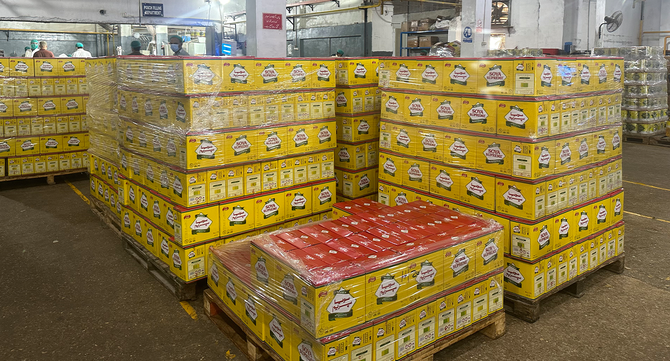

KARACHI: Pakistani food manufacturing company Agro Processors & Atmospheric Gases (APAG) plans to raise up to Rs2.6 billion ($9.37 million) through an initial public offering (IPO) this week to improve its production efficiency, Chief Executive Officer (CEO) Ahmad Ghulam Hussain said this week, as the entity eyes increasing exports to $25 million in three years by exporting to countries in the Middle East, North America and Europe.
APAG is one of Pakistan’s leading food manufacturing companies, known most prominently for making popular cooking oil Soya Supreme. The company, founded in 1981, also produces other items such as Smart Sauces, Smart Canola Cooling Oil and Malta Cooking Oil.
APAG’s initial public offering book building is set to take place from Aug. 27-28, with public subscription on Sept. 3-4. The company aims to raise Rs1.8 billion ($6.49 million) to Rs2.6 billion ($9.37 million) for machinery, energy systems, warehousing, marketing and raw materials, Hussain told Arab News during an interview on Tuesday.
The company currently has a production capacity of 90,000 tons which Hussain said it wants to enhance to 120,000 tons.
“We plan to increase our exports to the Middle East, North America and European countries,” the APAG CEO said. “We will be entering those markets very soon. We want to launch our brand in some of the Middle Eastern countries.”
Hussain said the company is very keen to expand into Qatar and the UAE, where it sees opportunities not only to boost direct sales but also to re-export Pakistani products to other countries.
Pakistan remains heavily dependent on imported edible oil raw materials, with Hussain estimating annual consumption at around 5 million tons. The country imports roughly 3.5–4 million tons of palm oil each year, he said, primarily from Indonesia and Malaysia while other imports include soft oils such as canola, soybean, grapeseed and cottonseed oil.
Hussain estimated around 5–8 percent of the overall edible oil market in Pakistan comprises of exports, mainly as value-added palm-based products. He said ghee accounts for roughly 70–75 percent of domestic edible oil consumption, while cooking oil makes up around 30 percent.
APAG currently operates at about 55 percent utilization and expects the IPO to increase its production capacity 33 percent through a program of balancing, modernization and replacement (BMR), he said.
“That would make our plant more efficient, our quality better, even one step ahead of others,” he said.
Hussain added that APAG expects the investments to generate returns within two to two-and-a-half years, while improving efficiency and product quality.
He said part of that investment will also help APAG respond to larger institutional and tender orders, which can require production volumes above the company’s monthly average.
Around 41 percent of the IPO proceeds are expected to go toward capital expenditure and plant machinery, while 17.8 percent are earmarked for biomass boilers. The company also plans to expand its solar program and invest in green utilities.
Civil works will include construction of a warehouse at the factory, which Hussain said would reduce logistics costs and dependence on rented storage.
Another 14 percent of the IPO proceeds are expected to be spent on additional marketing, particularly in markets where APAG sees greater potential.
APAG’s exports account for seven to eight percent of the company’s revenue, with Hussain saying the entity aims to expand into mayonnaise, ketchup, chili garlic and chicken spread products.
‘ARAB WORLD KNOWS OUR BRAND’
Hussain said the company was keen to launch its products in the Middle East, particularly Qatar and the UAE, as a lot of Pakistanis were residing in these two states.
“Even the Arab world knows our brand,” he said. “So we want to enter that market.”
The UAE, he said, was particularly attractive because of its established re-export market to Africa and other nations.
“We want to expand there and re-export our product from there to other countries,” he added.
APAG’s plan to enhance exports to the Middle East has been affected by tensions in the Middle East. Hussain said the company could have enhanced its sales in the Middle East, however, the United States (US) and Iran conflict affected exports.
Rising competition, shipping-related pressures, and other regional uncertainties have made the company more cautious, he said.
“We were very aggressive six to eight months ago,” Hussain said. “But because of this crisis, we have to be prudent about a lot of things.”
APAG expects its exports currently worth about $5-6 million to rise fourfold or 317 percent, he said.
“We want exports to go up to $20-$25 million in the next three years,” he said.


